Irish Bouzouki Course
 Declan Plummer
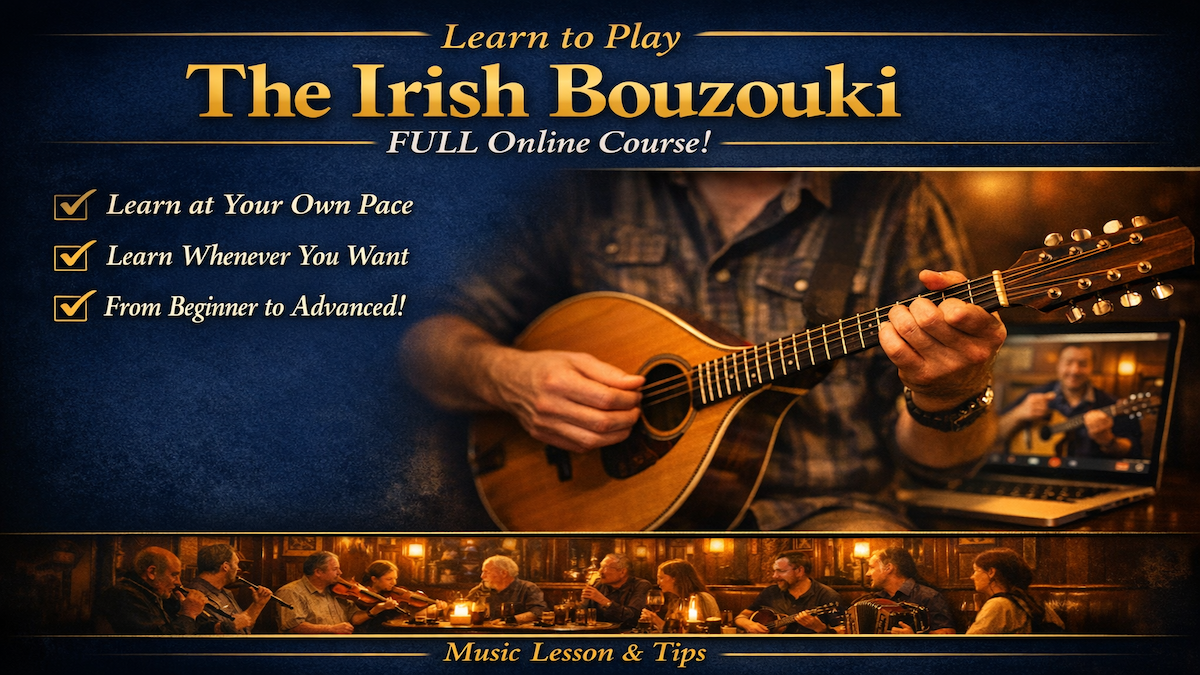
Learn how to play Irish bouzouki with confidence through structured lessons covering accompaniment, rhythm, and traditional Irish music techniques.
Learn Irish Bouzouki Online With A Structured Step-By-Step Course
Learning Irish bouzouki is one of the most rewarding journeys in traditional music, but it can also become one of the most confusing when the guidance is unclear. Many players begin with enthusiasm, only to find that after learning a few chords or rhythms, their accompaniment still does not sound settled, confident, or truly at home in Irish traditional music.
Every year, musicians search for phrases such as how to play Irish bouzouki, Irish bouzouki lessons for beginners, Irish bouzouki accompaniment, and the best Irish bouzouki course online. Yet many of those same learners still end up feeling uncertain about what they should practise, how accompaniment actually works, and why their playing does not sound as musical as they hoped.
If you have ever felt that your bouzouki playing is not quite right even though you know some of the chords, the problem is rarely lack of effort. More often, the missing ingredient is a clear and traditional learning path that shows not only what to play, but why it works and when it should be used.
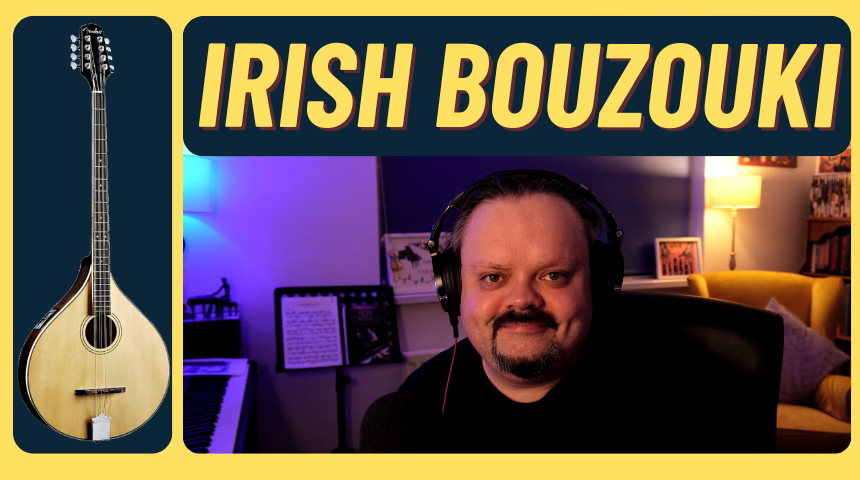
An online Irish bouzouki course can help students build real traditional music skills in a clear order, from tuning and chord playing to rhythm, countermelodies, notation, and tune learning. With guided lessons, downloadable resources, and practical demonstrations, learners can progress steadily from beginner level towards confident and musical playing.
Learning Irish bouzouki can feel overwhelming at first because the instrument sits at the meeting point of rhythm, harmony, accompaniment, and traditional style. Students often want to know how to tune the instrument, which chords matter most, how jigs and reels should feel, and how to sound convincing in a real Irish music setting rather than simply strumming shapes without direction.
A well-designed online course solves that problem by presenting the material in a logical sequence. Instead of jumping randomly between techniques, students can work through the essential foundations first, then develop stronger rhythm, broader harmonic understanding, more advanced flat-picking skills, and eventually learn to read music and play tunes with greater independence.
This approach is especially helpful for home learners who want flexibility without losing structure. With high-quality video lessons, downloadable handouts, audio examples, and clearly organised topics, students can revisit each stage as often as needed and make steady progress towards authentic Irish bouzouki playing.
- A complete course should begin with bouzouki setup, tuning, stringing, and understanding the instrument itself.
- Students need guided lessons in chords, rhythm patterns, dance types, flat-picking, notation, and tune learning.
- The best online learning combines video, audio, handouts, and repeatable practice at your own pace.
- Many learners know chord shapes but do not yet understand the role of Irish bouzouki in traditional music.
- Random lessons often create confusion because they do not build rhythm, harmony, and musical awareness in the right order.
- A structured course helps players move from guesswork to confident, tasteful accompaniment.
What A Complete Irish Bouzouki Course Should Include
A strong Irish bouzouki course needs more than a few isolated tune demonstrations. Students progress best when lessons are built around a full musical pathway. That pathway begins with the instrument itself, then moves into accompaniment, rhythm, style, advanced melodic work, and finally independent music reading and tune learning.
In practical terms, this means a course should cover tuning, stringing, fret layout, and the names of the instrument’s parts before expecting students to play with confidence. From there, players need clear demonstrations of chords, common chord progressions, and the rhythmic language of Irish traditional dance forms such as jigs, reels, hornpipes, slip jigs, polkas, and waltzes.
Pro Tip: Choose a course that teaches both technique and musical context. Learning a chord shape is useful, but understanding where it belongs in a jig, reel, or song is what makes your accompaniment sound genuinely musical.
A truly effective Irish bouzouki course goes well beyond chord charts. It should offer clear explanations of the instrument’s role in Irish music, step-by-step accompaniment techniques, practical examples drawn from real tunes, and musical context for every concept taught. It should also help students develop the confidence to play with others in sessions and groups.
Without that structure, progress tends to be slow and uncertain. With it, improvement becomes far more consistent because each idea supports the next and the student always understands the purpose behind the material.
From Basics To Advanced Skills
For beginners, the first goal is to become comfortable with the instrument and develop reliable timing. For intermediate and advanced students, the course should open further doors through countermelodies, flat-picking, chord scales, and polyphonic textures. That is where the Irish bouzouki becomes especially expressive, moving beyond accompaniment into something richer and more personal.
A complete programme also benefits from supporting resources. Audio examples help students internalise groove and melody. Downloadable handouts provide reference material away from the screen. Sheet music and chord diagrams make revision easier, while backing tracks allow players to practise in a more realistic musical setting.
Insight: The most valuable online music courses do not merely give information. They create a repeatable learning environment in which students can watch, listen, read, imitate, and then apply what they have learned in their own practice.
Building Strong Foundations On Irish Bouzouki
Every student benefits from starting with the practical essentials. If the bouzouki is not strung correctly, not tuned properly, or not understood physically, everything that follows becomes harder. A beginner course should therefore begin by showing how to string the instrument, how to tune it, and how the fretboard is organised.
That early stage is not a minor technical detail. It is what allows a player to practise with confidence. When students know the names of the instrument’s parts and understand how the strings and frets relate to pitch, they become far more secure and far less likely to feel lost.
Practice Focus: Spend time checking your tuning before every session. A few careful minutes at the beginning will improve your ear, sharpen your sense of pitch, and make all later chord and melody work more reliable.
Why Chords And Dance Types Matter So Much
Once the setup is secure, the next major step is chord playing. In Irish traditional music, accompaniment must support the melody without overpowering it. This means students need to learn useful chord shapes and, just as importantly, understand which progressions belong naturally to common dance types.
Jigs and reels often dominate early bouzouki learning because they appear so frequently in sessions. A course that teaches popular progressions for these forms gives students an immediate musical vocabulary. Rather than guessing at harmony, they begin to recognise patterns and respond more instinctively to traditional tunes.
Common Mistake: Many players memorise isolated chords without learning how those chords move inside real dance tunes. This leads to hesitant accompaniment. Always connect chord practice to rhythm, phrase shape, and tune type.
Developing Rhythm, Accompaniment, And Musical Style
Good Irish bouzouki playing depends on more than correct notes. It depends on pulse, lift, and sensitivity to traditional style. That is why rhythm-based lessons are so important. Students must learn not only what to play, but how to make jigs feel different from reels, and how other dance types carry their own characteristic motion.
A course that breaks these patterns down carefully gives players a much stronger musical foundation. When students understand how accompaniment behaves across dance types, they can play with greater confidence in sessions and develop a more instinctive response to live music.
Rhythm Pattern Box
Common Dance-Type Focus
| Dance Type | Rhythmic Feel | Practice Aim |
|---|---|---|
| Jig | Flowing triple feel | Keep the pulse even and buoyant |
| Reel | Driving duple feel | Develop clarity and steady momentum |
| Hornpipe / Waltz / Polka | Distinct character and accent pattern | Adjust groove rather than strumming everything the same way |
This kind of structured comparison helps students hear musical difference rather than treating all traditional repertoire as one style. That is essential if you want accompaniment to sound convincing and responsive.
Right-Hand Rhythm And Pulse
In Irish bouzouki accompaniment, rhythm matters even more than chord vocabulary. Students need to learn how to create lift without over-strumming, how to shape rhythm differently for reels, jigs, hornpipes, and songs, and how to recognise moments when not playing is the most musical choice.
Structure Breakdown Table
| Learning Area | Why It Matters | Result In Real Playing |
|---|---|---|
| Right-Hand Control | Creates clarity, pulse, and steadiness | Cleaner and more supportive accompaniment |
| Modal Harmony | Helps chords fit traditional tunes properly | Less clashing and more musical confidence |
| Listening And Restraint | Keeps the tune and ensemble at the centre | Tasteful session playing and better interaction |
Musical Listening And Interaction
Great bouzouki accompaniment depends on listening as much as technique. This means responding to phrasing in the tune, adjusting dynamics when playing in a session, and supporting singers differently from instrumentalists. These are not optional refinements. They are central to how the instrument works in traditional music.
Pro Tip: The best accompaniment often comes from listening first and playing second. If you can hear the phrasing, the lift, and the shape of the tune, your bouzouki part becomes much more natural and convincing.
Moving Into Countermelodies, Flat-Picking, And Polyphonic Playing
For players ready to move past basic accompaniment, flat-picking and countermelody work can transform the instrument. At this stage, the bouzouki is no longer serving only as a harmonic support. It begins to interact with the tune in a more independent way, adding shape, movement, and texture.
A course that teaches scales, chord scales, and key-based melodic materials gives students a practical way into this style of playing. Instead of adding decorative notes at random, they learn how countermelodies grow out of the tune’s tonal framework. This produces fuller and more musical results.
Pro Tip: Treat countermelodies as a continuation of accompaniment, not a display of speed. The goal is to support the tune beautifully, leaving space while still adding interest and motion.
Because this work can be technically demanding, it suits intermediate and advanced students especially well. Even so, when it is taught step by step, it becomes far more accessible than many players expect. Carefully sequenced lessons can make advanced bouzouki techniques feel achievable rather than intimidating.
Reading Music And Learning Tunes More Independently
Another major advantage of a complete course is that it does not stop at imitation. It helps students become independent musicians. Learning to read standard notation and bouzouki tablature gives players access to a far wider body of music and allows them to keep developing long after the first lessons are complete.
When notation is explained clearly in relation to real Irish tunes, students begin to connect symbols on the page with living sound. They can then explore ornamentation, phrasing, and tune structure in a more informed way. This is especially valuable for players who want to learn beyond a fixed course library and continue growing on their own.
Insight: Reading music does not replace learning by ear. Instead, it strengthens independence. For many students, the most useful path is to combine listening, watching, reading, and repeating until the tune begins to feel natural.
Why Flexible Online Learning Works So Well
One of the greatest strengths of an online Irish bouzouki course is flexibility. Students can learn at their own pace, revisit difficult sections, and return to key demonstrations whenever needed. This is especially useful for adult learners, busy musicians, and anyone balancing practice with work or family life.
Lifetime access to lessons means progress does not need to be rushed. A player can spend time strengthening one area, such as jig rhythm or tuning confidence, before moving on. Downloadable handouts, sheet music, and audio examples also support offline practice, which often leads to deeper learning than screen time alone.
Regular updates add further value. New tunes, ideas, and explanations keep the course alive, while opportunities to ask questions make the learning experience more personal. That combination of structure and ongoing support is one reason online tuition can be such an effective way to study traditional music.
Many musicians assume traditional instruments must be learned in person, but Irish bouzouki adapts especially well to online study when the course is designed properly. High-quality online lessons allow students to pause and replay difficult material, learn at a convenient pace, and revisit earlier concepts whenever needed.
Most importantly, a structured online course removes confusion by showing what to practise next. Instead of drifting between scattered videos, the student follows a musical sequence from beginner foundations towards confident accompaniment and deeper traditional understanding.
This is the thinking behind The Complete Guide to Irish Bouzouki. Rather than overwhelming students with disconnected theory or isolated techniques, the course follows a musical progression that reflects real Irish playing situations. Each stage builds on the last so that learners develop both understanding and usable skill.
Within that approach, students learn how Irish bouzouki accompaniment actually works, which chord shapes apply across many tunes, how rhythmic patterns create lift and drive, how to accompany reels, jigs, hornpipes, and songs, and how to build confidence for playing in real sessions. The material develops logically, without unnecessary gaps or guesswork.
Quote: When students are shown what the instrument is really for, bouzouki learning becomes much less about memorising shapes and much more about making good musical decisions.
A Practical Routine For Studying Irish Bouzouki At Home
Students make the fastest progress when they follow a consistent routine rather than practising randomly. A structured online course provides the content, but good results still depend on how that content is used in daily or weekly practice.
Practice Routine: Begin by checking tuning and revising one technical point from an earlier lesson. Then spend focused time on your current topic, such as chords, a rhythm pattern, or a scale. After that, apply the material to a real tune or backing track. Finish by reviewing handouts or notation and noting one clear goal for the next practice session.
This kind of routine works because it balances repetition with application. It keeps the fundamentals alive while steadily moving the student forward. Over time, that regular cycle of review, focused study, and musical application leads to stronger technique and a more authentic traditional sound.
If you want these ideas to become part of your playing, use a routine that strengthens both technique and musical awareness. Begin by checking tuning and revising one core chord or rhythmic idea. Then spend focused time on a single skill, such as modal chord choices, right-hand pulse, or listening to the phrasing of a tune. After that, apply the idea to a real tune or accompaniment example, and finish by reflecting on what sounded convincing and what still needs attention.
Practice Routine: Start with tuning and tone, move into one focused technical or harmonic topic, apply it to a real tune, and end by listening back critically. This keeps your practice musical rather than mechanical.
Is Learning Irish Bouzouki Challenging?
The Irish bouzouki occupies a distinctive place in traditional music. Unlike melody instruments such as fiddle, flute, or whistle, the bouzouki works in the space between rhythm and harmony. That gives it great musical power, but it also means the instrument is harder to understand at first than many students expect.
Some players struggle because they come from guitar or mandolin and naturally bring those habits with them. While that previous experience can help in some ways, it can also create problems if players treat Irish bouzouki as though it has the same role, the same rhythmic function, or the same musical priorities as those other instruments.
Other learners know a handful of chords but have never been shown how modal harmony works in Irish traditional music. Some rely on disconnected online videos, collecting fragments of information without a real system. Others do not yet understand how accompaniment should behave in sessions, so they either overplay or stay silent out of uncertainty.
Common Mistake: Many bouzouki players assume the problem is a lack of talent when the real issue is that they have never been shown a clear sequence for learning rhythm, harmony, listening, and accompaniment style together.
Understanding The Role Of Irish Bouzouki In Traditional Music
Before you can really learn Irish bouzouki, you need to understand its purpose in an ensemble. Irish bouzouki is not simply a rhythm guitar with a different tuning. It is not primarily a chord-melody instrument, and it is certainly not there to dominate the sound. Its musical value lies in the way it supports and shapes the texture around the tune.
At its best, Irish bouzouki accompaniment supports the melody, enhances lift and rhythm, outlines harmony without becoming heavy, and responds sensitively to the other instruments in the group. Great accompaniment often feels almost invisible. You notice it most clearly when it disappears, because the music suddenly loses shape, depth, or momentum.
Insight: The subtle role of Irish bouzouki is precisely why so many learners struggle. The instrument is powerful, but its strength comes from balance, timing, restraint, and musical response rather than constant activity.
The Most Common Mistake When Learning Irish Bouzouki
One of the biggest mistakes beginners and intermediate players make is moving too quickly towards complexity. They try to learn large numbers of chord shapes, impressive strumming patterns, and advanced harmonic substitutions before they have mastered the fundamentals that make accompaniment sound settled and musical.
In reality, strong Irish bouzouki playing is built on a smaller number of deeper skills. Right-hand control, steady pulse, modal awareness, tune structure, and musical restraint matter far more than collecting flashy ideas. When those essentials are secure, the more advanced aspects of accompaniment begin to make sense naturally.
Practice Focus: Instead of asking how many chords you know, ask whether your timing is steady, your rhythm suits the dance type, and your accompaniment leaves room for the melody to breathe.
For more advanced students, another big mistake they make is they start overthinking every chord, start wondering whether they are allowed to play, and start holding back out of fear. This course is designed to help such students find a more confident way of listening, responding, and supporting the tune. That transformation is the real value of learning Irish bouzouki properly. The goal is not simply to know more shapes or rhythms. It is to play with confidence, restraint, taste, and authenticity so that your accompaniment genuinely belongs within the music.
Getting The Most From The Full Curriculum
A broad curriculum is only useful if students engage with it in sequence and connect the parts together. The basics, chord work, rhythm studies, countermelodies, notation, and tune learning all support one another. When approached patiently, they form a coherent musical journey rather than a collection of unrelated topics.
For that reason, learners should resist the temptation to skip straight to advanced material. Flat-picking and polyphonic work become much easier when the earlier foundations are genuinely secure. In the same way, reading tunes becomes far more meaningful when rhythm, phrasing, and accompaniment are already part of the student’s musical understanding.
Key Takeaways
✅ A strong Irish bouzouki course should take students from setup and tuning through chords, rhythm, accompaniment, tune learning, and more advanced melodic techniques.
✅ The most effective learning combines high-quality video lessons with audio examples, handouts, sheet music, and the freedom to revisit material at your own pace.
✅ Chords and dance types are central to authentic accompaniment, so rhythm and harmonic understanding should be developed together rather than separately.
✅ Intermediate and advanced players benefit greatly from countermelodies, flat-picking, and polyphonic approaches that make the bouzouki sound fuller and more expressive.
✅ A consistent practice routine, built around review, focused study, and real musical application, is the best way to turn course material into lasting skill.
✅ Irish bouzouki is challenging because it sits between rhythm and harmony, so students need more than chord memorisation to play it well.
✅ Many learners struggle because they bring habits from other instruments, misunderstand modal harmony, or rely on scattered and unstructured lessons.
✅ Strong accompaniment grows from right-hand control, pulse, modal awareness, tune structure, musical listening, and restraint.
✅ A structured online course helps students progress logically from beginner fundamentals to confident and authentic traditional playing.
✅ The real goal is not simply technical improvement, but the confidence to support tunes musically in sessions and other real playing situations.
FAQ
Who is this course for?
This kind of structured approach is ideal for new players who want to start correctly, for guitarists or mandolin players moving across to bouzouki, for intermediate musicians who feel stuck, and for anyone who wants to play more confidently in Irish sessions. It is particularly valuable for students who are tired of disconnected lessons and want one clear path forward. Whether you are at the beginning of your journey or already have experience on another instrument, thoughtful Irish bouzouki lessons can save years of unnecessary frustration by showing you how the tradition works from the inside.
Beginners, guitarists or mandolin players moving to bouzouki, intermediate players who feel stuck, and musicians preparing for Irish sessions all benefit from a structured course because it replaces guesswork with a clear learning sequence.
Is This Kind Of Course Suitable For Complete Beginners?
Yes. A well-structured course begins with the fundamentals of the instrument, including setup, tuning, stringing, and basic chord work, so beginners can build confidence before moving into more advanced musical material.
What Should Intermediate Players Look For In An Irish Bouzouki Course?
Intermediate players should look for lessons in flat-picking, chord scales, countermelodies, dance-type accompaniment, and tune-based musical application. These areas help bridge the gap between basic chord playing and a more individual, expressive style.
Why Are Audio Examples And Handouts So Useful?
Audio examples train the ear and help students internalise rhythm, melody, and style. Handouts and sheet music give learners something practical to review away from the screen, which makes home practice more focused and efficient.
Do I Need To Read Music To Learn Irish Bouzouki?
No, but learning to read music can be extremely helpful. It supports independent learning, gives access to more repertoire, and helps students understand tune structure more clearly alongside listening and imitation. You do not need advanced theory, but you will learn the basics of modal harmony. Knowing how Dorian, Mixolydian, and Ionian patterns affect chord choice makes accompaniment much clearer and more musical.
Can Online Learning Really Prepare Me For Playing In Sessions?
Yes, provided the course teaches authentic rhythm, common progressions, tune awareness, and practical accompaniment skills. With steady practice, online learning can prepare students well for joining other musicians and taking part in traditional music sessions. A strong online course can prepare you very well for sessions if it teaches real accompaniment skills, rhythmic feel, modal harmony, listening, and the practical role of the instrument in traditional music.
What Is The Best Way To Practise Irish Bouzouki Accompaniment?
The best method is to combine tuning, rhythm work, modal chord awareness, and real tune application in the same practice session. This helps you connect technique to musical purpose rather than practising isolated ideas.
To take your learning to the next level,
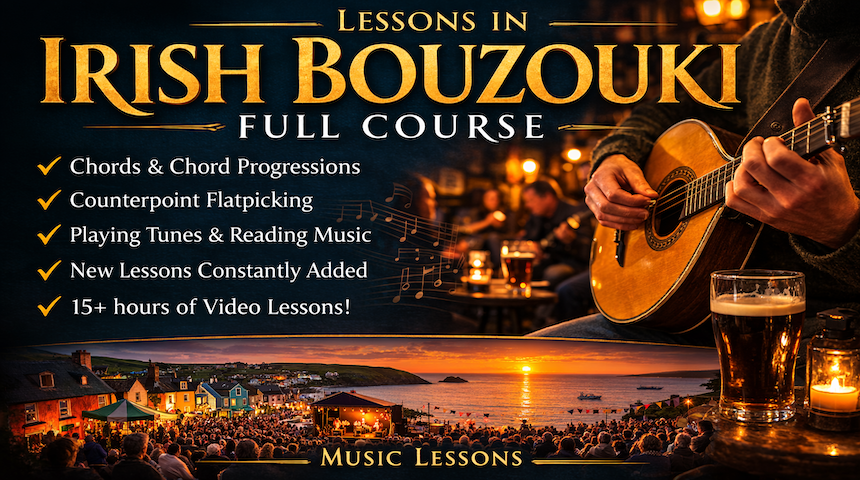
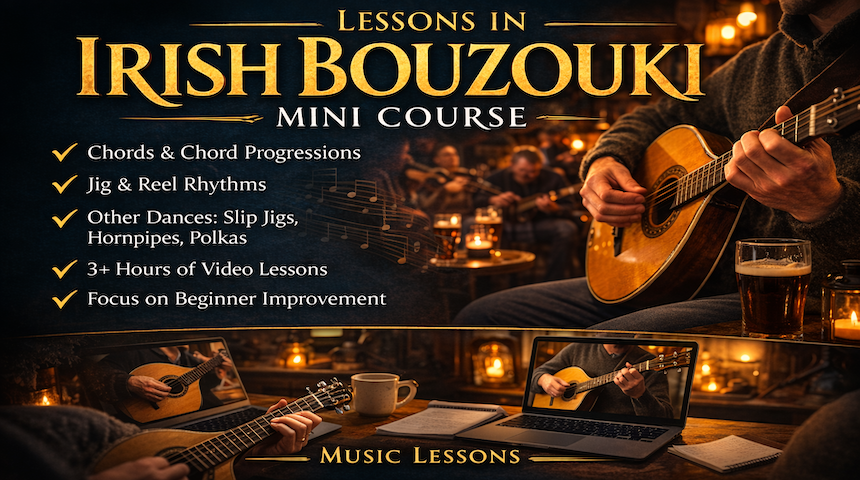
check out some of these amazing Courses & Apps
Categories: : Irish Traditional Music
Did this article answer all your questions?
If you have any questions, or you want to learn more,
Click the Picture Below to Join the Community for FREE!