How to Practice Irish Bouzouki More Effectively: Smart Strategies for Faster Progress
 Declan Plummer
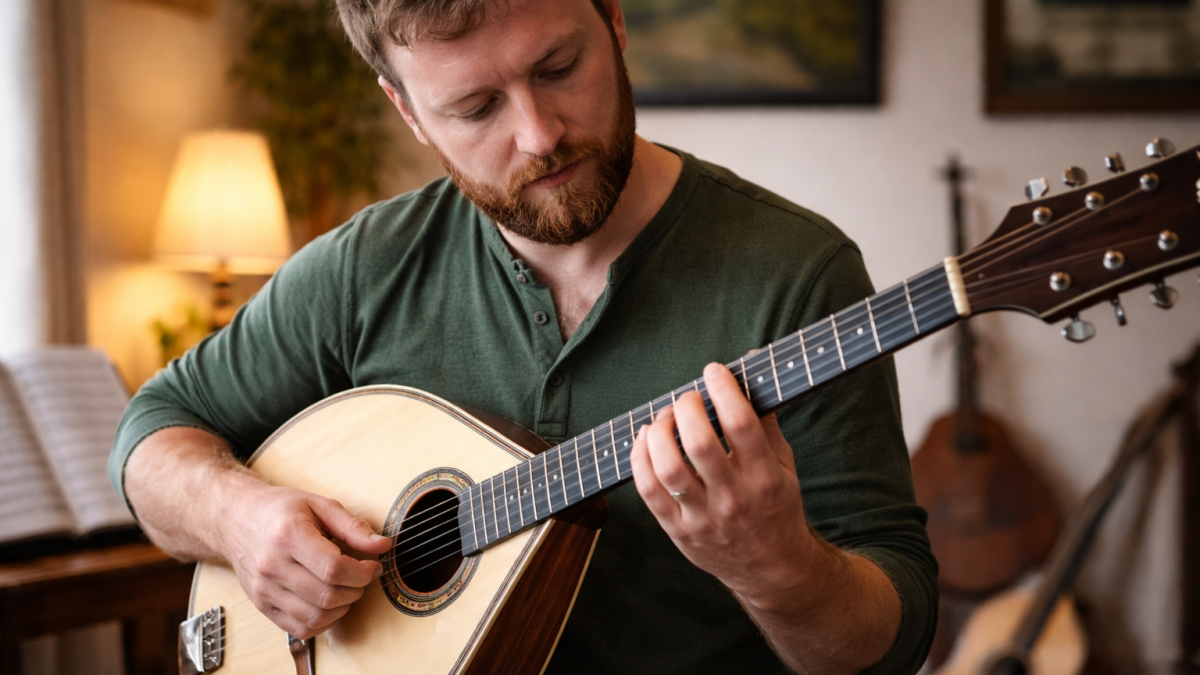
Learn how to practice Irish bouzouki smarter with focused strategies, slow practice, and techniques for faster musical progress.
Lesson 9 Lord Inchiquin -
Practice Tips & Main Insights
Learning Irish bouzouki isn’t just about collecting tunes — it’s about developing solid technique, efficient practice habits, and musical awareness that transfer across everything you play.
In a recent class session, several powerful learning principles emerged that go far beyond any one tune. This article focuses on those core practice lessons and expands them into a structured, practical guide you can apply to any piece of music. If you’ve ever felt stuck, frustrated with tricky sections, or unsure how to practise effectively — this guide is for you.
1. Not All Sections of a Tune Are Equal
One of the clearest insights from the lesson was this:
Some sections are naturally easier than others — and that’s completely normal.
Most traditional tunes (especially airs and harp-style compositions) tend to divide into sections that differ in difficulty. Typically:
- One section establishes harmony and flow.
- Another introduces position shifts, melodic variation, or technical challenges.
Understanding this changes everything.
What This Means for Your Practice
Instead of treating a tune as one long, continuous piece, divide it into:
- Comfort sections (build fluency and tone)
- Challenge sections (develop technique and control)
This reduces overwhelm and gives your practice sessions clear direction.
Practical Tip
During a 30-minute practice session:
- Spend 10 minutes reinforcing what feels easy.
- Spend 15 minutes isolating difficulty.
- Spend 5 minutes playing the whole piece for musical flow.
Balanced practice prevents burnout while still pushing your ability forward.
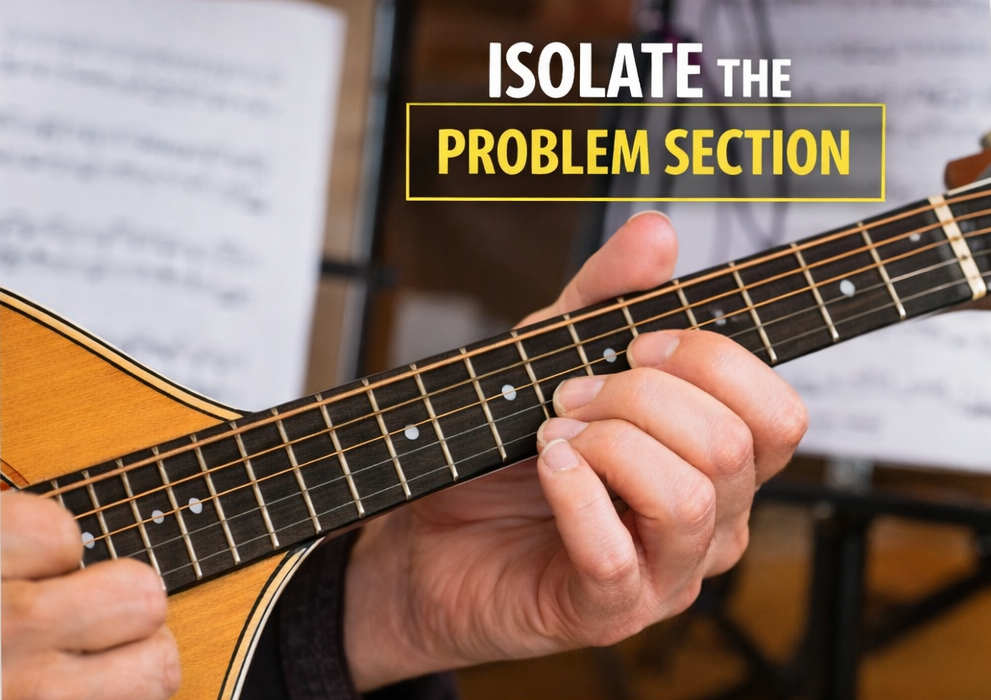
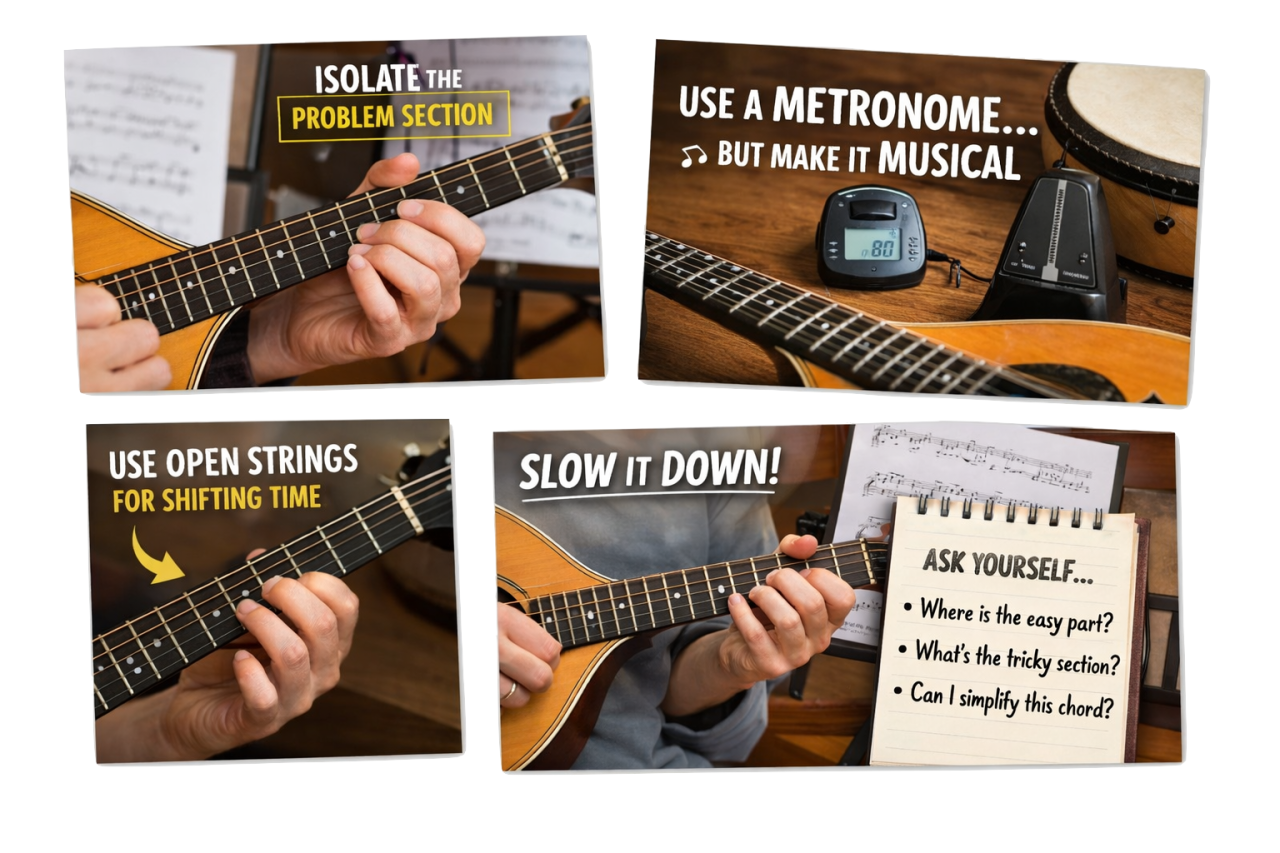
2. Isolate Problems — Don’t Just Play Through Them
One of the biggest mistakes musicians make is “run-through practice.”
You play the tune.
You hit the tricky part.
You stumble.
You keep going.
Nothing improves.
The lesson emphasised a much better approach: Take difficult parts out of context and practise them on their own.
Why Isolation Works
When you isolate:
- Your brain focuses on one movement pattern.
- Muscle memory develops faster.
- You eliminate surrounding distractions.
- You build confidence through repetition.
How to Do It Properly
- Identify the exact 1–2 bars causing difficulty.
- Loop them slowly.
- Repeat 10–20 times cleanly.
- Only then reinsert into the full section.
This method accelerates improvement dramatically. Instead of reinforcing mistakes, you’re reinforcing success.
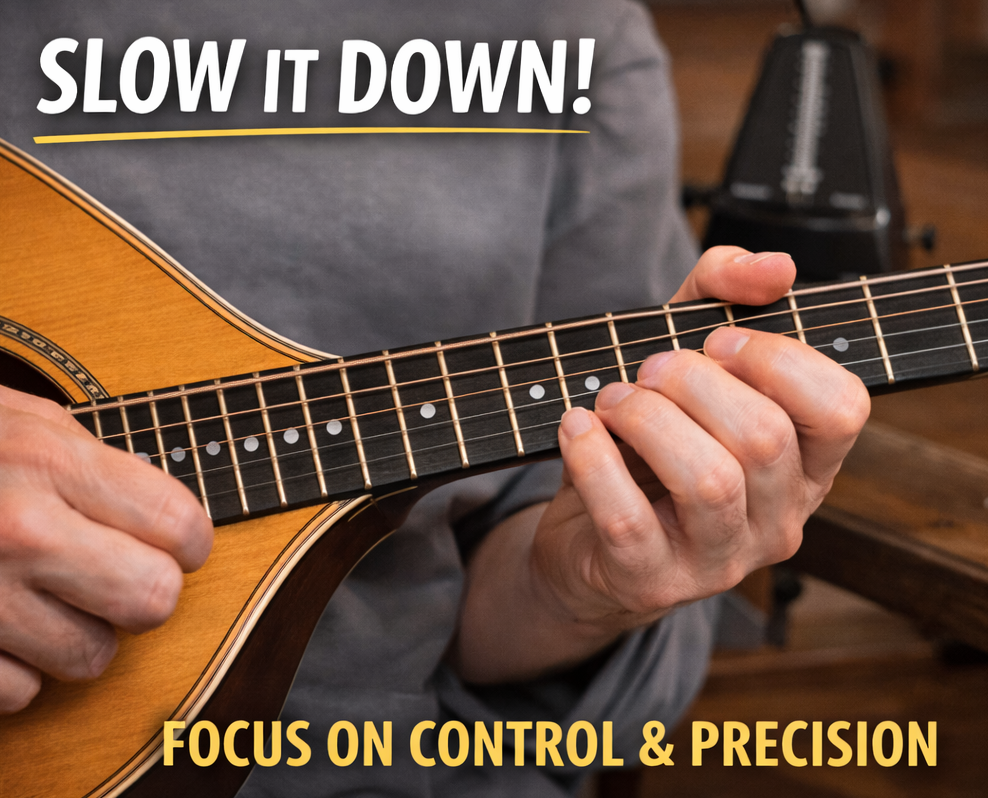
3. Slow Practice Is Not Optional
The session strongly emphasised slowing things down.
Many players think they’re practising slowly — but they’re not slow enough.
True slow practice means:
- No tension in hands
- No rushing between notes
- Full control of tone
- Intentional movement
Why Slow Practice Works
When you slow down:
- You notice inefficiencies.
- You fix finger placement.
- You reduce wasted motion.
- You develop precision.
Speed is not trained directly — it emerges from control.
If you can’t play something perfectly at 50% tempo, you won’t magically fix it at full speed. Slow, controlled repetition builds the foundation that faster playing rests upon.

4. Use a Metronome — But Make It Musical
Rather than relying only on a sterile click, the lesson suggested using:
- Bodhrán-style rhythm
- Percussion loops
- Light backing tracks
- Adjustable tempo tools
Why This Matters
A pure metronome builds timing.
A rhythmic backing track builds musical timing.
The goal isn’t robotic accuracy — it’s groove and feel.
How to Apply This
- Start at a tempo where you can play comfortably.
- Loop the tricky section.
- Increase tempo gradually.
- Never increase speed if mistakes appear.
Consistency is more important than speed. Musical rhythm develops when you feel the pulse, not when you chase tempo.
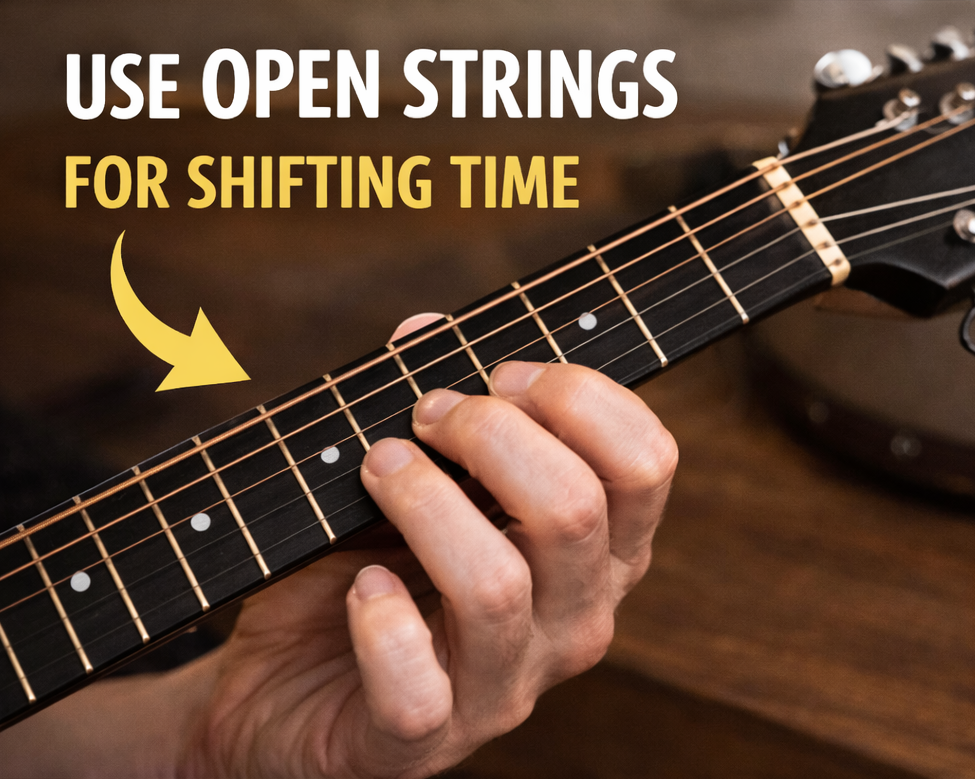
5. Use Open Strings as Movement Time
One subtle but powerful concept from the lesson was this:
Open strings give you time to move.
This applies broadly across Irish bouzouki playing.
Whenever an open string appears:
- Prepare your next hand position.
- Shift early.
- Reduce rushed transitions.
Open strings are not just notes — they are transition tools.
Learning to anticipate movement during open notes dramatically improves fluidity and reduces panic during position changes.
6. Anticipation Is Everything
Many technical problems arise because players react instead of anticipate.
Instead of thinking:
“What note am I on?”
Think:
“What shape or position is coming next?”
This shift in mindset improves:
- Chord transitions
- Position shifts
- Tone consistency
- Overall confidence
Anticipation reduces panic.
And panic is what causes mistakes.
Train your mind to stay one step ahead of your fingers.
7. Don’t Overcomplicate Chords
Another valuable takeaway was the idea that sometimes:
Simpler is better.
Especially when combining melody and harmony, it’s often better to:
- Omit a string
- Simplify a voicing
- Focus on core tones
- Prioritise clean sound over full shape
Trying to grab every note often creates tension and rushed playing.
Musical clarity beats harmonic density every time.
Clean, confident sound will always be more convincing than a crowded chord played poorly.
8. Practice Sections Multiple Times in a Row
Repetition was emphasised clearly:
Play the tricky part again. And again. And again.
Not mindlessly — intentionally.
The key is:
- Correct repetition
- Relaxed repetition
- Slow repetition
Ten clean repetitions are worth more than fifty rushed ones.
When repetition is done properly, your hands begin to trust the movement. That trust is what produces consistency.
9. Separate Technical Practice from Musical Practice
There are two distinct modes of practising, and both matter.
Technical Mode
- Slow
- Analytical
- Repetitive
- Isolated
Here you fix mechanics. You refine finger placement. You reduce tension.
Musical Mode
- Full run-through
- Focus on phrasing
- Focus on tone
- Focus on expression
Here you remind yourself why you’re learning the tune in the first place.
Blending both in every session ensures you grow technically without losing musicality.
10. Build a Practice Structure That Supports You
The lesson also highlighted something important about community and communication:
Learning music is easier when you:
- Ask questions
- Share struggles
- Get feedback quickly
- Interact with other players
Isolation slows progress.
Community accelerates it.
Even beyond direct instruction, simply knowing others are working on similar material builds motivation and accountability.
11. Accept That Different Setups Require Attention
The session opened with a reminder that every teaching or performance setup requires checking settings.
This translates into a broader learning lesson:
Preparation matters.
Before you practise:
- Tune properly.
- Sit comfortably.
- Adjust lighting.
- Remove distractions.
- Make sure your instrument is set up correctly.
Good practice conditions produce better results.
Poor setup creates unnecessary frustration.
12. Progress Comes from Consistency, Not Intensity
It’s tempting to overwork a difficult passage for hours.
But steady, consistent daily work wins every time.
20–30 focused minutes:
- Daily
- Structured
- Intentional
…will outperform a two-hour unfocused session once a week.
Consistency builds neural pathways.
Intensity often builds frustration.
Small daily improvements compound quickly.
13. Focus Areas to Apply to Any Tune
Whenever you learn a new piece on Irish bouzouki, ask yourself:
- Which section is easiest?
- Which section needs isolation?
- Where can I simplify chords?
- Where are open strings giving me movement time?
- Am I anticipating what’s next?
This simple framework transforms how you learn music. Instead of reacting emotionally to difficulty, you respond strategically.
14. The Bigger Picture: Technique Through Repertoire
Every tune you learn is:
- A vehicle for technique
- A training ground for timing
- A lesson in phrasing
- A confidence builder
Don’t just aim to “get through” tunes.
Aim to extract skills from them.
That’s how long-term progress happens on Irish bouzouki — not by collecting repertoire, but by refining the mechanics and awareness each piece teaches you.
Final Thoughts: Practise Smarter, Not Harder
The most important lessons from the session weren’t about one specific melody.
They were about:
- Slow, controlled repetition
- Isolating difficulty
- Using open strings strategically
- Simplifying when needed
- Practising with musical rhythm
- Anticipating transitions
- Structuring sessions intentionally
If you apply these principles consistently, you won’t just improve one tune — you’ll improve your entire approach to Irish bouzouki.
And that’s where real progress begins.
Tune - Lord Inchiquin
Practising Irish bouzouki can feel like a tug of war between enthusiasm and frustration. One day you’re flying through a tune; the next day your fingers won’t land cleanly, your timing slips, and everything sounds clunky. The good news is that effective bouzouki practice isn’t about grinding for hours—it’s about practising in a way that trains the skills you actually need: timing, coordination, clean chord changes, confident position shifts, and musical flow.
In a recent lesson built around the Carolan tune “Lord Inchiquin” (often credited to Turlough O’Carolan), the instructor, Declan, demonstrates a very practical approach to learning: melody first, chords second, then isolate the hard bits and loop them slowly. That lesson format is the perfect springboard for a broader guide, because the problems that show up in Lord Inchiquin are the exact ones that show up in most Irish bouzouki playing—especially when you’re moving from beginner to intermediate.
This post combines the key teaching points from the lesson with a clear, repeatable practice framework so you can progress faster, with less frustration, and build skills that transfer to every tune you learn.
Why Most Bouzouki Practice Fails (And What to Do Instead)
A lot of players practise by doing the same thing repeatedly: start at bar one, play until a mistake happens, restart, repeat. That approach feels like practice, but it often creates two problems:
- You spend most of your time playing parts you already know.
- You keep “rehearsing mistakes” at the same tricky spots.
What works better is a smarter method:
- Identify the exact bars that cause problems
- Remove them from the tune
- Slow them down
- Loop them until they’re automatic
- Put them back into the tune
This is exactly what Declan recommends in the Lord Inchiquin lesson: take the “wee tricky parts,” practise them individually, and use something like a metronome or backing track to stay honest.
The “Melody First” Rule: Build a Strong Foundation
One of the most important strategies from the lesson is simple:
Learn the melody cleanly before you add chords.
In the transcript, the instructor explicitly says they will:
- Play through the tune slowly with melody only
- Then play it again adding chords
- Then break it into sections and smaller parts
This order matters because bouzouki playing often involves two jobs at once:
- Your melody must be clear and accurate.
- Your rhythm/chords must be steady and supportive.
If the melody isn’t locked in first, adding chords usually makes everything collapse—timing, tone, and confidence.
Practice tip:
Before you even think about chords, aim for:
- consistent tempo (even slow tempo counts)
- clean note transitions
- confident picking direction (no panic strokes)
Break Tunes Into A and B Sections (Because They’re Not Equal)
A brilliant, very practical observation in the lesson is that:
The A section is easier than the B section.
That’s common in Irish music and tune arrangements. In Lord Inchiquin, Declan notes the A section is full of repeated harmony (largely D across both lines, with only a couple of changes like G and Asus4). The B section, on the other hand, introduces more technical demands like crossing strings and moving higher up the neck.
So don’t practise the whole tune as if every bar is equally difficult.
Instead:
- Use the A section to build flow, groove, and confidence.
- Use the B section to train technique (position shifts, coordination, tricky transitions).
Practice tip:
Spend your time proportional to difficulty. If the B section is where you fall apart, it deserves more time than the easy A section—even if the A section feels more fun.
Use “Anchor Chords” to Simplify the Harmony
A common reason bouzouki players struggle is chord overload: too many shapes, too many changes, too much to remember.
One lesson takeaway is that harmony can often be simplified. For example, early in the B section of Lord Inchiquin, Declan explains that for several bars:
“It’s all A for those 4 bars.”
Even though the chord labels may include variations (like Asus4, A power chord, and D5 over A), the practical reality is that you’re living in the sound world of A.
This creates a very effective practice approach:
- Treat complex-looking chord sequences as one harmonic “zone.”
- Focus on timing, tone, and clean movement instead of panicking about new chord names.
Practice tip:
When you see variations of the same chord family, practise them as a set:
- Asus4 → A5 → A-based voicings
Keep your hand relaxed and train the change rather than the label.
Stop Fighting the Instrument: Focus on the Courses You Need
A particularly useful and reassuring point from the transcript:
You can ignore the 4th course in many melody situations.
Declan mentions that if you’re playing melody with chords, your melody will typically sit on the top courses, so you can often focus on the first three courses and treat extra low notes as optional.
This is how many experienced bouzouki players think: support the music without making your left hand do unnecessary gymnastics.
Practice tip:
When a chord shape feels awkward, ask:
- “Is that bass note essential, or decorative?”
If it’s decorative, simplify it until your rhythm is solid.
Loop the “Last Two Bars” Method (Micro-Practice That Works)
In the lesson, the first major trouble spot appears near the end of the first line, involving a transition around G5 with movement through notes like F# and E. Declan's advice is exactly what smart practice looks like:
Practise the last two bars on their own.
This is micro-practice: short, targeted loops that train your hands to succeed.
Here’s how to do it effectively:
- Isolate 2 bars (or even 1 bar)
- Play it slowly, perfectly
- Repeat 10 times with no mistakes
- Increase tempo slightly
- Repeat again
If you make an error, don’t “push through.” Stop, reset, and do it again properly even slower!
Practice tip:
Set a rule: no more than 3 full-tune playthroughs before you isolate and fix something specific.
The “Open Strings Buy Time” Trick (Position Shifts Without Panic)
One of the most transferable strategies in the transcript is how Declan uses open strings as a practical tool.
At a key moment in the B section, they explain that open strings give you time to move your hand up the neck to reach higher frets—specifically around 7th, 9th, and 10th frets on the second course.
This is a pro-level habit that intermediate players need to learn:
Open strings are not just notes—they are time.
They create a moment where:
- rhythm continues
- sound continues
- left hand can shift smoothly without rushing
Practice tip:
When you see open strings in an arrangement, don’t waste them. Use them intentionally to prepare your next hand position.
Train the Real Enemy: Big Jumps (Like F# From 9th to 4th Fret)
Declan calls out one of the most challenging moves in the tune: playing an F# high up the neck (around the 9th fret) and then needing an F# much lower (around the 4th fret). That kind of jump is exactly where people lose timing.
Why the position swap is necessary?: it sets you up to land an A power chord cleanly at the end of the phrase. If you stay high too long, you have to rush down, cut the note short, and risk missing the chord.
So the practice goal becomes:
- switch earlier
- make the move deliberate
- keep the rhythm intact
Practice drill (highly effective):
- Play the high F# phrase
- Pause (still counting)
- Move to the low position
- Land the A power chord cleanly
- Repeat as a loop
Then remove the pause while keeping the same calm movement.
Use a Metronome… Or Better: A Backing Track You Can Control
Declan recommends practising with:
- a metronome
- a slowed backing track
- or percussion-style “click” sounds
He also mentions using software tools (like Logic Pro plugins) to create a more musical metronome feel—bongos, congas, bodhrán-style pulses—something that can be sped up or slowed down.
That’s a key idea for Irish bouzouki practice:
Rhythm practice is easier when it feels like music.
If a sterile click makes you tense, use a percussive groove that still holds time.
Practice tip:
Start slower than you think you need. A “too slow” tempo is often the fastest path to real speed later.
A Simple Weekly Practice Plan (Based on the Lesson Workflow)
Here’s a practical structure you can repeat every week with any tune:
Day 1–2: Melody Lock-In
- Learn the melody slowly
- Aim for clean transitions and consistent picking
- No chords yet
Day 3–4: Add Chords in the Easy Section (A section)
- Focus on rhythm and groove
- Simplify chord shapes if needed
- Keep the melody audible
Day 5: Attack the Hard Spots (B section loops)
- Identify 2–3 “problem bars”
- Loop each one slowly
- Use open strings to plan shifts
Day 6: Full Tune at Slow Tempo
- Play through cleanly with a backing pulse
- Stop and isolate mistakes immediately
Day 7: Musical Playthrough
- Record yourself
- Play with a backing track
- Focus on tone, dynamics, and flow
This mirrors what Declan does: play through, add chords, break into sections, isolate the tricky parts, and practise with time support.
Get Help Faster: Use Community Learning (Not Just Private Practice)
The last part of the lesson shifts from music to learning support, and it’s worth including because it affects progress:
- Declan encourages students to use the community for questions.
- Community gets faster replies than email.
- Other students may answer too, which builds collective learning.
This is a reminder that faster progress often comes from:
- asking better questions
- getting feedback sooner
- seeing how others solve the same problems
If you’re learning Irish bouzouki alone, even one active group can massively speed up your development.
Final Thoughts: Effective Irish Bouzouki Practice Is Strategic, Not Endless
If there’s one message to take from the Lord Inchiquin lesson and apply to everything you learn, it’s this:
Don’t practise more—practise smarter.
Play melody first, then add chords. Separate A and B sections. Use open strings to buy time. Loop the difficult bars. Use a metronome or a musical backing pulse. And don’t hesitate to lean on community feedback.
Do that consistently, and you’ll notice something important: your progress stops being random. It becomes predictable—because you’re training the exact skills that Irish bouzouki playing demands.
Categories: : Irish Traditional Music