Accompany The Old Maids of Galway on Irish Bouzouki
 Declan Plummer
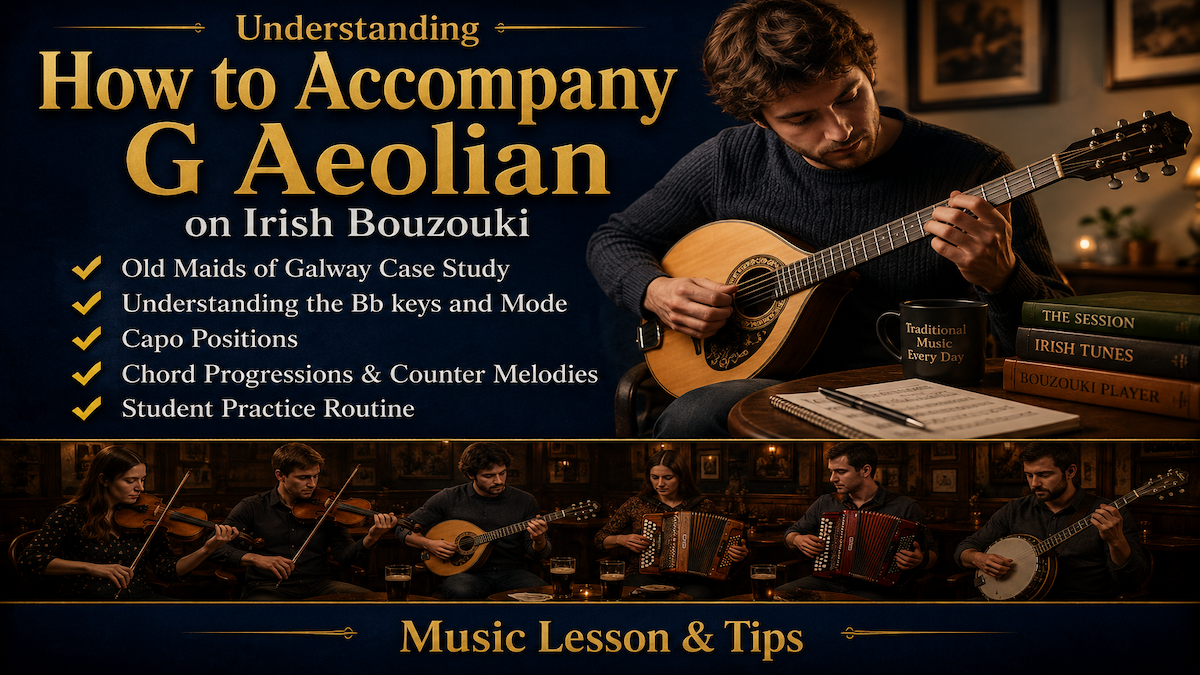
Learn Irish bouzouki accompaniment for The Old Maids of Galway with capo 5, G Aeolian chords, hammer-ons and counter-melody ideas.
Accompanying The Old Maids Of Galway On Irish Bouzouki
The Old Maids of Galway is a beautiful but awkward reel for Irish bouzouki accompaniment because the common fiddle version sits in G Aeolian. The most practical approach is to use capo 5, think in familiar Aeolian shapes, and combine block chords, hammer-ons, arpeggios and counter-melody ideas.
This lesson explores how to approach The Old Maids of Galway as an accompaniment challenge rather than simply a tune to strum through. The reel has a strong modal colour, a slightly unusual key centre for many whistle and flute players, and a harmonic shape that requires careful choices on Irish bouzouki.
For melody instruments, the tune may appear differently depending on the instrument being used. A fiddle player may commonly play the tune in G Aeolian, while a tin whistle player may need to think differently depending on the whistle. In this lesson, a B flat whistle is used so that the written fingering and sounding pitch can be managed more comfortably.
For bouzouki accompaniment, the central problem is not only finding the correct chords. It is finding a musical way to support the tune without killing the resonance of the instrument. This means avoiding excessive barring where possible and using open, ringing textures that still follow the contour of the melody.
- The tune is best understood here as a G Aeolian reel with a strong minor modal character.
- Capo 5 gives a practical way to use familiar Aeolian accompaniment shapes on Irish bouzouki.
- The accompaniment works best when block chords, hammer-ons, arpeggios and counter-melody ideas are combined.
Understanding The Key And Mode
The Old Maids of Galway is often encountered as a fiddle tune in G Aeolian. That immediately creates a practical issue for players who are used to D whistles, flutes or pipes. A tune with two flats in the key signature does not sit naturally under the fingers in the same way as the more common D, G, A or E modal session repertoire.
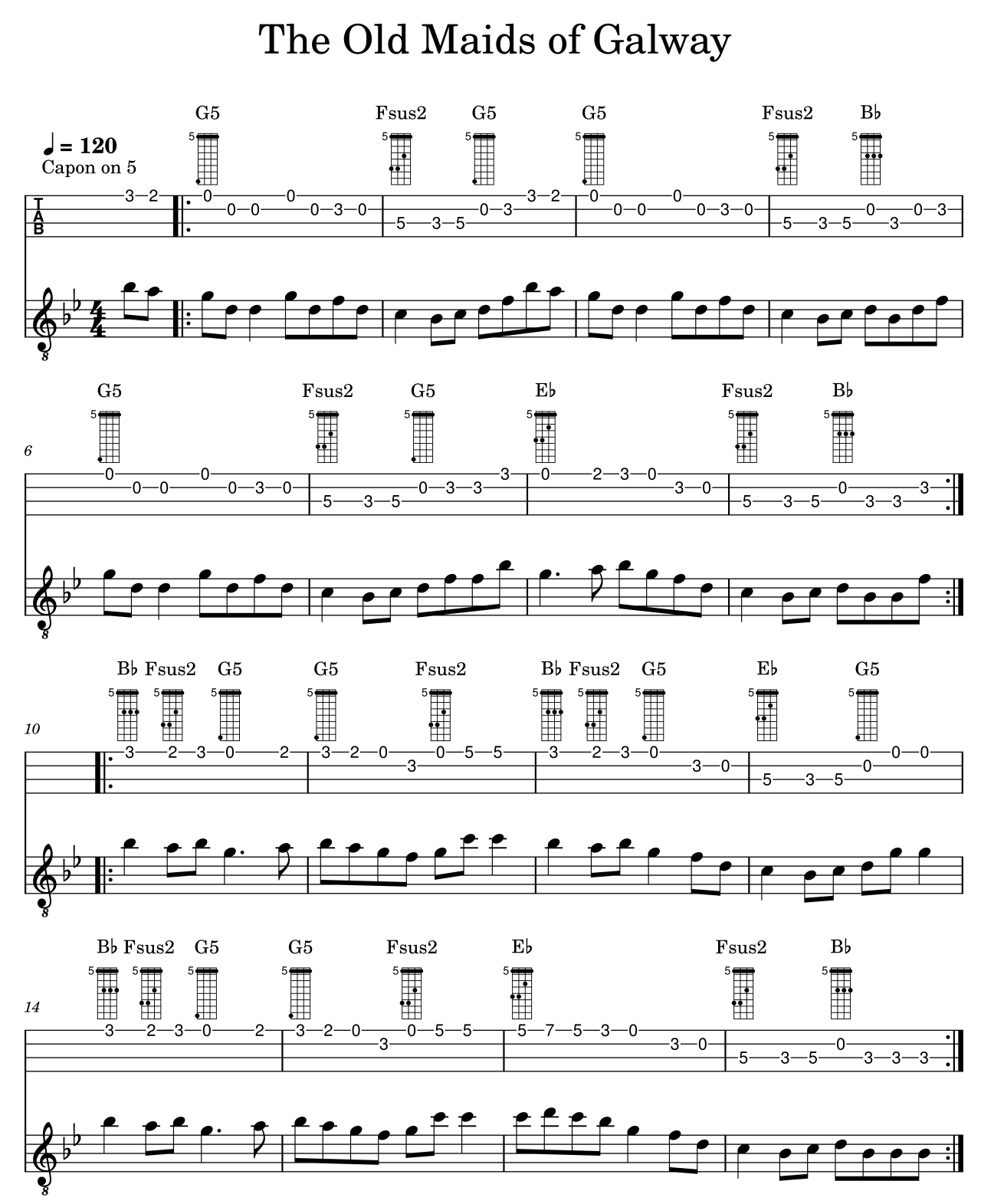
The Aeolian mode gives the tune its dark, minor sound. In G Aeolian, the important flat notes are B flat and E flat. These notes shape the colour of the tune and also influence the chord choices. If the accompaniment ignores those notes, the reel can quickly lose its character.
One useful way to think about this tune is to separate the written fingering from the sounding pitch. On a B flat whistle, it is possible to read or think through a more familiar shape while producing the lower sounding pitch required for the fiddle version. This is not always necessary for every player, but it is a helpful way to understand why different versions of the tune may appear in different notations.
PRO TIP
Before choosing bouzouki chords, identify the actual modal centre of the recording you are accompanying. A tune may look familiar on paper but sound in a different key depending on the instrument or version being played.
Why G Aeolian Feels Awkward
G Aeolian is not impossible on Irish bouzouki, but it does make certain chord shapes less convenient. The tune wants access to a G minor sound, but it also points towards B flat and E flat colours. These are manageable, but they need to be approached with care if the accompaniment is going to remain clean and resonant.
The danger is that the player starts forcing guitar-like barre chords onto the bouzouki. While this may technically produce the correct harmony, it can dampen too many strings and remove the ringing quality that makes Irish bouzouki accompaniment effective.
Choosing A Capo Position
The most practical solution explored in this lesson is to place the capo on the fifth fret. With the capo at five, the tune can be approached using shapes that feel similar to familiar Aeolian accompaniment patterns. The actual sound is G Aeolian, but the left hand can think through more comfortable shapes.
This does not solve every problem. The B flat chord remains awkward, and some moments in the tune still require careful handling. However, capo 5 gives a workable balance between playability, resonance and access to useful melodic ideas.
An alternative is to remove the capo completely. This gives access to lower, dronier sounds and makes certain notes easier to reach. However, the result can become very bass-heavy. It may work in some contexts, especially if you want a darker accompaniment texture, but it may not give the clearest or most flexible result.
PRACTICE BOX
Try the tune with capo 5 first. Then remove the capo and compare the sound. Listen for resonance, clarity, ease of movement and whether the accompaniment supports the melody without becoming too heavy.
Capo Five As The Main Option
With capo 5, the accompaniment can focus on a small number of important frets above the capo. The second, third and fifth frets become especially useful. The first and fourth frets are less central for the main accompaniment idea, so they can often be ignored at the early stage of learning.
This is useful because it reduces the amount of information the left hand has to manage. Instead of thinking about every possible chord, the student can begin with a controlled set of shapes and gradually add detail.
Core Chord And Texture Ideas
The accompaniment begins with the idea of three primary chords: chord one, chord four and chord five. In a modal tune, these do not always behave like major-key harmony, but the concept is still useful. It gives the player a simple map before adding counter-melody and ornamented movement.
The main home sound is a G5 power chord. This avoids making the harmony too major or too minor too early. It provides a strong, open centre and allows the melody to define the modal colour. On Irish bouzouki, this kind of power-chord texture can be much more effective than thick, fully voiced chords.
From this G5 shape, the player can begin adding hammer-ons onto the second and third frets above the capo. These small movements create energy without needing to change to a full chord every time. They also help the accompaniment follow the contour of the melody.
Solving The B Flat Problem
The B flat chord is one of the main challenges in this lesson. In G Aeolian, B flat is not an optional colour; it is part of the sound world of the tune. The problem is finding a way to include it without forcing the bouzouki into heavy, dampened chord shapes.
A full B flat major shape may be possible, but it can be uncomfortable and may not ring clearly. If several courses are barred or held down at once, the sound can become muffled. This is especially noticeable on a bouzouki, where resonance is a major part of the style.
A better solution is to use partial B flat shapes or imply the chord through movement. For example, using the notes B flat and D can give enough of the chord colour without needing the full fifth. This is not a complete textbook chord, but it can work musically because it gives the ear the essential information.
COMMON MISTAKE
Do not assume that the biggest chord shape is the best chord shape. On Irish bouzouki, a smaller voicing that rings clearly will often sound more musical than a full barre chord that kills the resonance.
Using Hammer-Ons Instead Of Heavy Chords
The most useful workaround is to build hammer-on ideas around the notes of the awkward chord. Instead of holding down a thick B flat shape, practise hammer-ons across the relevant courses on the 3rd fret above the capo. This creates the impression of harmonic movement while keeping the instrument alive and ringing.
This approach also suits Irish bouzouki style better than constant block strumming. The bouzouki can act as both a rhythmic and melodic accompaniment instrument. Hammer-ons allow the player to suggest harmony, rhythm and counter-melody at the same time.
Building Counter-Melody Ideas
Once the basic chord areas are understood, the next step is to add counter-melody. This does not mean playing a completely separate tune underneath the melody. It means creating small movements that follow or answer the shape of the tune.
A useful starting point is to listen for the direction of the melody. If the tune rises, the accompaniment can rise gently with it. If the tune falls, the accompaniment can answer with a downward shape. These movements should be simple and rhythmically stable.
The hammer-on figures around the second and third frets above the capo are especially useful here. They allow the player to decorate the G5 sound and move towards the B flat colour without committing to heavy chord shapes.
INSIGHT / QUOTE BOX
A strong Irish bouzouki accompaniment is not only about finding the right chords. It is about choosing textures that let the tune breathe while still giving it rhythm, colour and direction.
Mixing Three Main Ingredients
For this tune, the accompaniment can be built from three main ingredients: block chords, hammer-on counter-melodies and arpeggiated textures. None of these should dominate the entire performance. The aim is to move between them so the accompaniment stays interesting.
Block chords provide structure. Hammer-ons provide lift and movement. Arpeggios provide space and resonance. When these three ingredients are balanced, the accompaniment can support the reel without becoming repetitive.
Rhythm And Reel Accompaniment
Because The Old Maids of Galway is a reel, the accompaniment needs to maintain forward motion. Even when the tempo is slow for practice, the pulse should still feel like a reel. Avoid letting the accompaniment become too square or heavy.
A slow reel practice tempo is useful because it gives time to hear the harmonic problems clearly. It also allows the player to test whether a chord shape, hammer-on or arpeggio actually works. Once the ideas are secure, the tempo can gradually increase.
Rhythm Pattern Box
Start with a simple reel pulse: down-up movement across the beat, keeping the hand relaxed. Add emphasis lightly at the start of each bar, then use hammer-ons or arpeggios to fill the space without over-strumming.
Count slowly as: 1 and 2 and 3 and 4 and. Keep the rhythm even before adding decorative movement.
Avoiding Repetition
If the same accompaniment idea continues for too long, the tune can become static. A good rule is to notice when you have repeated the same pattern several times. At that point, add a small variation. This could be a block chord, a passing arpeggio or a short counter-melody.
The variation does not need to be dramatic. In traditional accompaniment, subtle changes are often more effective than large gestures. The goal is to keep the reel moving while still respecting the melody.
Practice Guidance For Students
Students should not try to solve the whole accompaniment at once. Start by learning the sound of the tune. Listen to where the phrases begin and end. Notice the places where the B flat colour appears, and pay special attention to the ends of sections.
Next, establish the home chord. With capo 5, practise the G5 shape until it feels secure. Add hammer-ons on the second and third frets above the capo. These should be clean, even and rhythmically controlled.
After that, experiment with the awkward B flat area. Do not begin by forcing a full chord. Instead, try partial shapes and hammer-on figures. Listen carefully to whether the sound supports the melody. If the shape sounds muffled, simplify it.
Finally, practise moving between the three main textures: block chords, hammer-ons and arpeggios. Each one should feel like part of the same accompaniment language. The aim is not to show off every idea at once, but to choose the right texture at the right moment.
Step-By-Step Practice Routine
Begin by listening to a recording of The Old Maids of Galway without playing. Identify the pulse of the reel and the darker Aeolian colour. Try to hear where the tune feels settled and where it moves towards a different harmonic colour.
Set the capo at the fifth fret and find the G5 home shape. Strum it gently, using only the courses needed to create a clear, open sound. Avoid pressing harder than necessary. The sound should ring, not choke.
Practise hammer-ons on the second and third frets above the capo. Keep the right hand steady while the left hand adds movement. Do this slowly at first, making sure every note speaks clearly.
Add the B flat colour using a partial voicing or a hammer-on figure. Compare the sound of a fuller chord with the sound of a smaller shape. Choose the option that gives the clearest musical result.
Play along with a slow version of the tune. Use block chords for the main structure, hammer-ons for movement and arpeggios for space. Do not fill every beat. Leave room for the melody.
Once the accompaniment feels secure, record yourself. Listen back for three things: whether the rhythm is steady, whether the modal colour is clear, and whether the bouzouki still rings naturally. Adjust your chord shapes if the sound is too heavy or muffled.
Key Takeaways
Key Takeaways
✅ The Old Maids of Galway is a rewarding but tricky reel because the G Aeolian sound creates awkward chord choices on Irish bouzouki.
✅ Capo 5 is a practical solution because it allows familiar Aeolian-style shapes while still producing the correct modal colour.
✅ The B flat area should be treated carefully, using partial voicings or hammer-on ideas instead of heavy barre chords.
✅ A strong accompaniment combines block chords, arpeggios and counter-melody rather than relying on one repeated strumming pattern.
✅ Resonance matters. A smaller, clearer bouzouki shape is often more effective than a technically complete chord that sounds muffled.
FAQ
What Key Is The Old Maids Of Galway In?
The version discussed in this lesson is treated as G Aeolian. This gives the tune a dark minor modal sound and brings B flat and E flat into the harmonic picture. Some written or transposed versions may look different depending on the instrument.
What Capo Position Works Best For Irish Bouzouki?
Capo 5 is the most practical option explored here. It allows the player to use familiar Aeolian accompaniment shapes while still supporting the G Aeolian sound of the tune. Other positions are possible, but they may create awkward chord shapes or overly heavy textures.
Why Is The B Flat Chord Difficult?
The B flat chord is difficult because a full shape can require uncomfortable fingering or excessive barring. On Irish bouzouki, this may dampen the resonance. A partial voicing or hammer-on figure can often give a more musical result.
Should I Use Full Chords Or Counter-Melody?
Use both, but do not rely on either one all the time. Full or partial block chords give structure, while counter-melody and hammer-ons create movement. The best accompaniment blends these textures so the tune remains clear and lively.
How Should I Start Practising This Tune?
Start slowly with capo 5 and a simple G5 home shape. Add hammer-ons on the second and third frets above the capo, then experiment with partial B flat colours. Once the shapes are comfortable, play along with a slow recording and gradually add variation.
To take your learning to the next level,
check out some of these amazing Courses & Apps





Categories: : Irish Traditional Music
Did this article answer all your questions?
If you have any questions, or you want to learn more,
Click the Picture Below to Join the Community for FREE!