Learn The Kesh Jig on Tin Whistle & Irish Bouzouki
 Declan Plummer
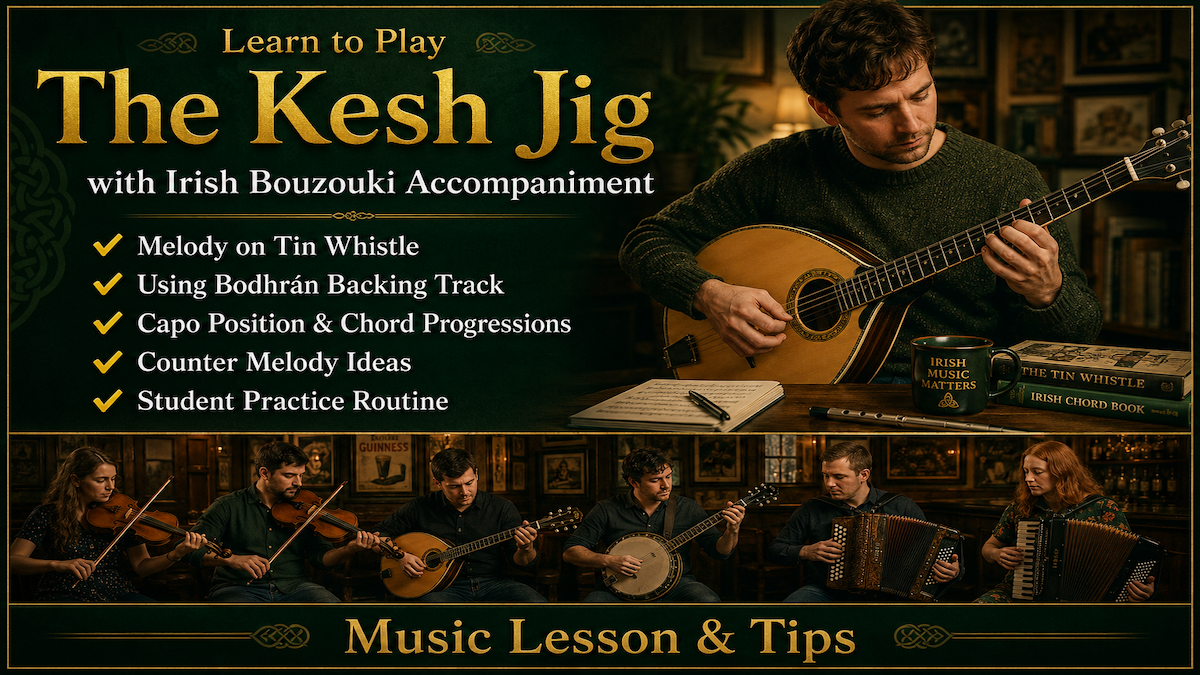
Learn The Kesh Jig in G major with tin whistle melody, Irish bouzouki accompaniment, capo 5 chords, jig rhythm and practice tips.
Learning The Kesh Jig For Tin Whistle And Irish Bouzouki
This lesson explores how to learn The Kesh Jig as a G major session tune, first on tin whistle and then as an Irish bouzouki accompaniment. The focus is on recognising the key, using jig rhythm, choosing a practical capo position, creating chord movement, and developing melodic accompaniment ideas.
The Kesh Jig is one of the best-known tunes in Irish traditional music. It appears regularly in sessions and is often one of the first jigs that players recognise by ear. Because it is so familiar, it also provides an excellent opportunity to study how melody, rhythm, chord choice, and accompaniment can work together.
In this lesson, the tune is treated as both a melody study and an accompaniment study. The tin whistle part gives us the melodic shape, while the Irish bouzouki part explores how to support that melody without simply strumming the same predictable chords every time.
The wider aim is to move beyond just playing the notes. A student should learn how to identify the key, feel the 6/8 jig pulse, use backing tracks carefully, and build a bouzouki part that leaves space for the tune while still adding movement and musical interest.
- The Kesh Jig is treated as a G major jig in 6/8 time.
- The tin whistle melody is used as the foundation for the accompaniment.
- The Irish bouzouki part uses capo 5 to create useful open-string shapes.
- The accompaniment should combine chords, rhythmic drive, drones, and small melodic ideas.
- The goal is to practise one clear version first, then gradually introduce variation.
Understanding The Tune
The Kesh Jig is a traditional Irish jig in 6/8 time. In this lesson, it is approached as a G major tune. One sharp in the key signature points towards either G major or E minor, but the strong presence of G in the melody makes G major the practical choice.
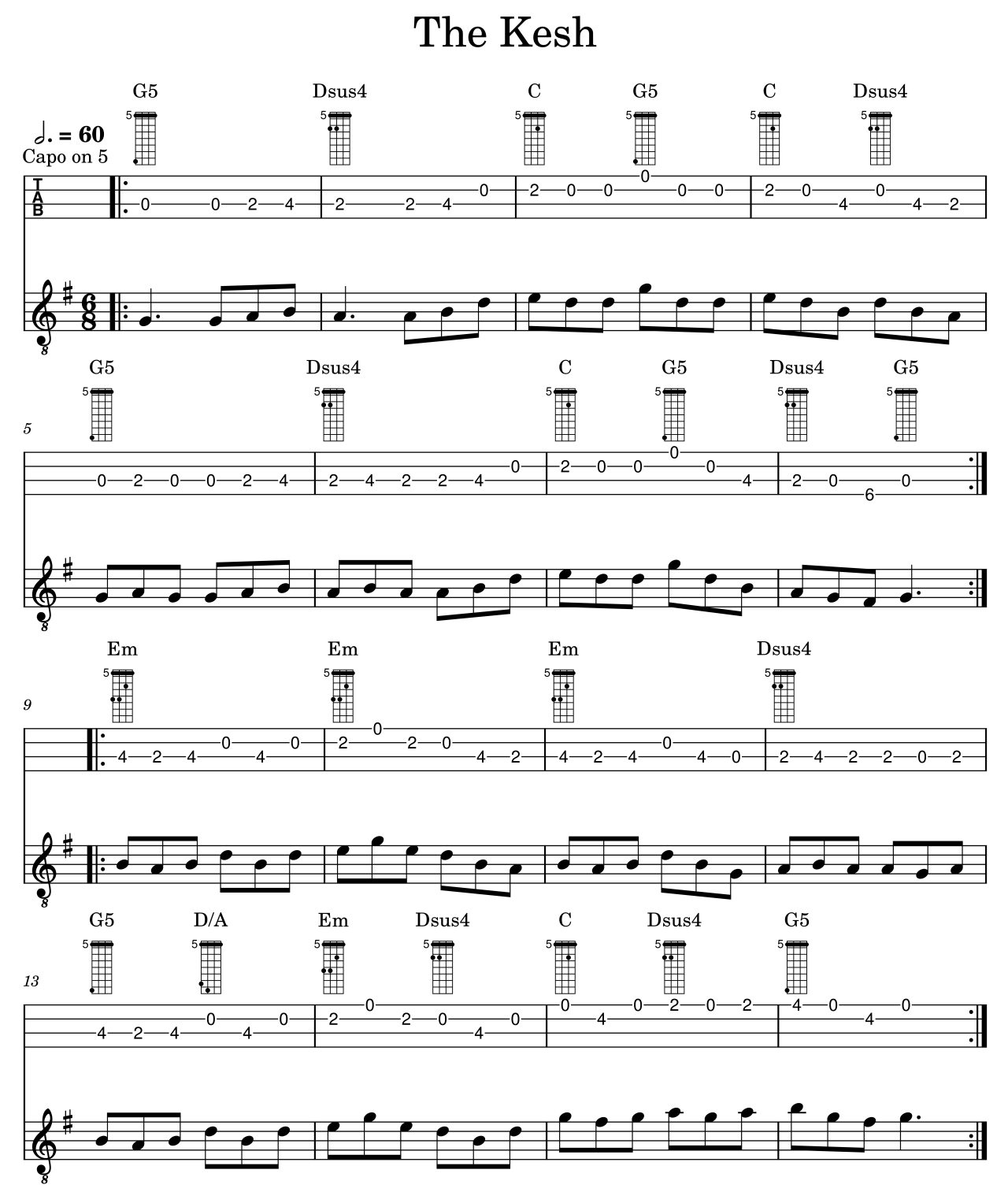
This is an important first step for any student learning Irish traditional music. Before choosing chords or accompaniment patterns, you should identify the key and the dance type. The key tells you which notes and chords are likely to work. The dance type tells you how the rhythm should feel.
A jig in 6/8 is normally felt in two main beats per bar, with each beat divided into three smaller pulses. Rather than counting six equal beats in a heavy way, it is more musical to feel the bar as two flowing groups: one-two-three, four-five-six.
PRO TIP: Before playing the accompaniment, say the pulse out loud as “one-two-three, four-five-six.” Repeatedly saying Bacon and Sausages can also provide the correct rhythmic drive. This helps you feel the jig rhythm as movement rather than as separate notes.
Why The Key Matters
When a tune has one sharp, it does not automatically mean it is in G major. It may also be in E minor, or it may use a related modal sound. In The Kesh Jig, the melody clearly centres around G, so G major is the most useful way to understand the tune for accompaniment.
For a bouzouki player, this matters because it gives you a clear harmonic home. You are not simply guessing chords. You are listening for where the tune settles, where it creates tension, and where it needs support from the accompaniment.
Tin Whistle First: Learning The Melody
The first practical stage is learning the tune on tin whistle. This gives a clear sense of the melody before any accompaniment is added. Even if your main instrument is Irish bouzouki, understanding the tune itself will make your accompaniment more musical.
A slow practice speed is useful, but there is a point where playing too slowly can become difficult. If the tempo is so slow that every note feels isolated, the tune can lose its natural flow. Start with a comfortable tempo and that gives you time to find/feel the next part of the piece. Once you've established a comfortable tempo aim to speed it up to a slow version of the tune, around 90 beats per minute.
At this speed, the student can hear where the notes land inside the bar while still keeping a sense of jig movement. The aim is not to rush towards session speed immediately, but to build enough fluency that the tune begins to feel like music rather than a string of separate finger movements.
PRACTICE: Play the melody twice through at a comfortable tempo. Keep the breathing relaxed and avoid panicking between phrases. The tune should feel steady before you increase the speed.
Using A Backing Track
A backing track can be extremely useful when learning a jig. It helps you keep time, hear the dance pulse, and practise playing through the tune without stopping. However, the backing track should support your practice rather than hide problems.
For this tune, a bodhrán-only backing is especially useful for bouzouki practice. If the backing track already contains bouzouki, it can become difficult to hear what your own accompaniment is doing. A rhythmic track gives you pulse and energy while leaving harmonic space for your own playing.
Rhythm Pattern Box: Feeling The Jig Pulse
Rhythm Pattern Box
| Bar Feel | Count | Bouzouki Idea |
|---|---|---|
| First Main Beat | 1 2 3 | Down-up-down or chord strike with movement |
| Second Main Beat | 4 5 6 | Down-up-down or answering phrase |
| Phrase Ending | Turnaround | Small roll, hammer-on, pull-off, or descending line |
This rhythm pattern is not meant to be a rigid rule for every bar. It is a starting point. Once the pulse is secure, you can add variation through chord changes, drones, rolls, hammer-ons, pull-offs, and small counter-melodies.
Irish Bouzouki Setup: Capo 5
For the Irish bouzouki accompaniment, the lesson uses capo 5. The reason for this is practical: it creates more useful open strings and gives the accompaniment a brighter, more resonant sound. Open strings are especially valuable in Irish bouzouki playing because they allow drones and ringing textures.
The tuning is understood in relation to the capo. With the capo placed on the fifth fret, the open courses behave as a new set of available notes. This makes G major shapes more accessible and helps the accompaniment sit naturally under the fingers.
The aim is not to use the lowest course all the time. Much of the melodic accompaniment can be built around the first, second, and third courses, with the fourth course brought in more deliberately for fuller chord shapes.
COMMON MISTAKE: Do not assume that a bigger chord is always a better chord. In Irish bouzouki accompaniment, open strings, drones, and partial chord shapes often sound cleaner than heavy full chords. This is what distinguishes the Irish bouzouki from guitar playing (melodic arpeggiated brightness of the bouzouki, vs powerful rhythmic drive of the guitar).
Why Open Strings Help
Open strings help the bouzouki ring. They also make it easier to create a sense of continuity between chord changes. Instead of every chord sounding like a separate block, the accompaniment can flow through the tune.
This is particularly effective in a jig because the rhythm is already moving quickly. If every beat contains a completely new chord shape, the accompaniment can become too busy. Open strings allow movement without clutter.
Building The Accompaniment
The accompaniment begins with the tune. Rather than forcing a generic chord pattern onto The Kesh Jig, the bouzouki part should respond to the direction of the melody. This means listening for where the tune rises, where it settles, and where a small bass movement or counter-line might be useful.
One useful idea in the lesson is a descending line with chords added around it. The goal is to create movement underneath the melody without distracting from it. This can work especially well at the end of a phrase, where the accompaniment can provide a small turnaround.
The accompaniment can include shapes that suggest E minor, D sus4, C major, G major, and G5, but the important point is not simply naming the chords. The musical purpose is to create direction. A student should hear how each shape leads to the next.
INSIGHT: A good Irish bouzouki accompaniment is not just a list of chords. It is a line, a rhythm, and a texture that supports the tune.
Using A Descending Line
A descending line gives the accompaniment shape. Instead of simply staying on G major, you can move through related chord colours while keeping the jig rhythm active. This creates a sense of progression without overwhelming the melody.
The student should practise this slowly at first. Each chord or partial chord should connect smoothly to the next. If the hand feels tense, simplify the shape. The rhythm and flow matter more than using the fullest possible chord voicing.
Chord Progression Box: A Practical Jig Accompaniment
Chord Progression Box
| Function | Possible Shape Or Colour | Musical Purpose |
|---|---|---|
| Opening Colour | G5 or G-based drone | Establishes the home sound |
| Passing Movement | E minor or related colour | Adds motion without leaving the key area |
| Suspended Tension | D sus4 or D5 colour | Creates lift before resolving |
| Phrase Resolution | C major to G major or G5 | Brings the phrase back home |
This progression should be treated as a learning framework rather than a final fixed answer. In a real session, the accompaniment may vary each time through the tune. For teaching purposes, however, it is useful to settle on one clear version so the student can practise deliberately.
Adding Rolls, Hammer-Ons, And Pull-Offs
Once the basic accompaniment is secure, small ornaments can be added. In the lesson, one important figure uses a downstroke, hammer-on, pull-off, upstroke, and final downstroke. This creates a compact five-part gesture on the second course.
The value of this figure is that it adds rhythmic and melodic detail without requiring a large chord change. It also fits naturally into the jig pulse when practised slowly. The danger is trying to add it before the basic rhythm is stable.
A roll-like figure can also be used on an open course. This creates a decorative sound while keeping the hand moving. However, these details should not appear constantly. If every phrase is decorated in the same way, the accompaniment quickly becomes repetitive.
PRACTICE: Isolate the five-part figure: downstroke, hammer-on, pull-off, upstroke, downstroke. Practise it slowly on its own before placing it back into the full tune.
Keep The Ornament In Time
The ornament must not interrupt the rhythm. If the hammer-on or pull-off causes the beat to slow down, simplify the idea. In Irish accompaniment, rhythm is the foundation. Decoration only works when it sits inside the pulse.
A good practice method is to play the figure without the tune, then with a bodhrán track, and only then with the melody. This makes it easier to hear whether the ornament is helping the rhythm or disturbing it.
Creating Counter-Melody
A more advanced accompaniment idea is to create a counter-melody. This means the bouzouki does not simply play chords under the tune. Instead, it creates a small melodic line that works alongside the main melody.
One useful approach is contrary motion. If the tune moves upward, the accompaniment can move downward. This creates independence between the parts and helps the bouzouki sound more intentional.
The challenge is balance. A counter-melody should not compete with the tune. It should add interest while still allowing the main melody to remain clear. This is why it is often best to use counter-melody at selected points rather than throughout the whole tune.
COMMON MISTAKE: Avoid changing chords too quickly just because the fingers can do it. At faster tempos, too many changes can make the accompaniment sound rushed and unsettled.
Choosing One Version First
In a live session, it is normal to vary the accompaniment each time through a tune. In a lesson or online course, however, it is often better to choose one version and practise it consistently. This gives the student something clear to learn.
Once that version is secure, variation can be introduced. The player can change an ending, replace a chord with a drone, add a roll, or create a new counter-line. The important thing is to develop variation from control, not from uncertainty.
Practising With Slow And Faster Versions
The lesson uses both slower and faster versions of the tune. This is a very effective way to practise. The slower version helps with accuracy, fingering, rhythm, and tone. The faster version tests whether the ideas still work when the tune begins to move.
Some accompaniment ideas sound good slowly but become too busy at speed. This is especially true when there are many chord changes. If the harmony changes too often, the player has no time to let each sound settle.
A useful test is to play the accompaniment at the faster tempo and ask whether the rhythm still feels relaxed. If the hand tightens or the line becomes messy, remove some detail. Simpler playing at the right tempo is usually more musical than complex playing that feels forced.
PRO TIP: Do not judge an accompaniment idea only at slow speed. Always test it closer to playing tempo. Some ideas are useful for practice but too crowded for performance.
Learning From Repetition
Repetition is not just about playing the tune again and again. It is about noticing what changes each time. If the same part breaks down repeatedly, isolate that part. If a roll is forgotten each time, practise the bar before it and the bar after it.
This is especially important in the second half of the tune, where it is easy to fall back on familiar chord shapes. The lesson deliberately explores alternatives to the usual E minor shape so that the accompaniment feels fresh.
Practice Routine
Start by listening to The Kesh Jig without playing. Tap the two main beats of the bar and feel the 6/8 pulse as two groups of three. Do this until the rhythm feels natural.
Next, learn the tin whistle melody slowly. Play one phrase at a time, keeping the breathing relaxed. Do not move on until the phrase has shape and flow.
After that, play the melody with a slow backing track. Aim for steadiness rather than speed. If the tune falls apart, reduce the tempo or return to phrase practice.
Then set up the Irish bouzouki with capo 5 and practise the basic G major shapes and drones. Spend time finding clean open-string resonance before adding full chord movement.
Once the sound is secure, add the descending accompaniment line. Practise it without the tune first, then with bodhrán only, and finally with the tin whistle recording.
Next, isolate the roll and hammer-on figure. Practise the five actions slowly: downstroke, hammer-on, pull-off, upstroke, downstroke. Place it back into the tune only when it stays in time.
Finally, play the full accompaniment through twice. On the first repeat, keep the part simple and clear. On the second repeat, add one variation only, such as a roll, a drone, or a small counter-melody.
Key Takeaways
Key Takeaways
✅ The Kesh Jig is a useful G major session tune for studying melody, rhythm, and accompaniment.
✅ A jig should be felt in two main beats, with each beat divided into three smaller pulses.
✅ Capo 5 on Irish bouzouki creates helpful open-string possibilities for this accompaniment.
✅ Good accompaniment combines rhythm, chord colour, drones, and small melodic ideas.
✅ It is better to learn one clear version first before adding variation and improvisation.
FAQ
How to know the jig is in G Major?
In this lesson, The Kesh Jig is treated as a G major tune. The one-sharp key signature could suggest G major or E minor, but the melody strongly centres around G, making G major the most practical choice for learning and accompaniment.
What Slow Tempo Should I Aim for?
A slow tempo around 90 beats per minute can be a useful target point. The aim is to play steadily while keeping the jig pulse alive. Once the tune feels fluent, gradually increase the speed.
Why Use Capo 5 On Irish Bouzouki?
Capo 5 creates useful open-string shapes for this G major accompaniment. It allows the bouzouki to ring more freely and makes drones, partial chords, and melodic accompaniment ideas easier to play.
Should I Play The Same Accompaniment Every Time?
For learning, it is best to practise one clear version first. In a real session, variation is natural and desirable, but students need a reliable foundation before changing chords, rhythms, endings, or counter-melodies.
How Can I Make My Bouzouki Accompaniment More Interesting?
Start with a strong jig rhythm, then add small details such as drones, descending bass movement, rolls, hammer-ons, pull-offs, and occasional counter-melody. The accompaniment should support the tune rather than compete with it.
To take your learning to the next level,
check out some of these amazing Courses & Apps


Categories: : Irish Traditional Music
Did this article answer all your questions?
If you have any questions, or you want to learn more,
Click the Picture Below to Join the Community for FREE!