Accompanying Sam Cormier’s Reel on Irish Bouzouki
 Declan Plummer
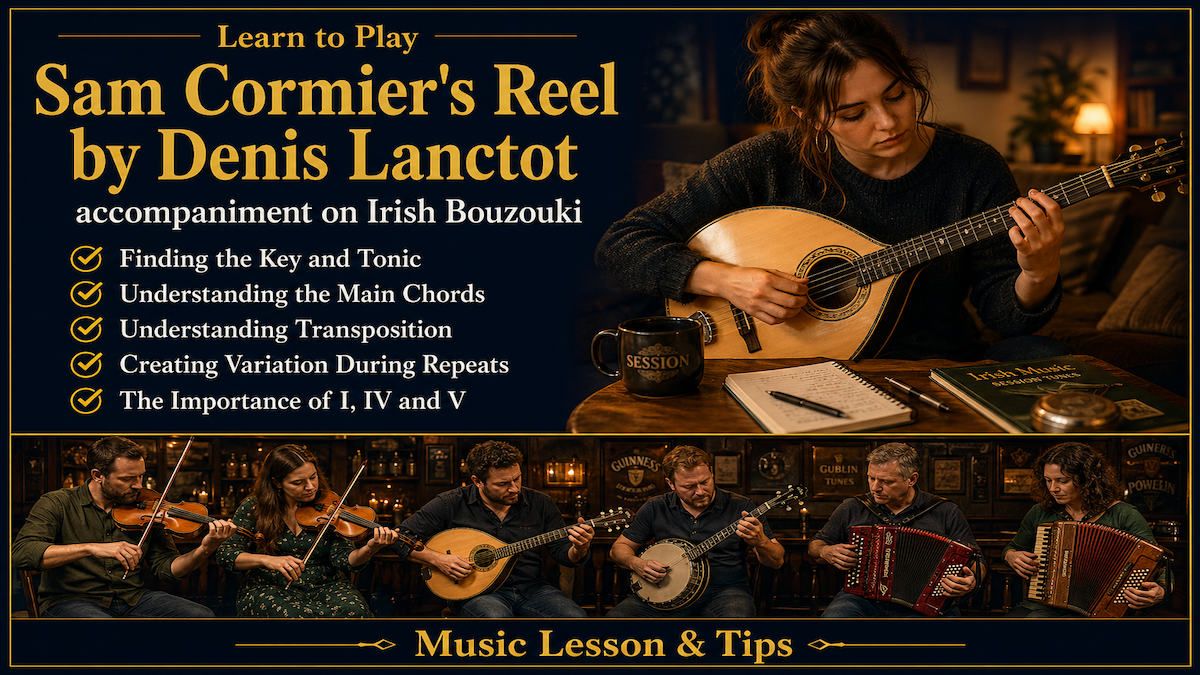
Learn how to accompany Sam Cormier’s Reel on Irish bouzouki using chords, rhythm, capo shapes and simple counter-melody.
Accompanying Sam Cormier’s Reel On Irish Bouzouki
This lesson explores how to accompany Sam Cormier’s Reel on Irish bouzouki by finding the key, identifying the strongest chords, listening carefully to the fiddle melody, and building a practical accompaniment using rhythm, chord shapes, counter-melody, variation, and repetition.
Sam Cormier’s Reel is a lively reel from Canada (composed by Denis Lanctot) with a bright, driving character and plenty of melodic movement. For bouzouki players, it offers a useful opportunity to practise one of the most important accompaniment skills: listening first, then gradually discovering what the tune needs.
Rather than beginning with a fixed chord chart, this approach starts with the melody itself. The aim is to hear where the tune feels settled, where it wants to move, and where a chord change genuinely supports the phrase. This is especially important in traditional music, where a simple accompaniment often works better than an over-complicated one.
In this lesson, the bouzouki is played with a capo on the second fret, allowing familiar D-position shapes to sound in E major. This makes the accompaniment easier to visualise while still matching the key of the fiddle recording.
- Use a capo on the second fret to play in E major with familiar D-position shapes.
- Listen carefully before choosing chords, especially in the A section and repeat.
- Build the accompaniment from simple chords first, then add counter-melody and variation.
Start By Listening To The Tune
The first stage is not playing. It is listening. Before adding bouzouki accompaniment, listen to the reel several times and focus on the shape of the fiddle melody. Notice where the tune lands, where it rises, where it repeats, and where the second time through differs from the first.
This is especially useful in Sam Cormier’s Reel because the A section contains small variations that affect the accompaniment. If the bouzouki part ignores these details, the chords may still be correct, but the overall arrangement can feel slightly disconnected from the tune.
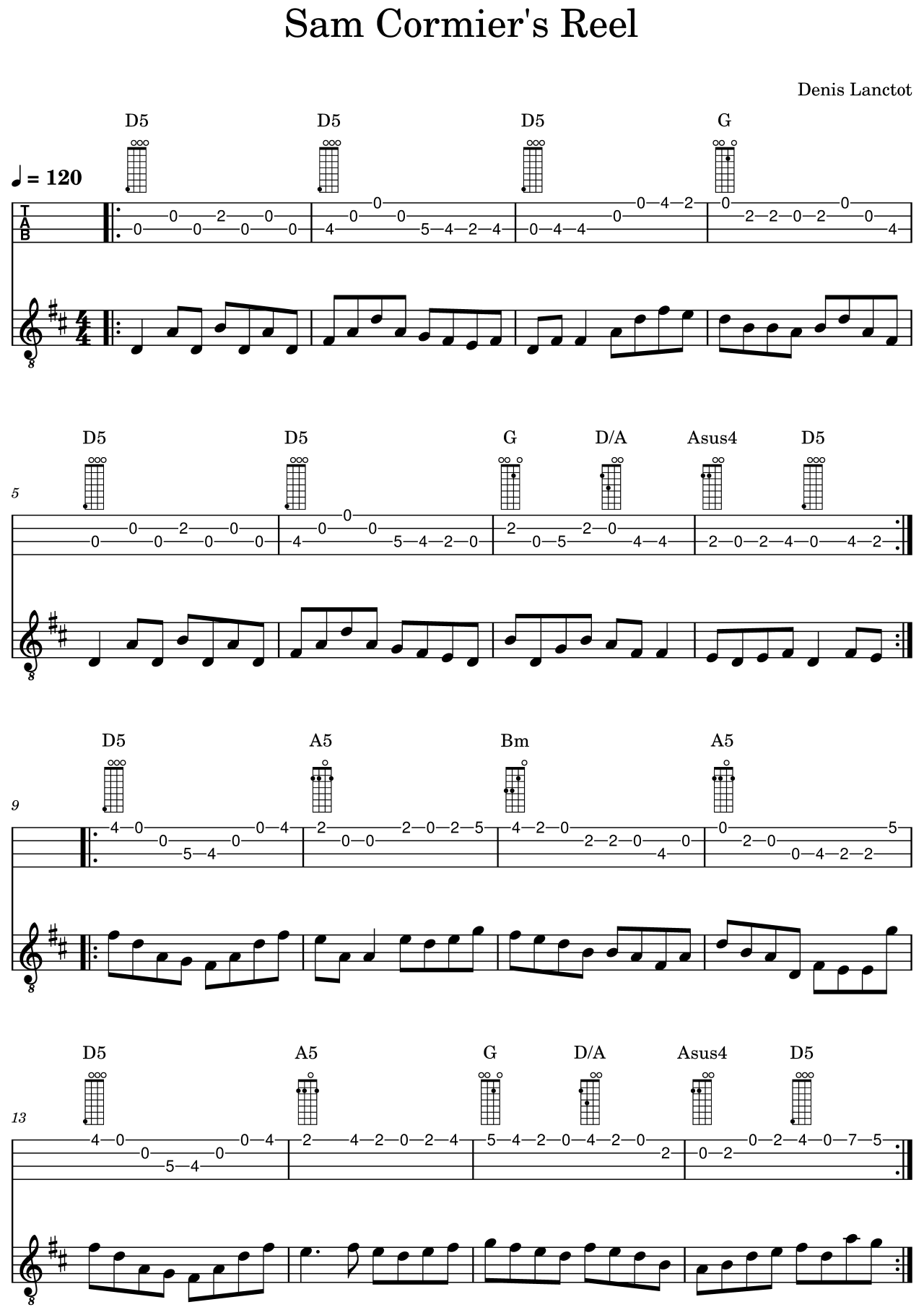
The following is a notation of the tune in a more standard tuning (D Ionian). Try adding the capo onto the 2nd fret of your Irish Bouzouki (assuming GDAD tuning), and see if you can still playing the chords notated below (the nut being the 2nd fret where your capo is located). This is good practice to become flexible in your mind about keys and focus more on chord patterns.
Pro Tip: Before trying to accompany a reel, sing or hum the first phrase. If you can feel the direction of the melody, your chord choices will usually become more natural.
Finding The Key And Tonic
With the capo on the second fret, D-position shapes sound one whole tone higher. This means that a D shape sounds as E, a G shape sounds as A, and an A shape sounds as B. In this lesson, the tonal centre is E major, so the main home chord is an E power chord played using a D-position shape.
The tonic is the note and chord that feels most settled. When accompanying, this is the chord you return to when the tune resolves. In this reel, the E sound gives the accompaniment its home base, while the A and B sounds provide movement away from and back toward that home.
Insight: A capo does not change the musical function of your shapes. It changes the sounding key. Think in both ways: the shape under your fingers and the chord the audience hears.
The Main Chords For The Reel
The most important chords in this arrangement are E5, A, and Bsus4. In functional harmony, these are chord I, chord IV, and chord V in E major. For bouzouki accompaniment, these three chords are often enough to create a strong, musical backing.
Chord Progression Box:
| Function | Sounding Chord | Capo Shape | Use In The Tune |
|---|---|---|---|
| I | E / E5 | D / D5 Shape | Home chord and main resolution point |
| IV | A | G Shape | Supports the lift in the A section |
| V | B5 / Bsus4 | A5 / Asus4 Shape | Adds tension before returning home |
Using E5 As The Home Chord
An E5 power chord is a strong choice because it avoids sounding too heavy or overly major. It gives the accompaniment a firm tonal centre while leaving space for the fiddle melody. This is particularly useful in traditional music, where drones, open strings, and modal colour can be more effective than thick block chords.
The A chord then acts as the main contrast. In the A section, it can be held slightly longer during the repeat to match the shape of the melody. This small adjustment makes the accompaniment feel responsive rather than mechanical.
Common Mistake: Do not force the B chord into every phrase just because it is chord V. If the melody does not need that tension yet, staying between E and A may sound cleaner.
Building The A Section Accompaniment
The A section is where most of the detailed work happens. At first, the accompaniment can stay simple: E5 moving to A and back to E5. This captures the main harmonic movement without distracting from the melody.
Once that is secure, you can begin adding a counter-melodic idea. Instead of only strumming chords, the bouzouki can echo part of the fiddle’s motion or create a small answering line underneath it. This works especially well when the phrase has a clear rhythmic shape.
The important point is timing. A counter-melody only works if it lands with the tune. In this lesson, one of the main discoveries is that a chord or note must arrive exactly on the beat. If the idea is too long, it needs to be shortened so the arrival point is clear.
Practice Box: Loop only the A section and practise two versions: one low and simple, then one higher with a small answering phrase. Keep both versions rhythmically clear before combining them.
Creating Variation Between Repeats
A reel normally repeats each section, so the accompaniment should not always sound identical. The first time through the A section can stay lower and more grounded. The repeat can move higher or use a slightly different direction, especially where the fiddle variation holds the A sound more clearly.
This also helps memory. If two versions are too similar, it becomes easy to confuse them at full speed. Creating a clear difference between the first time and second time makes the arrangement easier to remember and more musical for the listener.
Approaching The B Section
The B section moves higher in the melody, so the accompaniment can become more chordal. When the fiddle rises, too much counterpoint underneath can make the texture busy. A stronger homophonic accompaniment, where the bouzouki supports the tune with chords and rhythmic drive, may work better.
This does not mean the B section should be plain. You can still break up the chords by using hammer-ons, partial shapes, and rhythmic movement. However, the priority changes. Instead of trying to answer every melodic detail, the bouzouki gives the tune lift, pulse, and harmonic support.
Insight: When a tune rises into a higher register, accompaniment often works best when it becomes simpler, wider, and more supportive.
Adding Colour With C Sharp Minor (vi)
There is also the possibility of using C sharp minor as a colour chord. In E major, C sharp minor is chord vi. It can create a slightly more emotional or unexpected sound, especially in the second half of the tune.
One useful idea is to approach C sharp minor through its own dominant sound. This creates a short pull toward chord vi before returning to the main harmony. These substitute chords should be used carefully. They add interest, but they should not distract from the reel’s natural flow.
Using Rhythm And Hammer-Ons
The right hand is just as important as the chord choice. In a reel, the accompaniment must keep the pulse moving. Even when the left hand changes between chord shapes, the right hand should help maintain the drive.
Hammer-ons are especially useful because they add movement without requiring a full chord change. A simple hammer-on into a chord can make the accompaniment feel more connected to the fiddle line. It can also help the player keep momentum when moving from one phrase into the next.
Rhythm Pattern Box:
| Beat | Action | Purpose |
|---|---|---|
| 1 | Strong Downstroke | Establishes the groove |
| 2 | Lighter Strum Or Hammer-On | Adds lift and movement |
| 3 | Chord Reinforcement | Keeps the harmony clear |
| 4 | Prepare Next Shape | Connects smoothly into the next phrase |
Practice Routine For Learning The Accompaniment
Start by listening to the full reel several times without playing. Identify the A section, the A repeat, the B section, and the B repeat. Do not rush this stage, because the structure will guide every chord choice you make.
Next, play only the home chord and feel the pulse. With the capo on the second fret, practise the D-position shape that sounds as E. Then add the A chord and move between E5 and A until the change feels comfortable.
After that, introduce the B or Bsus4 chord only where it genuinely supports the phrase. Avoid adding it automatically. Listen for the moment where tension helps the tune return home.
Then isolate the A section. Create one low version for the first time through and one higher or more active version for the repeat. Practise both slowly until you can remember which one belongs where.
Finally, practise the B section with a more chordal approach. Keep the rhythm steady, use hammer-ons for lift, and make sure your accompaniment supports the melody rather than competing with it.
Key Takeaways
✅ The strongest accompaniment begins with listening, not guessing.
✅ With a capo on the second fret, familiar D-position shapes can be used to accompany the tune in E major.
✅ The main chords are E5, A, and Bsus4, but they should be placed according to the melody rather than forced into every phrase.
✅ The A section benefits from carefully planned variation between the first time and the repeat.
✅ The B section often works best with a more chordal, rhythmically supportive bouzouki part.
FAQ
What Key Is Sam Cormier’s Reel Played In Here?
In this lesson, the tune is treated as being in E major. The bouzouki uses a capo on the second fret, so D-position shapes sound one tone higher.
What Are The Main Bouzouki Chords For This Reel?
The main chords are E, A, and B, often played as E5, A, and Bsus4 or B5 shapes. These give the accompaniment a clear home, contrast, and return.
Should The A Section And Repeat Be Played The Same Way?
Not necessarily. A small variation between the first A section and the repeat can make the accompaniment more musical and easier to remember, especially if the fiddle melody changes slightly.
Why Use A Power Chord Instead Of A Full Major Chord?
A power chord gives a strong tonal centre without making the accompaniment too thick. This leaves more space for the fiddle melody and suits the open, driving sound of traditional music.
How Should I Practise This Tune Slowly?
Loop one section at a time, begin with only the basic chords, and add counter-melody or hammer-ons only after the rhythm is secure. Build the arrangement gradually rather than trying to play every idea at once.
Categories: : Irish Traditional Music
Did this article answer all your questions?
If you have any questions, or you want to learn more,
Click the Picture Below to Join the Community for FREE!