How to Accompany The Castle Jig on Irish Bouzouki (F# Dorian!)
 Declan Plummer
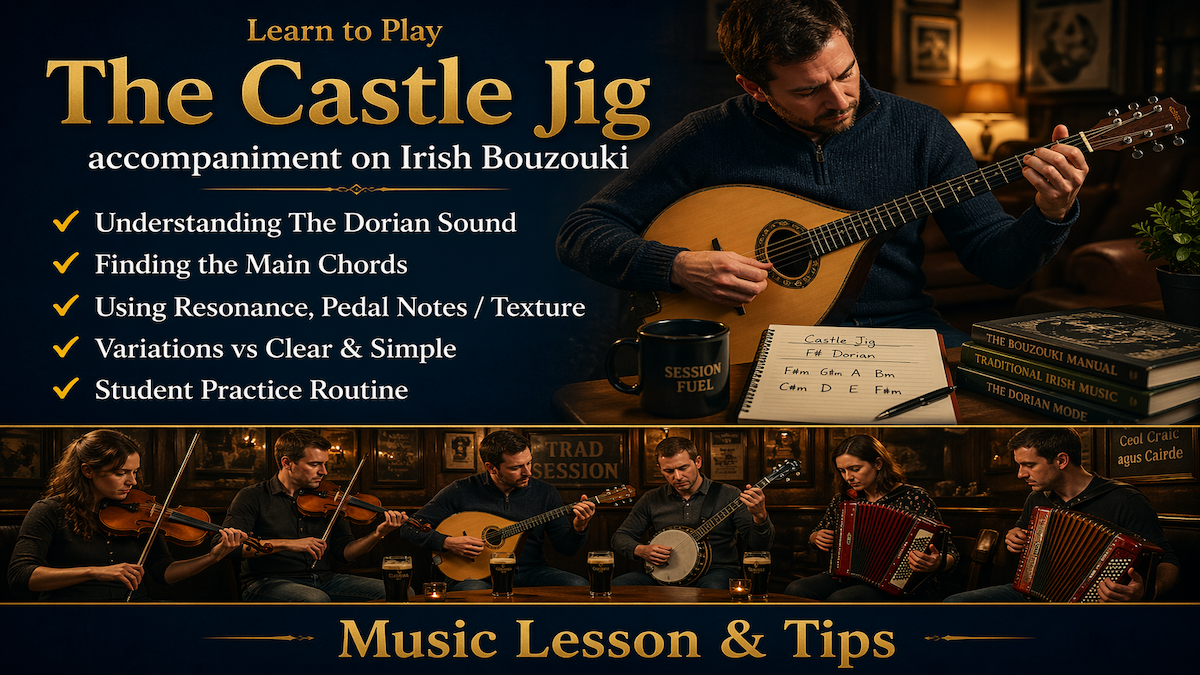
Learn how to accompany The Castle Jig on Irish bouzouki using F# Dorian chords, rhythm patterns, arpeggios, and practical ideas.
How To Accompany The Castle Jig On Irish Bouzouki
The Castle Jig can be accompanied effectively by recognising its F sharp Dorian sound, using a small group of reliable chords, and shaping those chords with simple rhythmic and melodic variations. The goal is not to overpower the tune, but to support the melody with resonance, movement, contrast, and tasteful musical choices.
Accompanying a fiddle tune on Irish bouzouki is about far more than strumming random chords underneath the melody. Good accompaniment supports the character of the tune, respects the lead instrument, and gives the music energy without taking attention away from it. In this lesson, we will look at how to build accompaniment for The Castle Jig, using practical ideas that can be applied not only to this tune, but to many traditional pieces in a similar modal style.

A central part of this lesson is hearing the tune as Dorian mode/scale (with its unique pattern of tones and semitones), rather than simply calling it minor. That difference matters. Once you understand the harmonies created by the Dorian Scale and the modal pull of the harmony, especially the movement between the 7th degree and the tonic, the chord choices begin to make much more sense. Most music students would learn the scales of D minor (harmonic) when thinking about chords, which normally include a raised leading note (C#). But it's absence here means that the 7th degree no longer functions as leading note to get back to D and instead is now called the subtonic This means that the harmony would now create a C major chord (based on C), not a C#diminished chord (based on C#). This has important consequence for all chord progressions and cadential points throughout the music! From there, you can start moving beyond basic backing patterns and experiment with arpeggios, rhythmic shapes, hammer-ons, and small melodic figures.
This is also a lesson in musical decision-making. There is not one single correct accompaniment for this tune. Several ideas work well, and the best choice often depends on the moment, the session, the player leading the tune, and the sound you want to create. That freedom is part of what makes accompaniment so rewarding.
- Identify the tune as F sharp Dorian so your chord choices reflect the modal sound.
- Use a core group of chords and aim to support phrase beginnings and endings clearly.
- Develop contrast by mixing simple strumming, arpeggios, hammer-ons, and light melodic ideas.
Understanding The Dorian Sound
One of the most important teaching points in this lesson is that the tune sits in F sharp Dorian. Many players casually describe traditional tunes as being in a minor key, but in practice a huge number of them use the Dorian mode instead of the natural minor scale. Hearing that difference helps you choose chords that sound convincing and idiomatic.

The Dorian sound keeps the minor third, so it still feels dark or serious, but it also contains a brighter raised sixth. In accompaniment, one of the strongest clues is the pull between the tonic chord and the chord built on the subtonic (flattened 7th). In this tune, that means hearing F sharp minor against E major or an E-based power sound. That back-and-forth motion gives the tune its modal colour and helps define the atmosphere of the accompaniment.
Pro Tip: Before trying to invent accompaniment patterns, sing or play the tonic note against the tune and listen for the chord that naturally wants to move back up to it. In Dorian tunes, that relationship often reveals the harmonic language very quickly.
When you can hear that upward return to the tonic, you stop guessing. Instead of reaching for random minor-key shapes, you begin working with the real harmonic grammar of the tune. That is what makes accompaniment feel secure, even when you later start adding variations.
The Main Chords For The Tune
For this arrangement, the accompaniment is built from a small, practical set of chords. The most important is F#5 or F#min as the tonal centre. From there, the accompaniment regularly uses Esus2, D major, B minor, and C#5 or C #sus4. These are enough to build a strong, coherent backing without cluttering the tune.
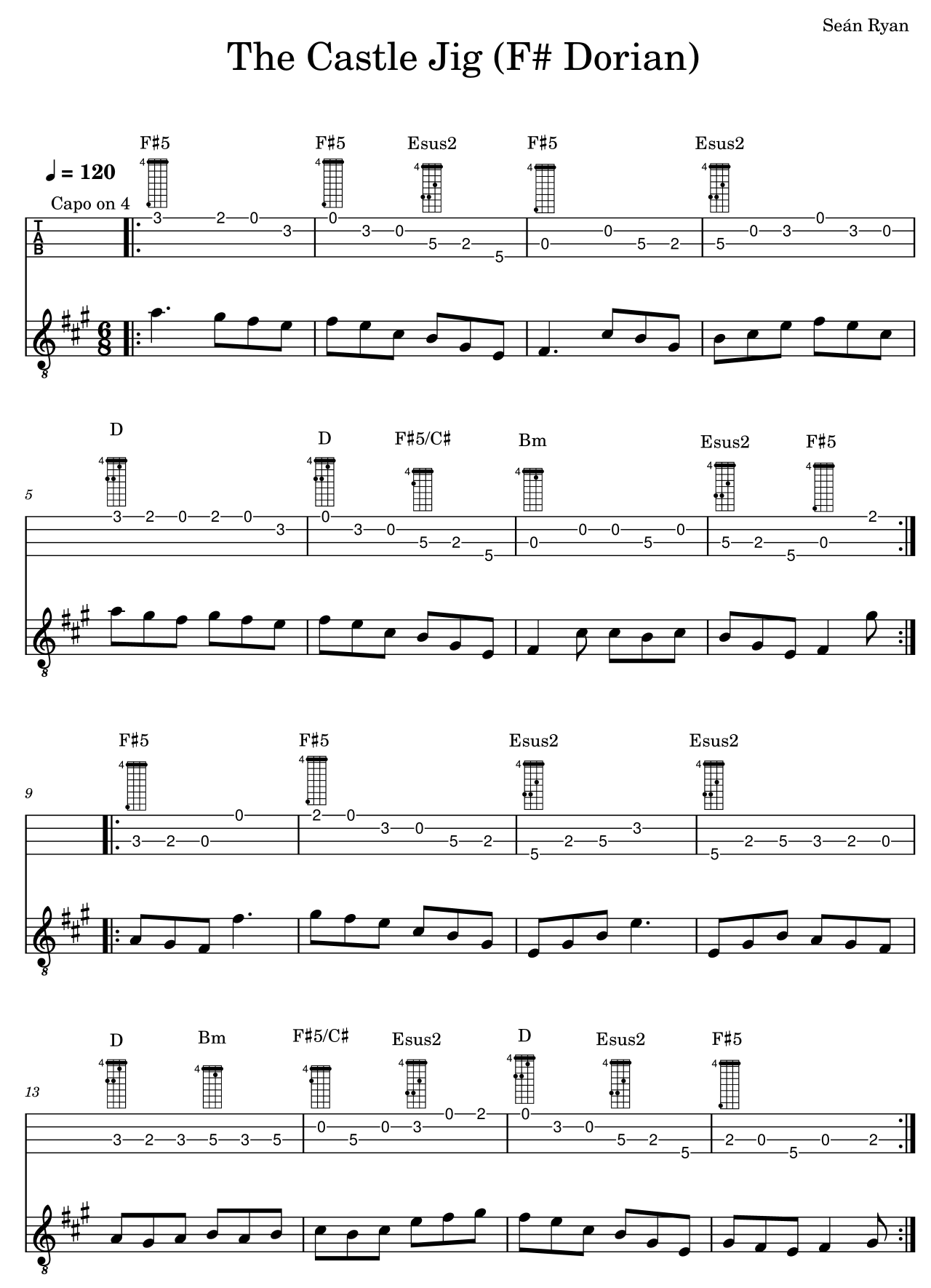
A very useful way to think about these chords is functionally. In simple scale-degree terms, the lesson works with movement around 1, 7, 6, 5, and 4 type relationships. That descending, stepwise feel is common in traditional music and gives the accompaniment a strong sense of direction. The player is not just changing shapes; he is guiding the tune through a familiar modal pathway.
Insight: A small number of well-chosen chords often produces a better accompaniment than a large number of clever ones. Traditional music usually responds best to clarity, pulse, and shape rather than harmonic overcomplication.
| Chord | Function In The Tune | Effect |
|---|---|---|
| F#5 or F#m | Tonic home chord | Gives stability and resolution |
| E5 or E major or Esus 2 colour | Flattened seventh area | Creates the recognisable Dorian pull |
| D major | Descending support chord | Adds momentum and colour |
| B minor | Passing or contrasting chord | Softens the motion and widens the palette |
| F#5/C# or C#5 or C#sus4 | Dominant-style lead back | Pushes the harmony toward the tonic |
How To Build A Strong Basic Accompaniment
The lesson begins by keeping things simple. Rather than rushing into elaborate patterns, the accompaniment first follows the tune with the most essential chord movement. This is exactly the right starting point for students. If the harmony, pulse, and phrase structure are not solid, decorative ideas will only make the playing weaker.
A useful rule here is to aim for strong support at the beginning and end of each phrase. Those are the moments where the melody most clearly needs grounding. Even if you do nothing else, placing the right chord confidently at those points will make the accompaniment sound musical and intentional.
Practice Box: Loop only the A section of the tune and play just two chords at first. Focus on clean timing, even tone, and hearing where the melody settles. Once that feels secure, add the extra passing chords one at a time.
This approach also helps you avoid one of the biggest problems in accompaniment: playing too much too early. Strong accompaniment often sounds effortless because it is built on a very clear foundation. Once the tune is anchored properly, you can then choose where extra interest should go.
Common Mistake: Do not try to fill every gap in the melody with extra notes. If the accompaniment becomes too busy, it distracts from the tune and weakens the rhythmic lift that a jig needs.
Using Resonance, Pedal Notes, And Texture
A particularly interesting point in the lesson is the treatment of ringing notes. On bouzouki, certain open or sustained notes can continue to sound across several chords. Rather than always treating every sounding pitch as part of the harmony, it is often better to hear some of them as pedal notes or resonant colour. That creates a more natural traditional texture.
This matters because accompaniment on fretted instruments is not the same as writing strict four-part harmony on paper. In real playing, some notes ring longer than others, some are decorative, and some belong more to the instrument’s resonance than to the chord itself. Thinking musically instead of mechanically allows the accompaniment to breathe.
Insight: Not every note you hear needs a chord label. Sometimes the best sound comes from allowing a tonic note to ring over changing harmony, especially in modal accompaniment where resonance is part of the character.
Texture is equally important. The lesson shows a contrast between fuller chordal support and more broken, arpeggiated movement. That contrast keeps the accompaniment alive. If every section is strummed in exactly the same way, the tune can become flat. Varying texture between sections gives the music shape.
Creating Variations In The A Section
Once the harmonic framework is established, the lesson begins exploring alternative ways to accompany the repeated A section. This is where accompaniment becomes more creative. Instead of repeating one pattern, the player experiments with several ideas: simple strumming, arpeggiated movement, hammer-ons, slides, and melodic figures that grow out of the chord shapes.
That is an excellent model for students. Rather than trying to invent a complete accompaniment from scratch, start with one dependable idea and then create two or three variations. These variations do not need to be dramatic. Sometimes a small rhythmic change, a different register, or a slight melodic rise is enough to make the repeat feel fresh.
Practice Box: Write down or record four short A-section ideas. Keep the first very simple, make the second more rhythmic, make the third more arpeggiated, and let the fourth include one melodic feature such as a hammer-on or slide.
The important point is that these ideas are interchangeable. You do not need to treat one fixed version as the only correct accompaniment. Traditional accompaniment often develops through trial, repetition, and combination. A player might use the first half of one idea with the ending of another. That kind of experimentation is not a mistake. It is part of the craft.
Keeping The B Section Clear And Effective
Interestingly, the B section is treated more simply. After all the experimentation in the A section, the accompaniment settles into clearer chordal support. This is a useful reminder that contrast is musical. Not every part of the tune needs the same level of detail. Sometimes the best way to shape the full performance is to let one section carry more variation and allow another to remain more grounded.
The B section also highlights the value of directional chord movement. Descending progressions followed by a return upward help the listener feel the structure of the tune. Even without flashy ornamentation, that directional movement gives the accompaniment momentum and purpose.
| Section | Best Accompaniment Approach | Why It Works |
|---|---|---|
| A Section | More variation and melodic ideas | Keeps the repeat engaging |
| B Section | Cleaner chordal support | Provides contrast and reinforces structure |
Technique Considerations When Playing Amplified
The lesson also points out something many players only discover after plugging in: small noises become much more noticeable through amplification. Sympathetic resonance, string noise, accidental ringing, and rough pull-offs can all become exaggerated. This does not mean the playing is poor, but it does mean technique has to be more deliberate.
Muting becomes especially important. Bringing the thumb in to dampen strings, controlling how aggressively notes are attacked, and deciding when to let strings ring are all part of mature accompaniment technique. In an acoustic session, some of these details may pass unnoticed. Through a pickup and speaker, they can become part of the foreground.
Common Mistake: Players often assume the issue is only tuning or chord choice, when the real problem is uncontrolled resonance. If the accompaniment sounds messy when amplified, check muting and string damping before changing the harmony.
Practice Routine
Start by listening to the tune several times without playing. Sing the tonic note quietly to yourself and listen for the Dorian colour, especially the movement between the home chord and the flattened seventh sound.
Next, play only the core chords in time with the melody. Do not add ornamentation yet. Concentrate on entering cleanly at the beginning and end of each phrase so the structure of the tune becomes obvious.
Then isolate the A section and create two accompaniment versions: one simple strummed version and one arpeggiated version. Repeat each enough times that the movement feels natural rather than memorised mechanically.
After that, add one melodic device such as a hammer-on, slide, or short scalic link. Keep it small. The point is to add expression without disturbing the pulse or covering the melody.
Finally, play the whole tune through and allow yourself some freedom. Combine ideas, simplify when needed, and listen carefully to which sounds genuinely support the tune. Record yourself if possible so you can hear whether the accompaniment is balanced, clear, and musical.
Key Takeaways
✅ The Castle Jig works well with an accompaniment approach built around its F sharp Dorian sound rather than a vague idea of minor harmony.
✅ A small group of core chords can produce a strong and authentic backing when they are placed clearly and rhythmically.
✅ Repeated sections become more musical when you vary texture through strumming, arpeggios, hammer-ons, and light melodic movement.
✅ Good accompaniment supports the melody rather than competing with it, so balance and restraint matter as much as creativity.
✅ The best results come from experimenting, combining ideas, and allowing your own musical taste to shape the final accompaniment.
FAQ
Do I Need Lots Of Chords To Accompany A Jig Well?
No. In most cases, a few well-chosen chords played with confidence will sound better than a large number of complicated harmonic changes. The key is hearing the mode correctly and supporting the phrases clearly.
How Do I Know If A Tune Is Dorian?
Listen for a minor feel that still has a brighter lift than natural minor. Often the strongest clue is the relationship between the tonic and the subtonic seventh chord, which gives many traditional tunes their characteristic modal flavour.
Should I Repeat The Same Accompaniment Every Time?
Not necessarily. Repeating a simple idea can be effective, but many tunes benefit from small changes on repeated sections. Even a slight change in rhythm, texture, or register can make the accompaniment feel more alive.
Why Does My Accompaniment Sound Messy When Amplified?
Amplification makes sympathetic resonance, string noise, and uneven attacks much easier to hear. Work on damping unwanted ringing, controlling sustain, and using a cleaner touch before assuming the harmony itself is wrong.
Can I Use These Ideas On Other Traditional Tunes?
Yes. That is one of the most valuable parts of this lesson. The chord relationships, rhythmic shaping, modal listening, and variation methods can all be transferred to many other jigs and traditional tunes with a similar harmonic feel.
Categories: : Irish Traditional Music
Did this article answer all your questions?
If you have any questions, or you want to learn more,
Click the Picture Below to Join the Community for FREE!