Augmented Sixth Chords Explained: Italian, French and German Chords in Music
 Declan Plummer

Learn how augmented sixth chords work, how to build them, and how Italian, French, and German chords resolve in music.
Understanding Augmented Sixth Chords
Augmented sixth chords are chromatic pre-dominant chords that create strong tension by expanding outward into the dominant chord. In practice, they are built from the lowered sixth degree of the key and are most often used to lead smoothly into chord V, especially in minor keys.
If you already understand basic diatonic harmony, augmented sixth chords are one of the next major steps into chromatic harmony. They may look intimidating at first because they are often presented as three separate chords, but in reality they are best understood as one basic harmonic idea with three common versions: Italian, French, and German.
The key to learning them is to stop thinking of them as mysterious labels and instead focus on their interval structure, their tendency to resolve outward, and their role before the dominant. Once you hear how the flattened note falls and the sharpened note rises, the sound and function become much easier to recognise.
This lesson also clears up several common confusions, including why these chords are named Italian, French, and German, why they are more common in minor keys, and why the German version often needs more careful handling in classical-style harmony exercises.
- Augmented sixth chords are chromatic chords that usually prepare chord V.
- They are built around the interval of an augmented sixth, usually between the lowered sixth and raised fourth scale degrees.
- The Italian, French, and German forms are closely related and differ mainly in their inner notes.
What An Augmented Sixth Chord Actually Is
An augmented sixth chord is a chord that contains the interval of an augmented sixth, usually above the bass note. In the key of C major, the typical outer notes are A flat and F sharp. Those two notes form the essential interval, and their behaviour explains the chord’s purpose.
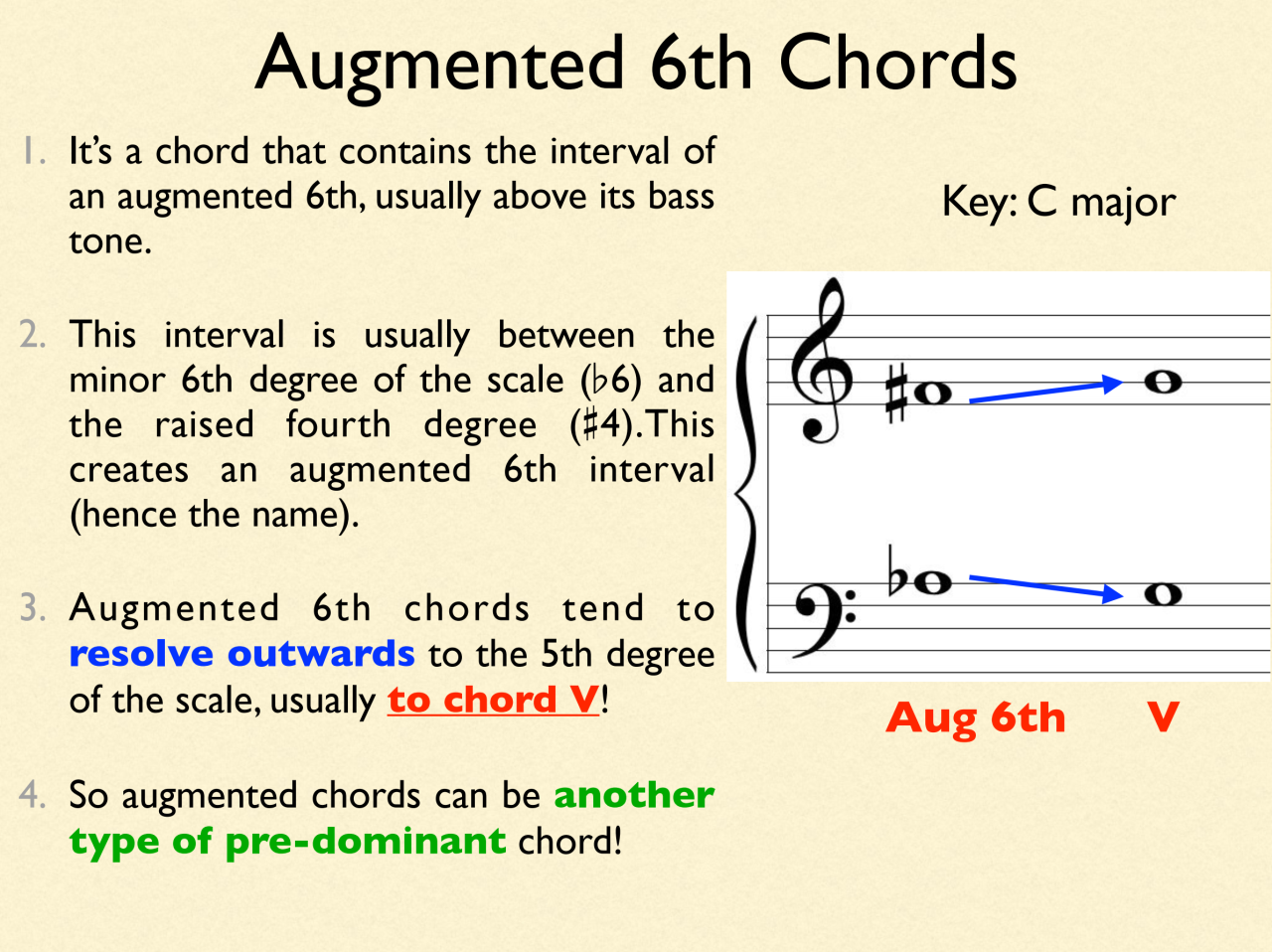
The lowered note, A flat, tends to fall downward to G. The sharpened note, F sharp, tends to rise upward to G. Because both notes move outward in contrary motion toward the same target pitch, the chord creates a very strong pull into a harmony containing G. In C major, that makes chord V, a G major harmony, the most natural destination.
This is why augmented sixth chords are usually described as pre-dominant chords. Their job is not to sound stable on their own. Their job is to intensify the approach to the dominant and make the arrival of chord V feel smooth, dramatic, and inevitable.
PRO TIP
When identifying an augmented sixth chord, focus first on the outer notes rather than the full spelling. If the outer voices expand outward by semitone to the dominant, you are very likely dealing with an augmented sixth function.
How To Build The Basic Form
The most practical method is to begin with the key and locate the lowered sixth degree. In C major, the sixth degree is A, so the lowered sixth is A flat. That becomes the bass note of the chord. From there, you build upward according to the version of the chord you want.
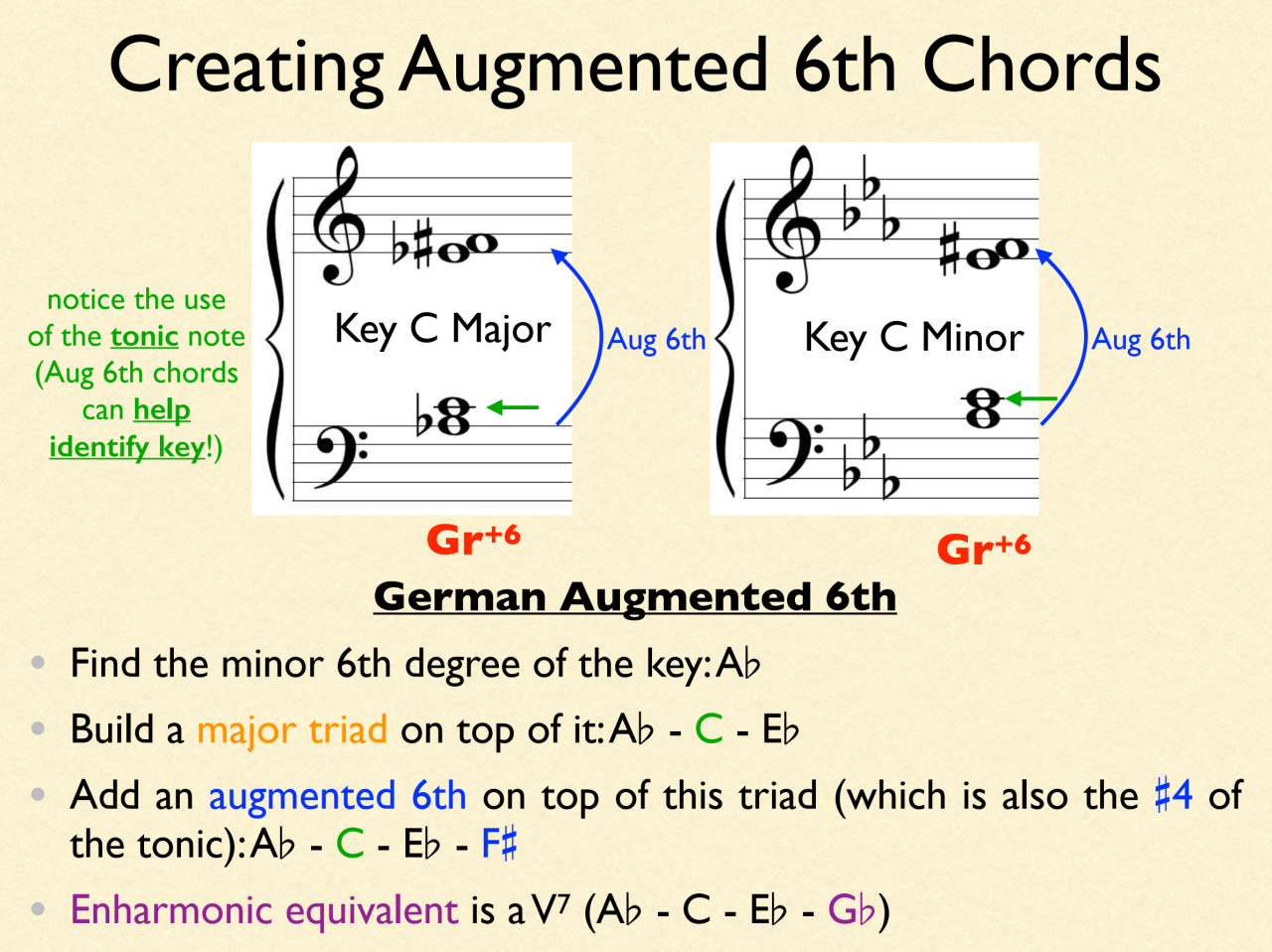
For the German form, build a major triad on the lowered sixth degree. In C major, that gives you A flat, C, and E flat. Then add the augmented sixth above the bass, which is F sharp. The result is A flat, C, E flat, and F sharp.
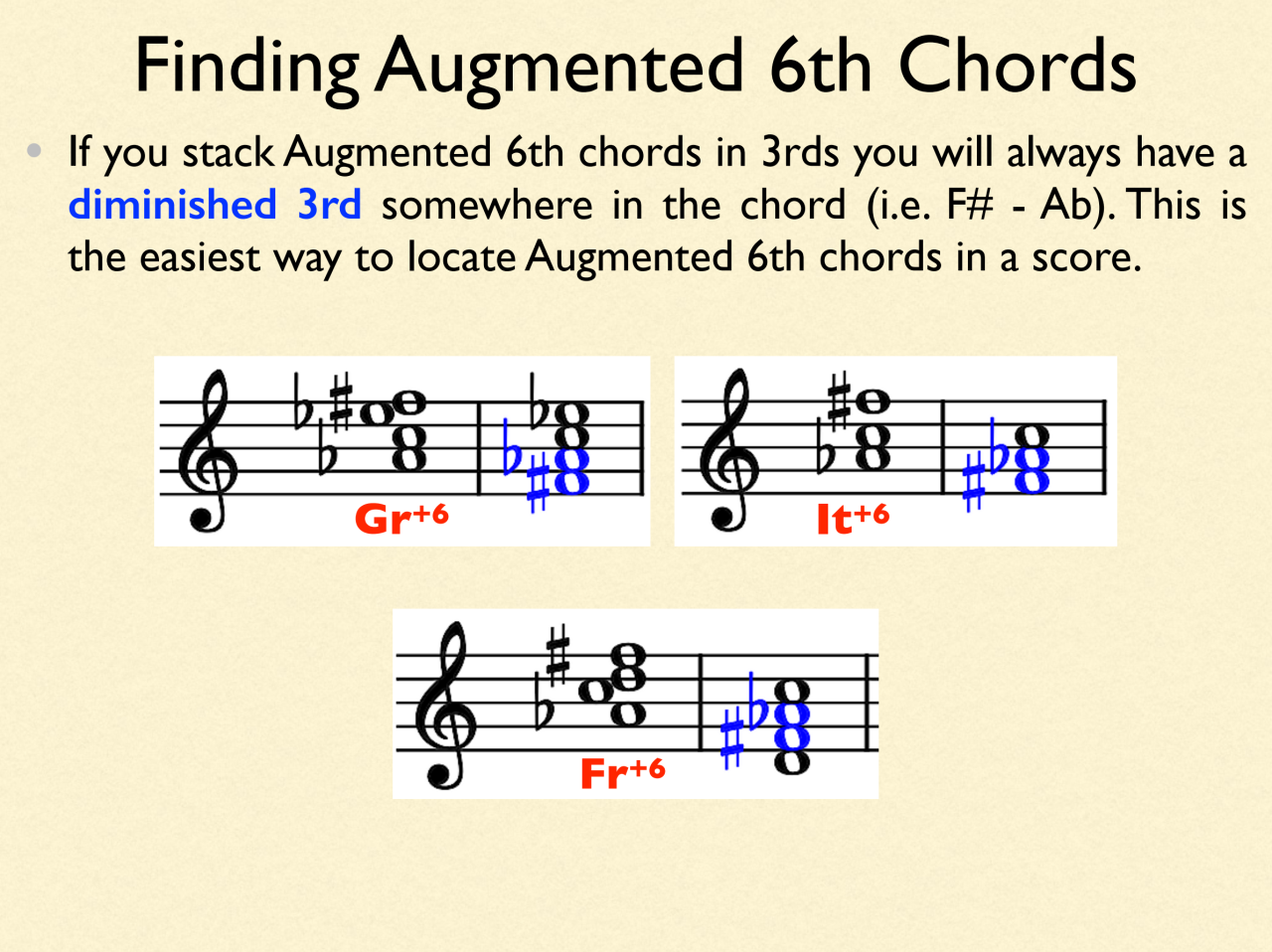
This spelling matters. F sharp is not just a random enharmonic choice. If you respell it as G flat, the function changes. Instead of behaving like an augmented sixth expanding outward, it begins to resemble a dominant seventh chord in another key. In harmony, spelling is not only visual. It reflects function and resolution.
INSIGHT
A useful way to hear this chord is to think of it as a tension chord that “opens out” into the dominant. The flattened note falls, the sharpened note rises, and the whole sonority leans toward chord V with remarkable smoothness.
| Step | In C Major | Purpose |
|---|---|---|
| Find the lowered sixth | A flat | Creates the bass of the chord |
| Add the tonic note | C | Helps define the key |
| Add the fifth or substitute note | E flat or D depending on type | Creates the specific version |
| Add the raised fourth | F sharp | Forms the augmented sixth and drives to G |
The Three Types: Italian, French, And German
The Italian, French, and German augmented sixth chords are not three completely different harmonic ideas. They are three common spellings built around the same essential interval and the same basic destination. All three normally lead to the dominant, and all three centre around the lowered sixth and raised fourth degrees.
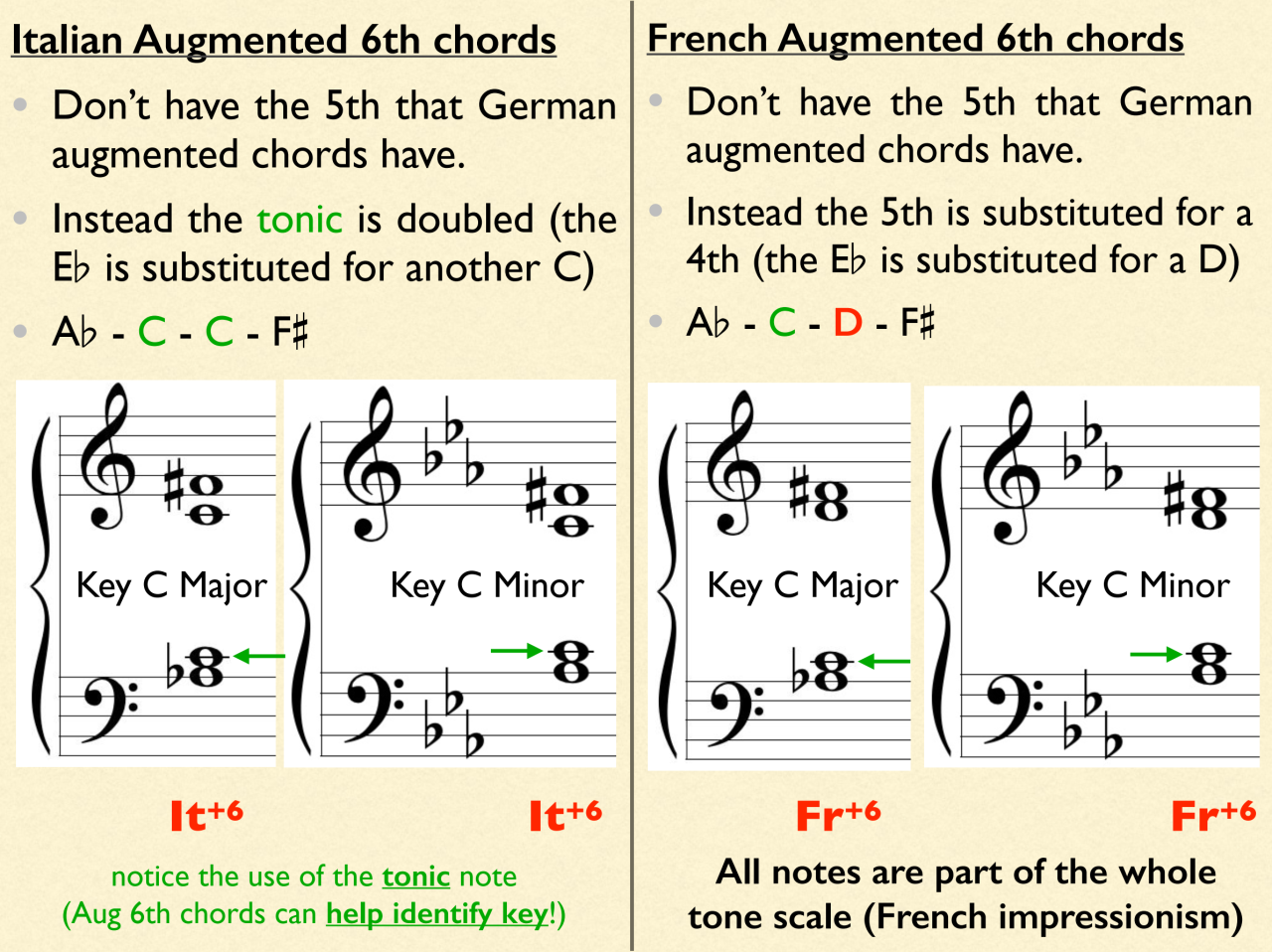
The Italian augmented sixth is the simplest. In C major, it contains A flat, C, C, and F sharp in four-part writing. The fifth of the chord is omitted, and the tonic is doubled instead. This gives the chord a more open sound and makes voice-leading easier.
The French augmented sixth replaces the fifth with the second degree of the key. In C major, that gives A flat, C, D, and F sharp. This creates a brighter, slightly more angular sonority because of the close spacing in the middle of the chord.
The German augmented sixth is the fullest version. In C major, it contains A flat, C, E flat, and F sharp. Because it includes a complete triad on the lowered sixth degree plus the augmented sixth above the bass, it sounds rich and complete, but it also creates a voice-leading complication when moving directly to V.
PRACTICE BOX
Write all three augmented sixth chords in C major and C minor. Then sing or play the outer notes resolving into chord V. This will train both your ear and your eye at the same time.
| Type | Notes In C Major | Main Feature |
|---|---|---|
| Italian | A flat, C, C, F sharp | No fifth; tonic doubled |
| French | A flat, C, D, F sharp | Includes scale degree 2 |
| German | A flat, C, E flat, F sharp | Fullest spelling; richest sound |
Why These Chords Usually Resolve To V
Augmented sixth chords nearly always behave as pre-dominant harmony. That means their normal role is to lead into chord V before a cadence. This happens because the outer notes are designed to resolve by semitone into the dominant scale degree.
In C major, A flat falls to G and F sharp rises to G. Once both of those voices arrive, the dominant chord becomes the most convincing next step. This is one reason these chords are so effective. They do not simply decorate the harmony. They intensify it and focus the listener’s ear toward a clear goal.
The German version requires special care in classical harmony. If it moves straight to V, it can create parallel fifths. To avoid that, it often resolves first to chord I in second inversion and then moves on to V. This preserves smoother voice leading and follows stricter common-practice rules.
COMMON MISTAKE BOX
A frequent mistake is to treat the German augmented sixth exactly like the Italian or French version in four-part writing. In strict harmony exercises, moving straight to V often creates parallels, so students should normally use I6/4 as an intermediate step.
Why They Are More Common In Minor Keys
Augmented sixth chords are often easier to spot and easier to build in minor keys because several of the required notes are already present in the key signature. In C minor, for example, A flat and E flat are already part of the scale, so only the raised fourth degree, F sharp, needs to be introduced chromatically.
That makes the sonority feel less remote than it does in a major key, where more notes usually need to be altered. This is one reason augmented sixth chords appear so naturally in minor-key repertoire. The harmonic colour is dramatic, but the notation and voice-leading are often more straightforward.
For students, this means minor keys are often the best place to begin practising them. Once the shape and resolution are secure in minor, it becomes easier to transfer the concept into major keys and more advanced chromatic progressions.
Why The Names Are Misleading
Despite their familiar labels, these chords are not inherently French, German, or Italian in origin. The names are historical labels that became standard in English-language theory, rather than accurate descriptions of national style or invention.
That means students should avoid attaching too much meaning to the names themselves. They are best treated as convenient memory tools for three different spellings. The real musical substance lies in the interval of the augmented sixth, the chromatic voice-leading, and the chord’s pre-dominant function.
This is actually helpful once you realise it, because it stops the topic from becoming more complicated than it needs to be. Rather than chasing historical myths, you can concentrate on what matters in analysis and composition: construction, resolution, and context.
QUOTE BOX
The labels may be traditional, but the real lesson is practical: hear the outward pull, identify the lowered sixth and raised fourth, and observe how the chord prepares the dominant.
How To Practise Augmented Sixth Chords
Start by choosing one key at a time and writing the augmented sixth interval alone. Identify the lowered sixth degree and the raised fourth degree. Then play those outer notes on the piano and resolve them to the dominant note by contrary motion. This helps you hear the chord’s gravitational pull before you even add the inner notes.
Next, write the Italian, French, and German versions in that same key. Compare the inner notes and listen for the subtle change in colour between them. The outer notes do the essential work, but the inner voices shape the texture and determine which version you are hearing.
After that, practise resolving each chord correctly. Let the Italian and French move directly to V. For the German version, practise both the textbook resolution through I6/4 and the direct move to V so that you can hear why the stricter solution is normally preferred in classical-style exercises.
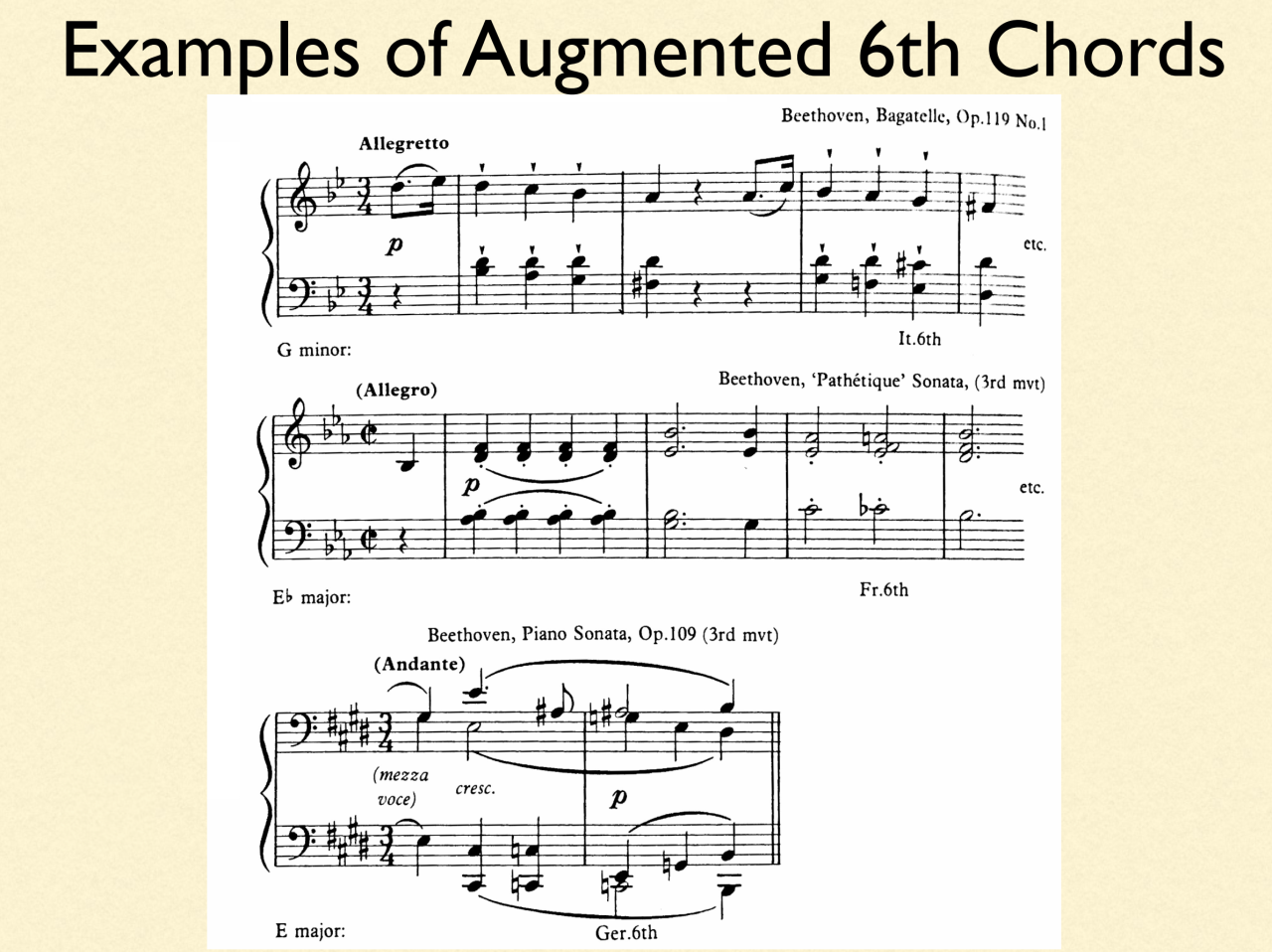
Finally, find examples in real music. Classical repertoire is full of them, but they also appear in more modern styles whenever a composer wants a strong chromatic preparation for the dominant. Once you recognise the sound, you will start hearing it much more often.
Practice Routine
Begin by selecting one simple key such as C major or C minor. Write the scale, identify the sixth degree, and lower it if needed. Then locate the raised fourth degree. Play just those two notes and listen carefully to how they want to resolve outward into the dominant.
Next, build the Italian augmented sixth. Play it slowly, then resolve it to chord V. Repeat this several times until the sound feels familiar. After that, do the same with the French version and compare the brighter, slightly tighter sonority created by the extra inner note.
Then build the German augmented sixth. Practise resolving it first into I6/4 and then to V. Pay attention to the voice-leading rather than just the chord labels. Your goal is not only to name the chord but to hear how each note behaves.
Once you are confident in one key, move through several minor keys, since these chords often feel more natural there. Finish by writing a short four-bar progression that includes one augmented sixth chord leading to a cadence. This turns theory into real musical practice.
Key Takeaways
✅ Augmented sixth chords are chromatic pre-dominant chords that usually lead to chord V through outward semitone motion.
✅ The essential interval is formed by the lowered sixth and raised fourth degrees of the key.
✅ Italian, French, and German augmented sixth chords are closely related versions of the same harmonic idea.
✅ The German version often needs extra care in classical writing because a direct move to V can create parallel fifths.
✅ These chords are especially common and easier to build in minor keys, where fewer chromatic alterations are required.
FAQ
What Is The Easiest Way To Identify An Augmented Sixth Chord?
The quickest method is to look for the outer notes. If you see a lowered sixth degree in the bass and a raised fourth degree above it, and both resolve outward by semitone to the dominant, you are almost certainly looking at an augmented sixth chord.
Why Is The German Augmented Sixth Harder To Use?
The German version contains a fuller sonority, but in four-part classical harmony it can create parallel fifths if it moves directly to chord V. For that reason, it is often resolved through chord I in second inversion before moving to the dominant.
Are Augmented Sixth Chords Only Found In Classical Music?
No. They are most commonly studied through classical harmony, but the underlying sound and function can appear in later tonal music as well. Any style that uses strong chromatic voice-leading into the dominant can make use of the same harmonic principle.
Why Are They More Common In Minor Keys?
They are often more common in minor because the lowered sixth and other required notes already fit the minor key more naturally. This means fewer accidentals are needed, which makes the chords easier to notate, hear, and integrate into a progression.
Do The Names Italian, French, And German Describe Their Origin?
Not in any reliable musical sense. These names are traditional labels used to distinguish the three common spellings. They are useful for learning, but they should not be treated as literal descriptions of where the chords came from or who used them most.
To take your learning to the next level,
check out some of these amazing Courses & Apps



Categories: : Music Theory
Did this article answer all your questions?
If you have any questions, or you want to learn more,
Click the Picture Below to Join the Community for FREE!