Diminished Seventh Chords Explained: Music Theory Guide
 Declan Plummer

Learn how diminished seventh chords work, how to build them, and how they create tension in music theory.
Why Diminished Seventh Chords Matter In Music
Diminished seventh chords are powerful harmonic tools used to create tension, drama, and movement in music. Built from stacked minor thirds, they are highly versatile, appearing in both major and minor keys, and are essential for modulation, expressive harmony, and advanced music theory understanding.
When students first encounter chromatic harmony, diminished seventh chords often stand out as one of the most distinctive and expressive sounds. They are not simply theoretical constructs, but practical tools used across classical, jazz, film, and popular music to shape emotional direction.
Understanding how these chords are built, where they appear, and how they resolve will significantly deepen your ability to analyse, compose, and perform music with confidence. They represent a key step forward from basic triads into more advanced harmonic thinking.
- Diminished seventh chords are built entirely from minor thirds
- They create strong tension and usually resolve quickly
- They are essential for modulation and expressive harmony
What Is A Diminished Seventh Chord?
A diminished seventh chord can be understood most simply as a chord built by stacking minor thirds on top of each other. This symmetrical structure gives the chord its distinctive sound and unique flexibility.
For example, starting on B, you can build a diminished seventh chord by adding a minor third above each note: B to D, D to F, and F to A♭. This creates a four-note chord where every interval between adjacent notes is the same.
This symmetry is what makes diminished seventh chords so versatile. Because the intervals repeat evenly, the chord can be inverted multiple times and still retain the same overall sound quality, allowing it to function in many harmonic contexts.
Pro Tip: If you are unsure how to build a diminished seventh chord quickly, simply pick any note and stack minor thirds upward four times. This method always works.
Two Ways To Understand The Structure
There are two important ways to think about diminished seventh chords. The first is the practical method of stacking minor thirds, which is ideal for quick construction and performance.
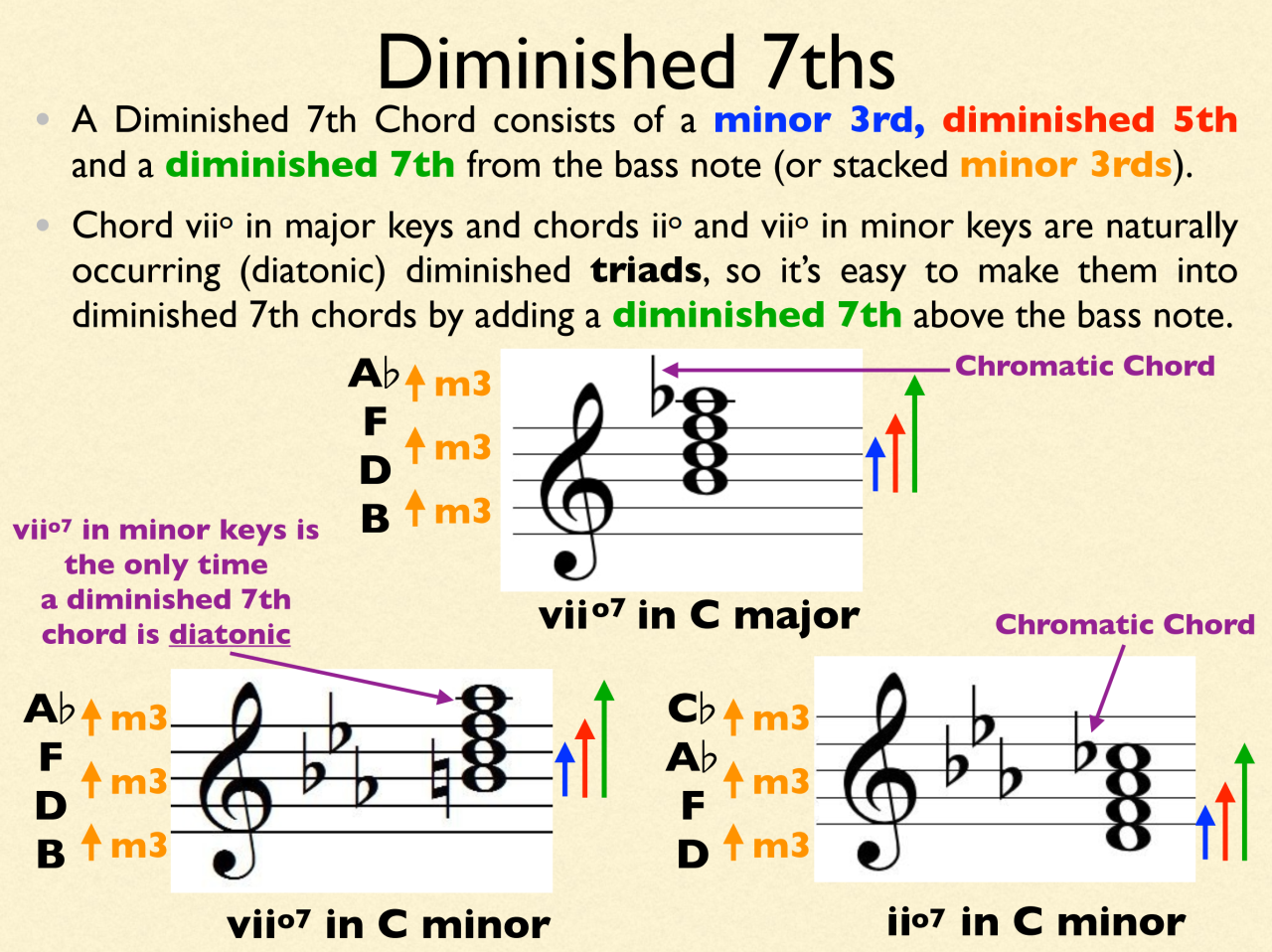
The second method is more analytical. From the root note, the chord contains a minor third, a diminished fifth, and a diminished seventh. These intervals define the chord’s identity and distinguish it from other seventh chords.
Insight: The presence of both a diminished fifth and a diminished seventh interval is what gives this chord its intense instability and strong pull toward resolution.
Why Diminished Seventh Chords Are Chromatic
Diminished seventh chords are usually considered chromatic because they introduce notes that do not belong to the original key. In a major key, this typically means adding an accidental to complete the chord structure.
For instance, in C major, the leading note chord naturally forms a diminished triad. To turn it into a diminished seventh chord, an A♭ must be added, which lies outside the key. This creates a chromatic colour that enhances harmonic tension.
Practice Tip: When analysing music, always check whether the top note of a diminished seventh chord belongs to the key. If not, you are dealing with a chromatic chord.
Where Diminished Seventh Chords Appear
In major keys, diminished seventh chords most commonly appear on the leading note (chord VII). This chord already forms a diminished triad, making it the most logical place to extend into a seventh chord.
In minor keys, they often appear on chord II and chord VII. These chords are already diminished in their basic triad form, meaning only one additional note is required to create a fully diminished seventh chord.
Common Mistake: Writing incorrect accidentals is a frequent error. Always ensure notes are spelled correctly (e.g. C♭ instead of B) to reflect the correct harmonic function.
Fully Diminished Vs Half Diminished Chords
A fully diminished seventh chord contains only minor third intervals and includes a diminished seventh from the root. In contrast, a half diminished chord replaces the top interval with a minor seventh instead.
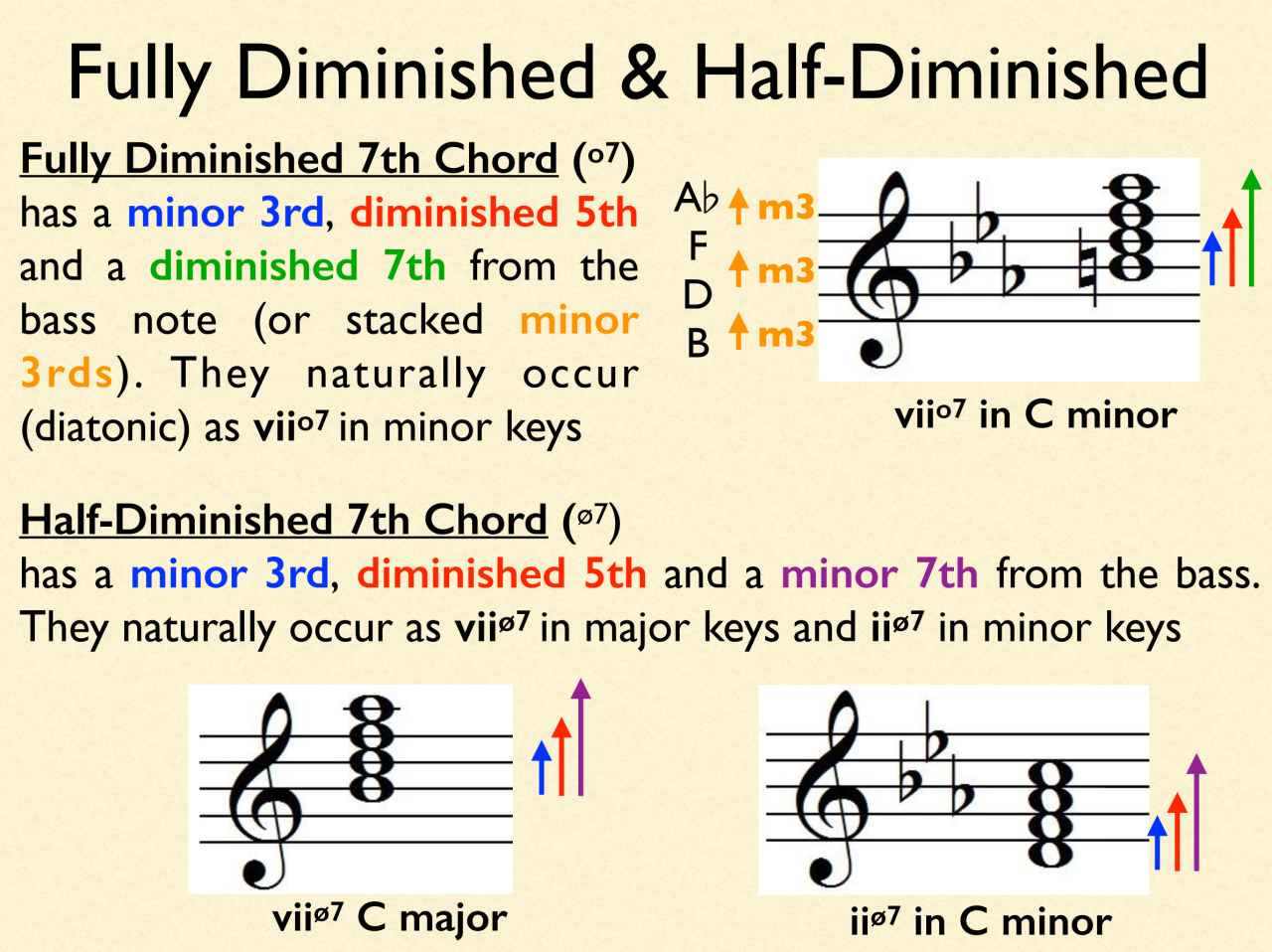
This single note difference significantly affects the sound. Fully diminished chords create intense tension and instability, while half diminished chords produce a softer, more restrained tension.
| Chord Type | Top Interval | Sound Character |
|---|---|---|
| Fully Diminished | Diminished 7th | Highly tense and dramatic |
| Half Diminished | Minor 7th | Softer, more subtle tension |
How Diminished Seventh Chords Resolve
One of the defining features of diminished seventh chords is their strong tendency to resolve. Each note within the chord typically moves by step to a more stable chord, often inward toward the tonic.
This resolution creates a sense of release after tension, making diminished chords ideal for dramatic musical moments and cadential movement.
Insight: The inward resolution of diminished seventh chords is what gives them their characteristic “pull” toward stability.
How To Recognise The Sound
Diminished seventh chords have a distinctive, tense sound that is often associated with suspense, drama, and emotional intensity. They are frequently used in film scores and classical repertoire to heighten anticipation.
Training your ear to recognise this sound is essential. Listening actively and identifying the chord in context will strengthen your musical understanding and improve both analysis and performance skills.
Practice Tip: Try comparing diminished seventh chords with major and minor chords. Notice how much stronger the sense of tension feels in contrast.
Practice Routine
To fully understand diminished seventh chords, a structured practice routine is essential. Follow these steps consistently to build both theoretical knowledge and aural awareness.
Begin by constructing diminished seventh chords from different root notes using stacked minor thirds. Play them slowly and ensure each interval is correct.
Next, practise resolving each chord to a tonic chord. Focus on smooth voice leading and listen carefully to how the tension releases.
Then, compare fully diminished and half diminished chords. Play them side by side and identify the subtle difference in sound and tension.
Finally, apply these chords in short chord progressions. Experiment with using them to create dramatic moments in your own short compositions.
Conclusion And Key Concepts
Key Takeaways
✅ Diminished seventh chords are built entirely from minor thirds, creating a symmetrical structure.
✅ They are among the most powerful chords for creating tension and dramatic effect in music.
✅ Fully diminished chords are more intense than half diminished chords due to the diminished seventh interval.
✅ They commonly appear on leading note chords in major keys and supertonic or leading note chords in minor keys.
✅ Developing the ability to hear these chords is essential for advanced musicianship and analysis.
FAQ
What is the easiest way to build a diminished seventh chord?
The simplest method is to stack minor thirds on top of each other starting from any root note.
What is the difference between fully and half diminished chords?
A fully diminished chord includes a diminished seventh interval, while a half diminished chord uses a minor seventh instead.
Why do diminished seventh chords sound tense?
Their structure contains unstable intervals that strongly want to resolve to more stable chords.
Where are diminished seventh chords most commonly used?
They are commonly found in classical music, jazz harmony, and film scores, especially in moments of tension or transition.
Do I need to learn diminished seventh chords for exams?
Yes, they are essential for higher-level theory exams and are important for both analysis and ear training.
To take your learning to the next level,
check out some of these amazing Courses & Apps



Categories: : Music Theory
Did this article answer all your questions?
If you have any questions, or you want to learn more,
Click the Picture Below to Join the Community for FREE!