What Is a Neapolitan Chord? Meaning, Function and Examples in Music
 Declan Plummer
Learn what a Neapolitan chord is, how it works, why it appears in minor keys, and how to recognise and use it in music.
What Is A Neapolitan Chord?
A Neapolitan chord is a major chord built on the lowered second degree of the scale, and it is most often used in first inversion. In practice, it usually acts as a pre-dominant chord that leads strongly toward chord V, giving the harmony a dramatic, expressive colour.
In this lesson, we are looking at one of the most distinctive chromatic harmonies in tonal music: the Neapolitan chord. Although the name sounds highly specific, this is not a chord used only by composers from Naples, nor is it restricted to one historical period. It appears across Baroque, Classical, Romantic, and even modern film music.
The reason the chord matters is simple. It gives a familiar progression a sudden change of colour without completely destabilising the key. That makes it memorable, expressive, and extremely useful for analysis, listening, and composition. Once you understand how it is built and where it tends to go, you will start hearing it everywhere.
The video lesson also touched briefly on borrowed chords and altered chords, but the central focus of this lesson is the Neapolitan chord itself: what it is, how to find it, why it is more common in minor keys, and how it functions in real music.
- A Neapolitan chord is the lowered second degree of the scale turned into a major chord.
- It is usually found in first inversion, which is why it is often called the Neapolitan sixth.
- Its most common job is to prepare chord V before resolving to chord I.
Why The Name Can Be Misleading
Music theory names are not always as logical as students would like. The Neapolitan chord is a good example. It became associated with the Neapolitan school of composers, especially in eighteenth-century Naples, but the chord was not invented there and it had already existed before those composers made frequent use of it.
That means the name is historical rather than literal. You should not assume the chord belongs only to one city, one style, or one period. In exactly the same way that later musicians can popularise a sound without inventing it (for example, the so-called 'Jimi Hendrix' chord), Neapolitan composers helped make this chord well known, but they were not its sole users.
Insight: Many music theory terms reflect usage and tradition more than strict accuracy. The best way to understand the Neapolitan chord is not through its name, but through its sound and function.
How To Build The Chord
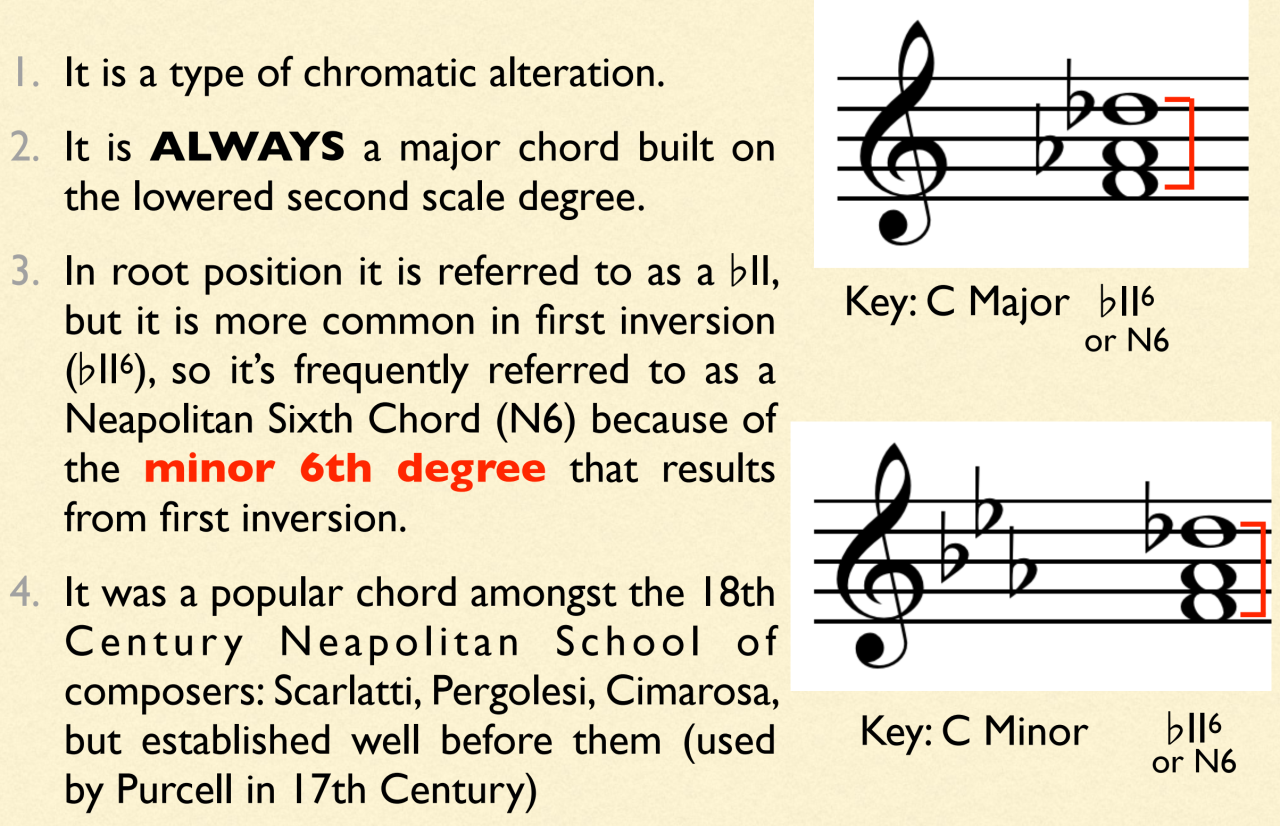
The easiest definition is this: take scale degree 2, lower it by a semitone, and build a major triad on that note. In C major, chord ii would normally be D minor. If you lower the D to D flat and build a major triad, you get D flat major: D flat, F, and A flat. That is the Neapolitan chord in C.
This is why the chord is often labelled as a flattened II or lowered supertonic. In some classical textbooks you may also see it labelled with N, but in modern explanation it is often clearer to call it ♭II because that tells you exactly where it comes from.
One important rule must stay in your mind: it is a major chord. If the triad is not major, then it is not functioning as a true Neapolitan chord.
Pro Tip: Do not think of the chord as “random chromatic colour.” Build it systematically from the lowered second degree of the scale. That makes it much easier to identify in analysis and to use in your own harmony exercises.
Why It Is Usually In First Inversion
Although the chord can appear in root position, the most common version is first inversion. In C major, instead of D flat–F–A flat with D flat in the bass, you are more likely to see F–A flat–D flat. Because the interval from the bass note F up to D flat is a sixth, this form is often called the Neapolitan sixth.
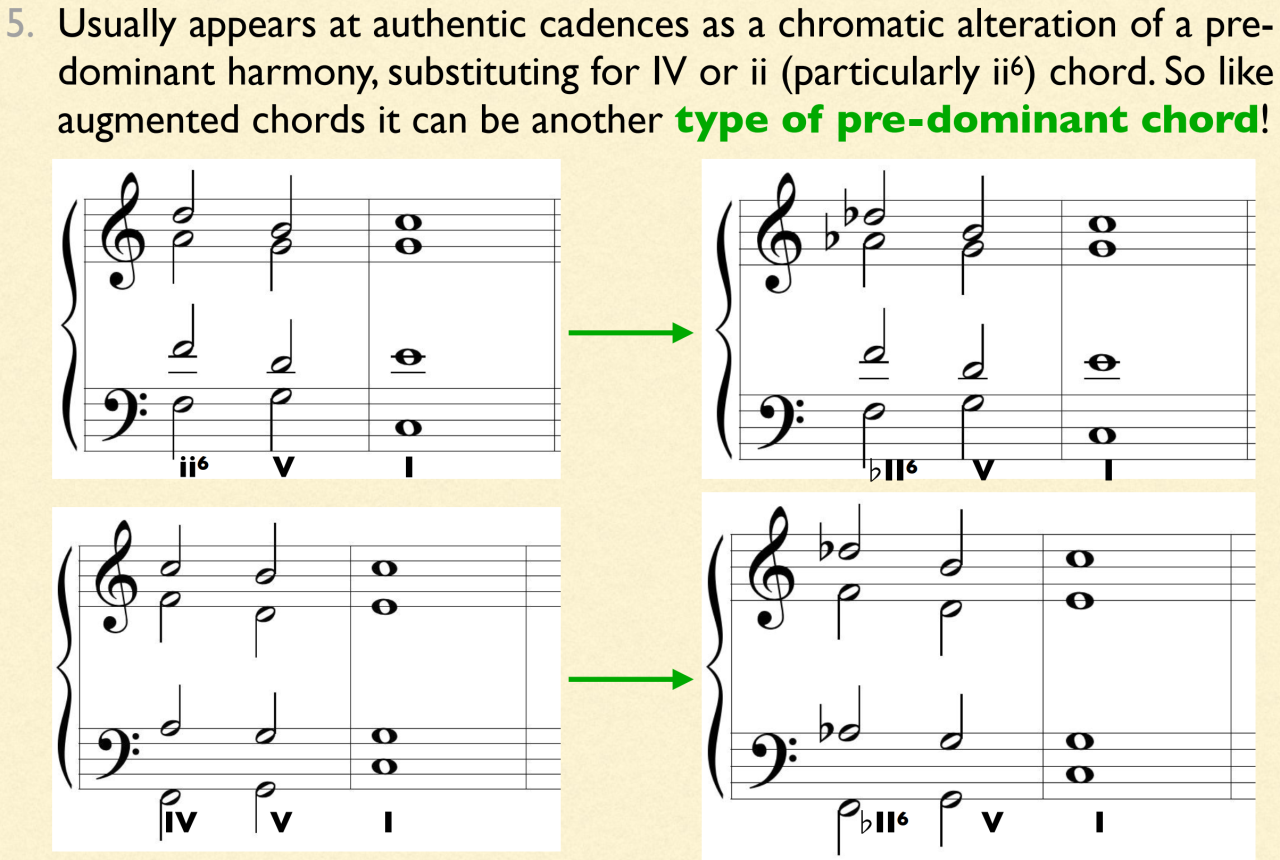
This inversion smooths the bass line and helps the chord move more naturally into chord V (in the same way as IV progresses to V). It also softens the weight of the lowered second degree in the bass, which can otherwise sound rather heavy. For that reason, when students first learn the chord, it is wise to learn the first inversion version first.
Practice Box: In every key you study, write the Neapolitan chord first in root position and then immediately rewrite it in first inversion. Say the notes aloud. This helps you associate the label “Neapolitan sixth” with the sound and spacing you will actually meet in repertoire.
Why It Appears More Often In Minor Keys
Neapolitan chords are more common in minor keys, and that is a very useful observation. In a minor key, one of the notes you need is often already present in the key signature. That means less chromatic alteration is needed to create the chord.
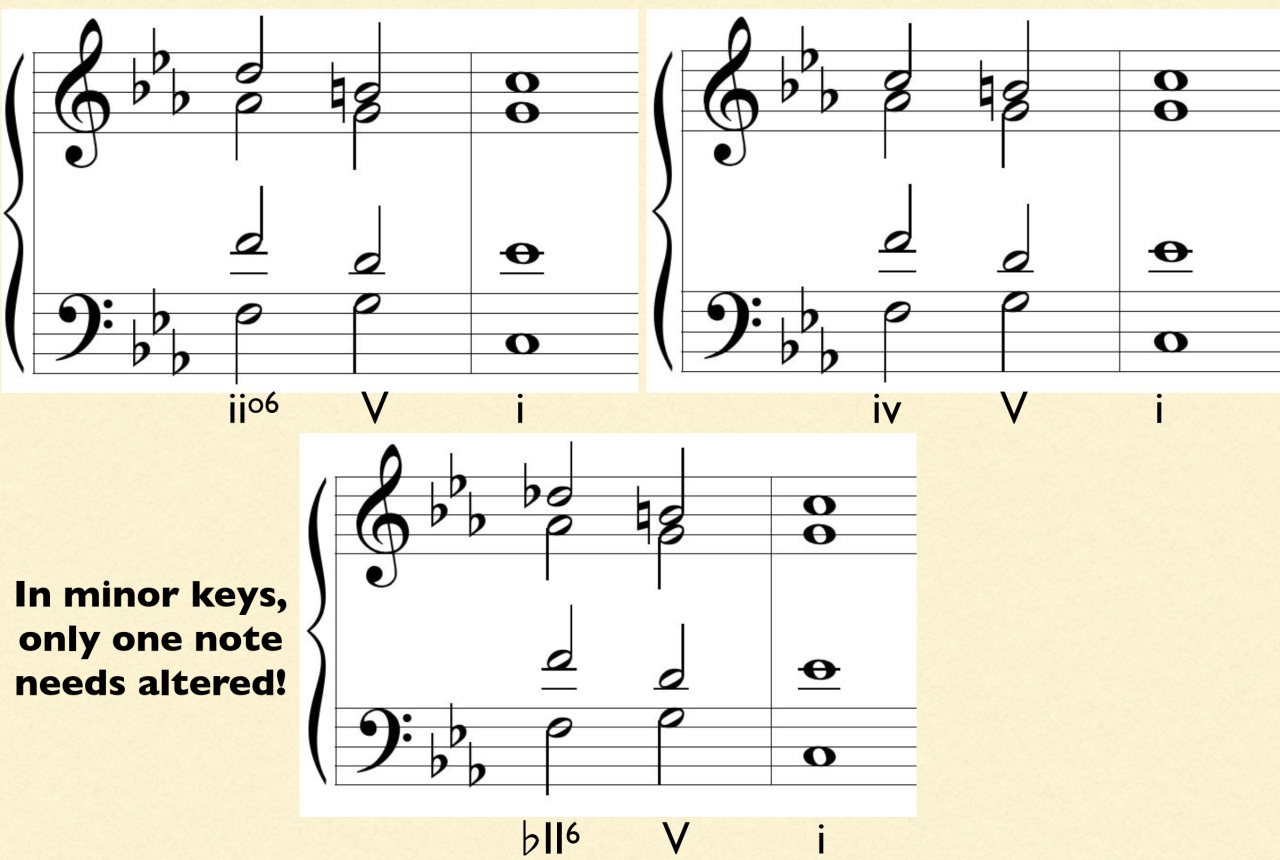
Take C minor as an example. The Neapolitan chord is still D flat major: D flat, F, A flat. In C minor, A flat already belongs to the key signature, so only one note must be altered. In C major, both D and A must be lowered. Because the minor key does some of the work for you, the chord feels more natural there and tends to occur more often.
This is one reason the Neapolitan chord is often associated with dark, intense, or dramatic repertoire. Minor keys already provide a richer environment for chromatic harmony, and the Neapolitan fits especially well into that world.
Common Mistake: Students sometimes assume the Neapolitan chord must literally contain a flat sign in the notation. That is not always true. In sharp keys, the chord may be created by lowering a sharp note to a natural note. What matters is that scale degree 2 has been lowered relative to the key.
How The Chord Functions In Harmony
The Neapolitan chord is best understood as a pre-dominant chord. In other words, it usually comes before chord V. Instead of using an ordinary ii–V–I progression, a composer can replace ii with the Neapolitan. That gives the cadence a stronger and more unusual colour while still leading convincingly toward the dominant.
Its most common role, then, is in cadential movement. The sound is not random at all. It creates tension, redirects the harmonic colour, and then points firmly toward the dominant before the music resolves.
| Function | Typical Progression | Effect |
|---|---|---|
| Ordinary Pre-Dominant | ii – V – I | Stable and familiar |
| Neapolitan Pre-Dominant | N6 – V – I | Dramatic, expressive, intensified cadence |
| Occasional Variant | N6 – I6/4 – V | Stronger cadential preparation |
How To Hear A Neapolitan Chord
A good way to train your ear is to listen for the characteristic colour of the lowered second degree and the way the harmony then pulls toward V. There is often a useful melodic clue: a descending line such as b2–1–7–1 can make the chord easier to spot, especially when the lowered second degree creates a striking chromatic inflection.
In a minor key, the sound can feel unexpectedly bright for a moment because the chord itself is major, even though it belongs inside a darker harmonic setting. That brightness is exactly what makes the chord so effective. It does not remove tension; it intensifies it by colouring the route to the dominant.
Insight: The Neapolitan chord often sounds both surprising and inevitable. It gives the listener a new harmonic colour, but because it still leads so strongly to V, the overall direction of the phrase remains clear.
Famous Musical Examples
One of the best-known examples appears in Beethoven’s Moonlight Sonata. This is especially useful because Beethoven is not a Neapolitan composer, which proves again that the chord is not limited to one school or period. In the famous opening movement, the Neapolitan appears in a minor-key context and acts as a powerful pre-dominant sonority.
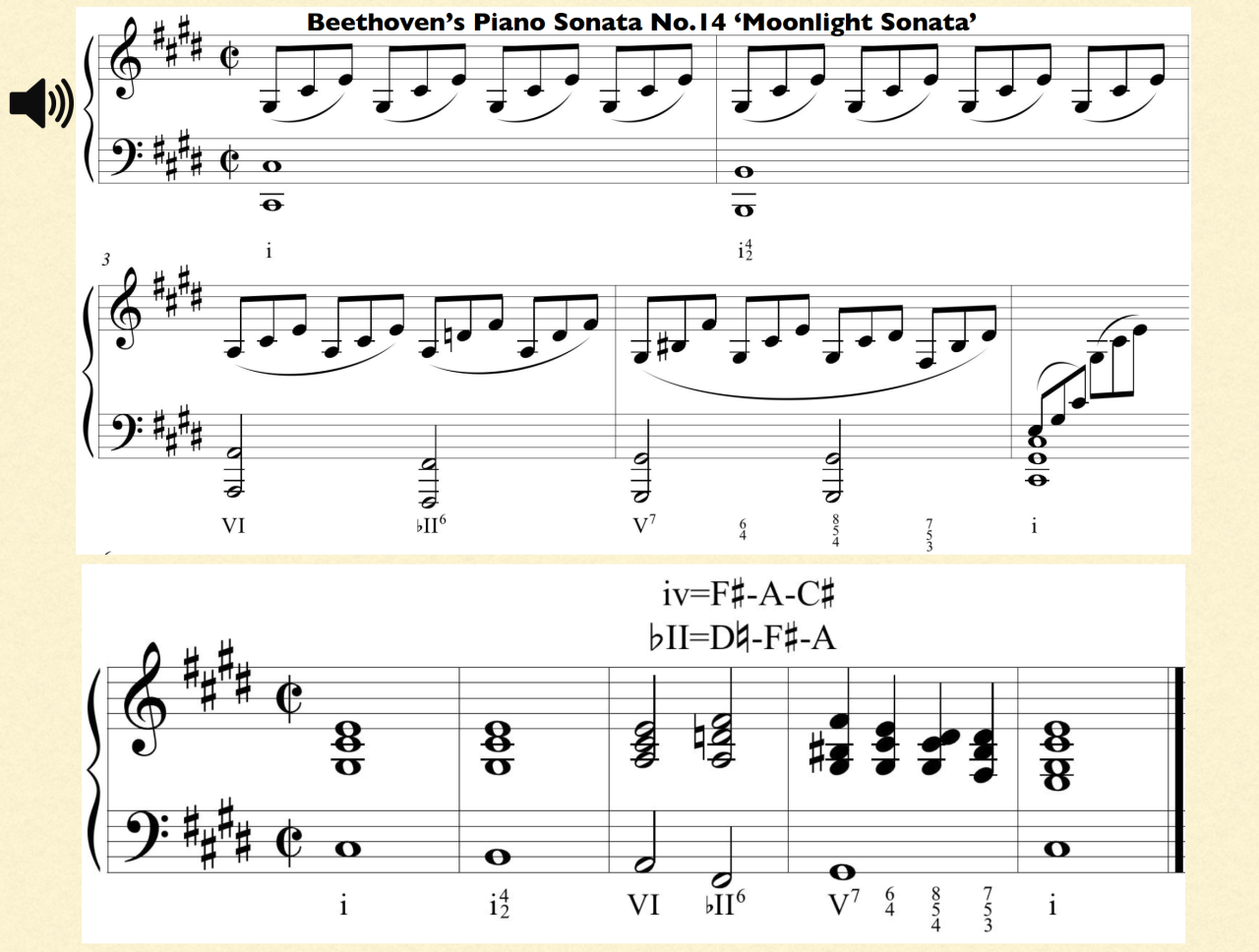
Similar harmonic motion appears in film music, including science-fiction scoring (the exact harmonic progression from the Moonlight Sonata is also found in Star Trek - 2009). That connection is helpful because it reminds us that chromatic harmony is not an abstract theory exercise. These sounds continue to be used because they are dramatically effective. The Neapolitan chord can lift the music, intensify mood, and create an almost cinematic pull into the cadence.
Even when listeners cannot name the chord, they often recognise its emotional effect. That is why studying it is worthwhile: it improves not only your analysis, but also your listening and composing instincts.
How To Find It In Any Key
There is a reliable process you can follow in every major or minor key. First, identify scale degree 2. Second, lower that note by a semitone. Third, build a major triad on the lowered note. Fourth, place the chord in first inversion if you want the most common practical version.
For example, in A major, scale degree 2 is B. Lower it to B flat, then build B flat major: B flat, D, F. In first inversion, that becomes D, F, B flat. That is your Neapolitan sixth in A major. The same basic method works in A minor as well.
Practice Box: Pick five random keys and build the Neapolitan chord in each one without using an instrument. Then check yourself at the keyboard afterwards. This strengthens both theoretical fluency and practical keyboard awareness.
How To Practise Using It
A strong way to practise the chord is through cadences. Play a standard ii–V–I in several keys, then replace ii with N6. Compare the sound. This lets you hear the difference between ordinary pre-dominant motion and the richer chromatic version.
You can also harmonise short melodies and experiment with placing the Neapolitan just before a cadence. Do not overuse it at first. A single well-placed Neapolitan chord is often more effective than using the colour repeatedly.
If you improvise, the same advice applies. Keep the phrase tonally clear, introduce the Neapolitan before V, and listen carefully to what happens to the melodic line above it. The chord often opens a fresh expressive route without forcing you to abandon the key.
Step-By-Step Practice Routine
Step 1: Choose one key and write out its scale clearly, including the correct key signature.
Step 2: Identify scale degree 2 and lower it by a semitone.
Step 3: Build a major triad on that lowered note and then rewrite it in first inversion.
Step 4: Play or sing the progression N6–V–I several times until the sound becomes familiar.
Step 5: Repeat the process in both a major key and its parallel minor so you can compare how the chord feels in each setting.
Step 6: Find one real repertoire example, such as Beethoven, and identify exactly how the chord prepares the cadence.
Step 7: End by composing a four-bar phrase of your own that uses one Neapolitan chord convincingly.
Further Chromatic Harmony Context
The lesson briefly moved beyond the Neapolitan chord into borrowed chords and altered chords. That wider context is useful because it reminds us that chromatic harmony includes several different techniques. Borrowed chords often come from the parallel minor, especially in major keys, while altered chords usually modify one note inside an existing triad.
However, the Neapolitan remains a particularly important starting point because its construction is clear, its function is strong, and its sound is easy to recognise once you know what to listen for. If you understand this chord properly, you are already developing the core habits needed for wider chromatic harmony study.
Key Takeaways
✅ A Neapolitan chord is a major triad built on the lowered second degree of the scale.
✅ It is most often used in first inversion, which is why the label Neapolitan sixth is so common.
✅ The chord usually functions as a pre-dominant and moves strongly to chord V.
✅ It appears more naturally in minor keys because fewer notes need to be altered.
✅ Learning to hear and build this chord will strengthen your harmony, analysis, and composition skills.
FAQ
Is A Neapolitan Chord Always Major?
Yes. The defining triad is major. If the chord built on the lowered second degree is not major, it is not functioning as a standard Neapolitan chord.
Why Is It Called The Neapolitan Sixth?
It is usually placed in first inversion, and the interval from the bass note to the top note is a sixth. That common inverted form is therefore called the Neapolitan sixth.
Does The Chord Only Appear In Classical Music?
No. It is strongly associated with classical repertoire, but similar harmonic colour appears in film music and other styles as well. Its dramatic pull toward the dominant makes it useful far beyond one tradition.
What Chord Does It Usually Go To?
Most often it moves to chord V. In some cadential settings it may pass through a cadential six-four first, but its normal function is still to prepare the dominant.
How Can I Learn To Hear It Faster?
Practise comparing ordinary ii–V–I progressions with N6–V–I progressions in several keys. The more often you hear that altered pre-dominant colour leading into V, the quicker your ear will recognise it in real music.
To take your learning to the next level,
check out some of these amazing Courses & Apps


Categories: : Music Theory
Did this article answer all your questions?
If you have any questions, or you want to learn more,
Click the Picture Below to Join the Community for FREE!