How to Master Grade 7 Theory Question 1: Figured Bass, Harmony and Progressions
 Declan Plummer
Learn how to improve Grade 7 Theory Question 1 with clear guidance on harmony, figured bass, dominant sevenths and key progressions.
How To Improve Grade 7 Theory Question 1
Grade 7 Theory Question 1 becomes much easier when you recognise the harmonic patterns behind the notes. The key skills are spotting cadences, using passing 6-3 chords correctly, handling dominant sevenths with confidence, watching for accidentals in minor keys and modulations, and avoiding weak or unstable harmonic choices.
This question is not only about naming chords. It is about understanding how the harmony behaves across the whole texture. You need to hear how the bass supports the upper notes, notice where the music is moving towards a cadence, and decide whether a note belongs to the harmony or is simply decorative.
Many students find Grade 7 difficult because the writing becomes more stylistically sensitive than in earlier grades. A chord may look possible on paper, yet still sound weak or awkward in context. That is why it helps to think musically rather than mechanically. The strongest answers are usually the ones that sound convincing as well as looking correct.
The good news is that the examiners use familiar patterns again and again. Once you understand those patterns, the question becomes far more manageable, and you can begin to collect the extra marks that separate an adequate answer from a strong one.
- Look for cadential 6-4s and passing 6-3s before deciding on individual chords.
- Use chord vii˚ carefully, usually in first inversion and most convincingly inside a passing 6-3 progression.
- Include a dominant seventh when it genuinely belongs and the seventh resolves down by step.
Why Harmonic Patterns Matter More Than Guesswork
The first step in Question 1 is to stop thinking of each bass note as a separate puzzle. Instead, look for the larger harmonic motion. Often the whole phrase is pointing towards a cadence, a modulation, or a familiar progression. When you identify that bigger shape first, the individual figured bass symbols begin to make much more sense.
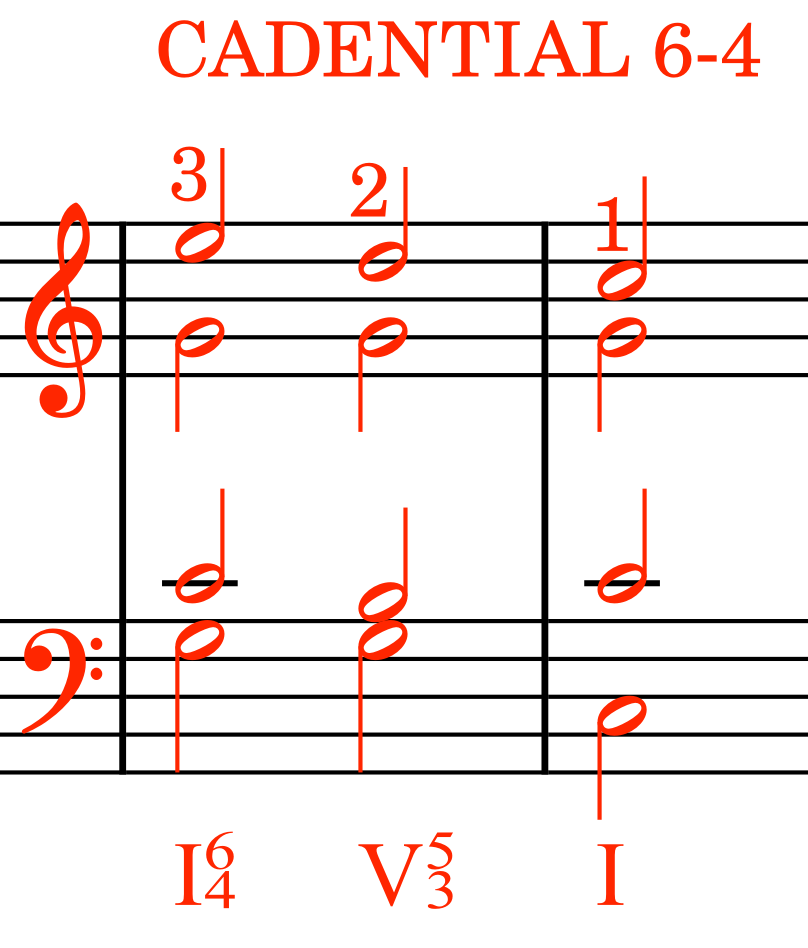
- Look for 3-2-1 (a descending stepwise motion) in the melodic line at the end of a phrase / the end of the extract. This can usually be harmonised by a cadential 6/4 (Ic - V - I).
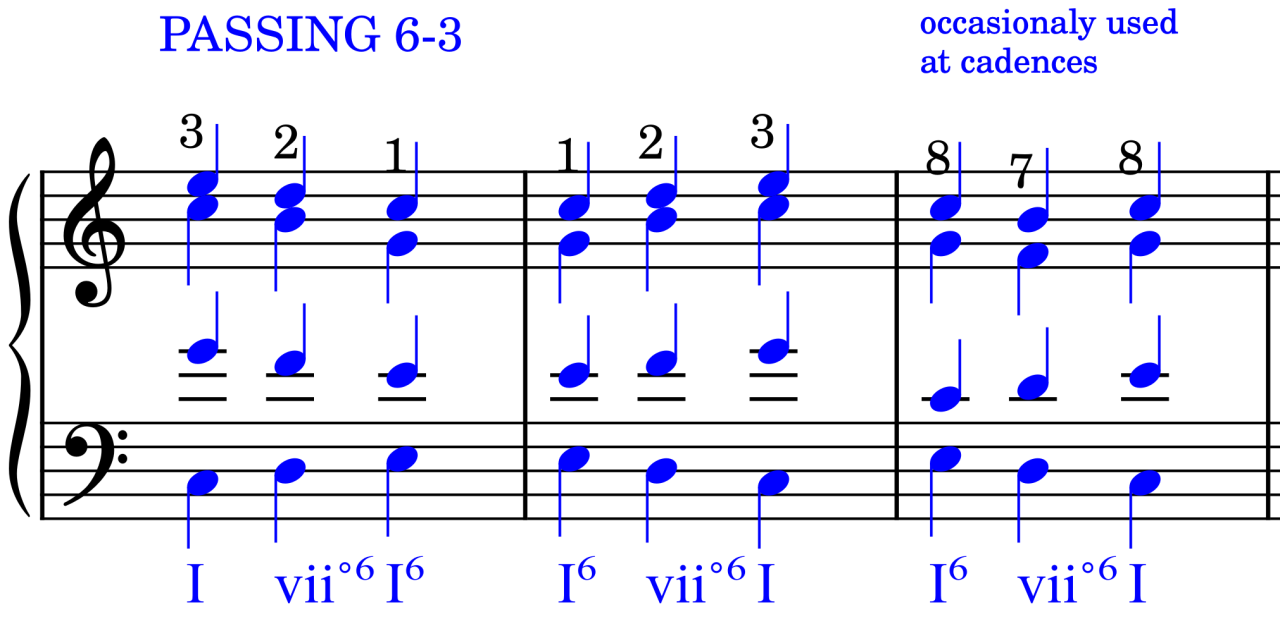
- Look for a 3-2-1 or 1-2-3 (a descending/ascending stepwise motion) in the melodic line somewhere in the pre-cadential material. This can usually be harmonised by a passing 6/3 (I-vii˚b-Ib or Ib-vii˚b-I). It can sometimes be used as a cadence of the melodic line moves 8-7-8.
- Be careful of Continuation Lines: the harmony must account not only for the first bass note, but also for the notes that continue across the line. That means you are harmonising the full sonority, not one isolated note at a time. Students sometimes lose marks by choosing a chord too quickly without checking whether it still works over the whole continuation.
The exam is testing whether you can recognise musical logic like this.
Insight
A useful mindset is to ask, “What is this phrase trying to do?” before asking, “What chord goes under this note?” That small change often leads to much stronger harmonic decisions.
The Passing 6-3 Progression
One of the most important Grade 7 patterns is the passing 6-3. This appears as I - vii˚b - I (i - vii˚b - i in minor keys) or the same in reverse! The middle chord does not function as a strong destination. Instead, it smooths the bass line and links two positions of the tonic harmony.
That is why the passing 6-3 is so useful. It explains why chord vii˚ appears at all, because chord vii˚ is generally weak on its own. When it is placed between two tonic chords, however, it makes musical sense. It behaves like a passing harmony, much as a passing note links two more stable pitches.
Students should memorise this pattern in both directions. Sometimes it moves from root position tonic to first inversion tonic, and sometimes it works backwards. In either case, the principle is the same: the middle harmony is there to connect, not to dominate.
| Pattern | Meaning | What To Remember |
|---|---|---|
| I – vii˚b – Ib | Passing 6-3 | 3-2-1 melody in pre-cadential material. Chord vii˚ works because it links two tonic positions |
| Ib – vii˚b – I | Reverse Passing 6-3 | 1-2-3 melody in pre-cadential material. Same idea in reverse direction. 8-7-8 at cadences |
| Cadential 6-4 – V – I | Cadence pattern | 3-2-1 always at cadences. Still essential from Grade 6 onwards |
Pro Tip
If chord vii˚ seems possible but chord V sounds stronger, choose chord V unless the music clearly suggests a passing 6-3. Chord vii˚ is usually most convincing only inside that specific progression.
How To Use Dominant Sevenths Properly
Dominant sevenths are one of the main ways to gain extra credit at Grade 7. If there is even a small possibility of a melodic note being thought of as the 7th of the V7 chord, and it behaves as all 7ths do and falls by step, then it definitely needs to be included in the figured bass! In Baroque-style writing, the dominant seventh is a natural and highly characteristic sound.
This is a crucial rule. The seventh must resolve down by step. If it does not fall, it should not be treated as a real seventh chord in your analysis. In other words, the chord must not only contain the seventh; it must behave like one!
This becomes a powerful decision-making tool in the exam. When students are uncertain whether a note should count as part of the harmony, they can ask whether the seventh resolves correctly. If it does, including the dominant seventh is often the right choice. If it does not, the note may be decorative instead.
Practice Box
Train yourself to say this aloud while practising: “Leading notes rise, sevenths fall.” This helps keep two commonly confused ideas separate and makes chord decisions much quicker.
Figured Bass For Seventh Chords
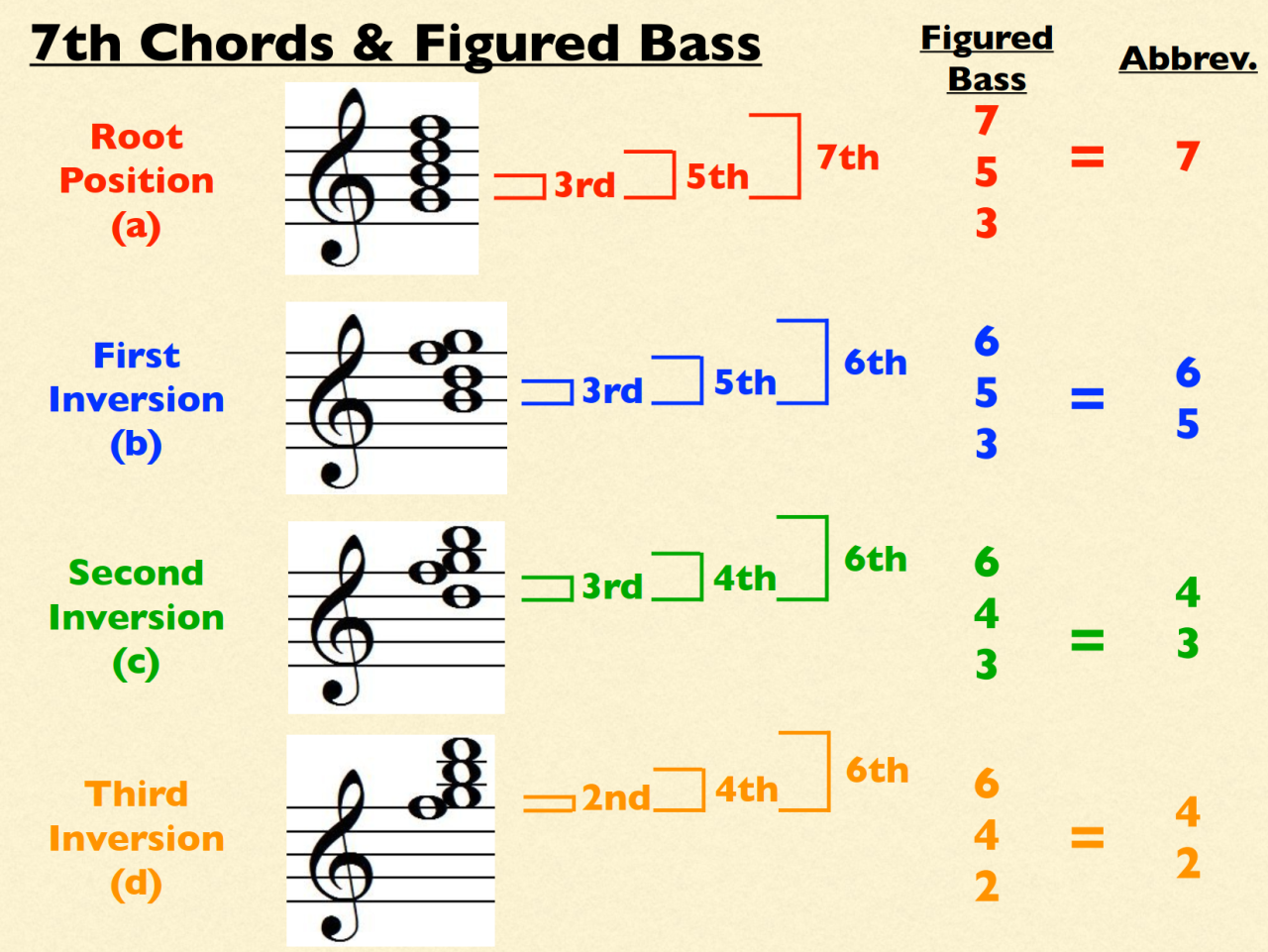
Grade 7 also introduces the figured bass symbols for seventh chords, and these must be known securely. Root position is usually abbreviated to 7. First inversion is 6-5. Second inversion is 4-3. Third inversion is 4-2, although some textbooks shorten this further to just 2.
These figures matter because the wrong abbreviation can accidentally describe a triad instead of a seventh chord. For example, 6-3 suggests an ordinary first inversion triad, not a first inversion seventh chord. That is why accuracy with these numbers matters so much.
| Seventh Chord Position | Abbreviation | Memory Aid |
|---|---|---|
| Root Position | 7 | Start the sequence at 7 |
| First Inversion | 6-5 | Most common dominant seventh inversion |
| Second Inversion | 4-3 | Do not confuse with 6-4 |
| Third Inversion | 4-2 or 2 | Final step in the pattern 7, 6-5, 4-3, 4-2 |
Secondary Sevenths, Modulation, And Accidentals
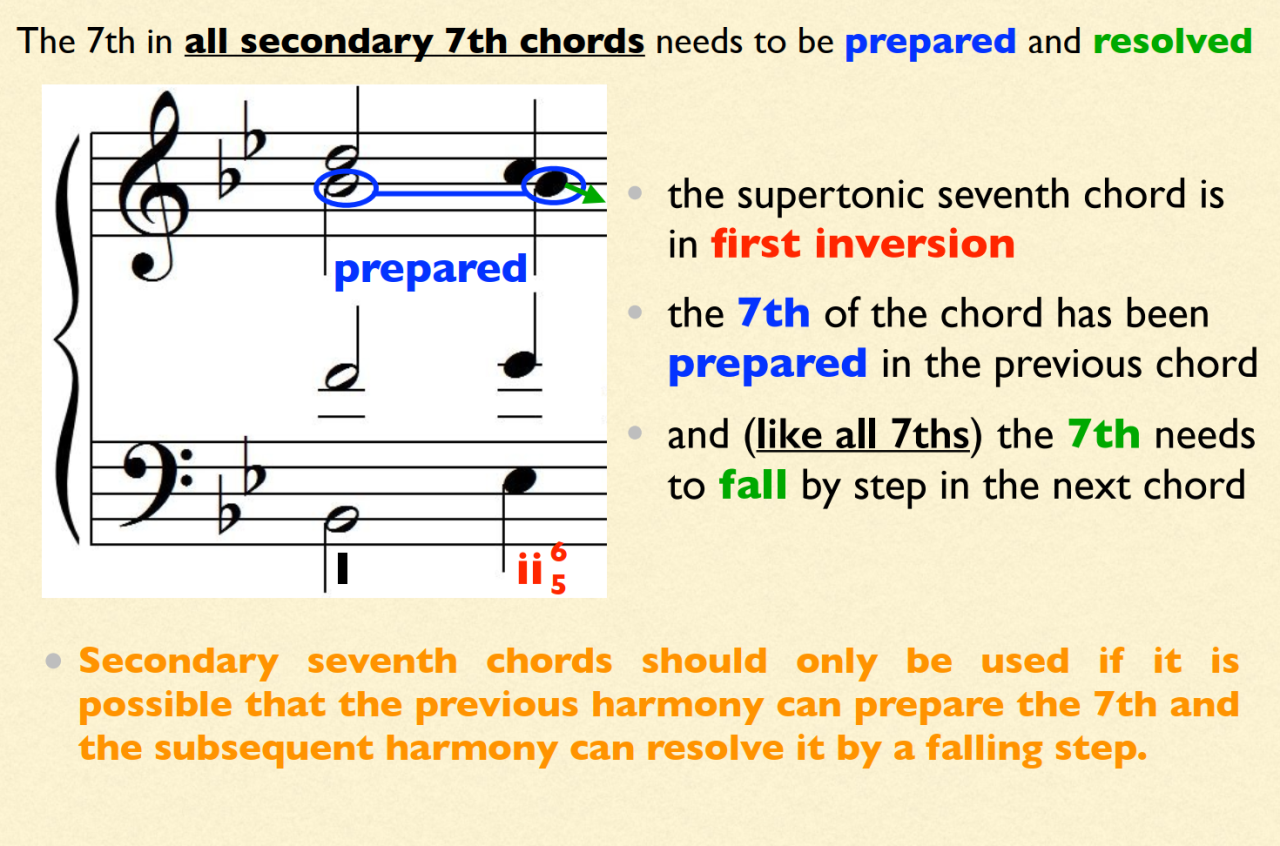
Not every seventh chord is treated like a dominant seventh. Secondary sevenths, especially chord ii7 and chord vii˚7, need more careful handling. Their sevenths should usually be prepared in the previous chord in the same voice and then resolve downwards. That makes them more demanding than dominant sevenths, which can appear more freely in Baroque harmony.
Another key Grade 7 challenge is remembering accidentals in the figured bass, especially in minor keys and during modulation. Students often expect the raised leading note to appear visibly in the melody, but that does not always happen. Sometimes the harmony still requires the sharpened note, and you must indicate it in the figured bass even when it is not obviously written above.
This is why careful harmonic thinking matters. A passage in a minor key may seem free of accidentals at first glance, yet chord V or chord VII may still demand the raised seventh. Missing that sign can cost marks even if the overall harmonic plan is otherwise sound.
Common Mistake
Do not assume that a missing accidental in the melody means no accidental is needed in the harmony. In minor keys and modulating passages, the figured bass may still need to show the altered note clearly.

Avoiding False Relation
False relation is another danger point in Grade 7. This happens when one part gives a note in one form, such as D natural, and another part answers too closely with D sharp in a different voice. Even if each note is individually explainable, the effect can sound stylistically awkward.
This often appears during modulation, when students are trying to move from one key to another and accidentally leave behind notes from the old harmony. A better chord choice can often remove the clash completely. In practice, this means checking whether a safer pivot chord would avoid the cross-relation and strengthen the modulation.
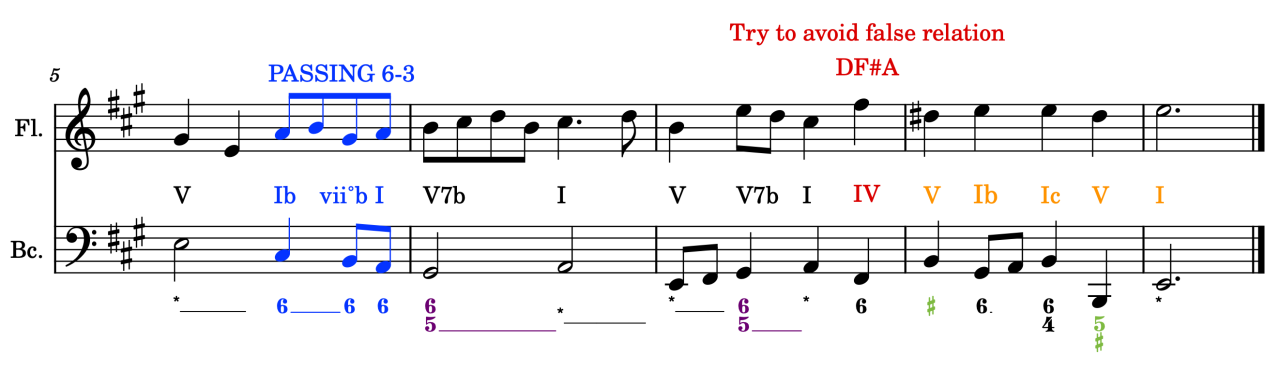
1) Good use of Passing 6-3 progression
2) Dominant 7th can be used (in first inversion) to include the D as part of the E-G#-B-D chord, and it falls to the next new harmony note.
3) Try to avoid false relation - the 6 figured bass implies a D-F#-A chord (IV in old key) which clashes with the D# in the B-D#-F# (V in the new key) in the beat.
4) A pivot chord F#-A-C# chord (vi in the old / ii the new key) could have been used to avoid false relation.
5) D# imply modulation to E major and they must be included in the figured bass.
6) Good use of Cadential 6-4 progression in the modulation bar of the question.
Insight
A good pivot chord does more than connect two keys. It also prevents awkward clashes by belonging naturally to both the old key and the new one.
Practice Guidance For Stronger Grade 7 Answers
The most effective practice method is to hear what you write. Play the harmony at the keyboard, sing the outer parts, or use notation software if available. When you listen back, weak chord choices become much easier to spot. You will hear when a cadence fails to land, when a dominant seventh does not resolve properly, or when a false relation creates an awkward colour.
It is also worth keeping a short checklist beside you. Ask whether the phrase contains a cadence, whether a passing 6-3 is possible, whether chord VII is really justified, whether any dominant sevenths have been missed, and whether the key requires an accidental in the figured bass. This kind of disciplined checking builds accuracy very quickly.
Above all, keep the style simple and secure. The goal is not to invent unusual harmony. The goal is to write something that sounds stylistically correct, fluent, and well controlled.
Practice Routine
Begin by scanning the whole phrase before writing anything. Mark the key, likely cadence points, and any places where a modulation might be happening. This prevents you from making isolated chord choices too early.
Next, look specifically for the two major patterns you already know: the cadential 6-4 and the passing 6-3. These often provide the clearest structure in the phrase and make the surrounding chords easier to understand.
Then fill in the most certain harmonies first. Add tonic and dominant chords at cadences, check whether any dominant sevenths can be used, and confirm that every seventh resolves down by step.
After that, review the weaker moments. Ask whether a chord VII is genuinely acting as part of a passing 6-3 or whether a stronger chord V would be better. Check for possible false relation and make sure any necessary accidentals are included in the figured bass.
Finally, play through the whole answer. Listen for balance, direction, and stylistic consistency. If something sounds unstable or unclear, revise it before moving on.
Key Takeaways
✅ Grade 7 Question 1 becomes clearer when you recognise full harmonic patterns rather than guessing chord by chord.
✅ The passing 6-3 is one of the most important new progressions to recognise, and it explains the best use of chord VII.
✅ Dominant sevenths are valuable, but only when the seventh genuinely belongs and resolves down by step.
✅ Secondary sevenths are more demanding because they usually need preparation as well as downward resolution.
✅ Accidentals in minor keys and modulations must be shown carefully in the figured bass, even when the melody does not display them clearly.
FAQ
When Should I Use Chord VII In Grade 7 Theory?
Use chord VII very carefully. It is usually strongest in first inversion and is most convincing when it forms part of a passing 6-3 progression between two tonic positions.
How Do I Know Whether To Include A Dominant Seventh?
Include it when the harmony is genuinely chord V and the seventh resolves down by step. If the note does not fall correctly, it is safer not to analyse it as a dominant seventh.
Why Are Accidentals So Easy To Miss In Minor Keys?
Because the raised leading note may be required by the harmony even when it is not visible in the melody. You must think harmonically, not only visually, when writing the figured bass.
What Is False Relation?
False relation is the awkward clash created when one voice uses a note such as D natural and another voice answers closely with D sharp. It often appears during modulation if the harmony is not controlled carefully.
What Is The Best Way To Practise Question 1?
Practise by identifying cadences and common progressions first, then write the most certain chords, and finally play the result back. Hearing the harmony is one of the fastest ways to improve accuracy and style.
To take your learning to the next level,
check out some of these amazing Courses & Apps

Categories: : Music Theory
Did this article answer all your questions?
If you have any questions, or you want to learn more,
Click the Picture Below to Join the Community for FREE!