Secondary Dominant Chords Explained: Chromatic Harmony Made Simple
 Declan Plummer

Learn secondary dominant chords, how they work, and how to hear and use chromatic harmony in real music with clear examples.
What Are Secondary Dominant Chords?
When students first meet chromatic harmony, it often seems more difficult than it really is. Textbooks can make the subject feel crowded with labels, exceptions, and historical detail, but the central idea is actually very manageable. A chromatic chord is simply a chord that includes at least one note outside the home key. That accidental is what gives the harmony its extra pull and colour.
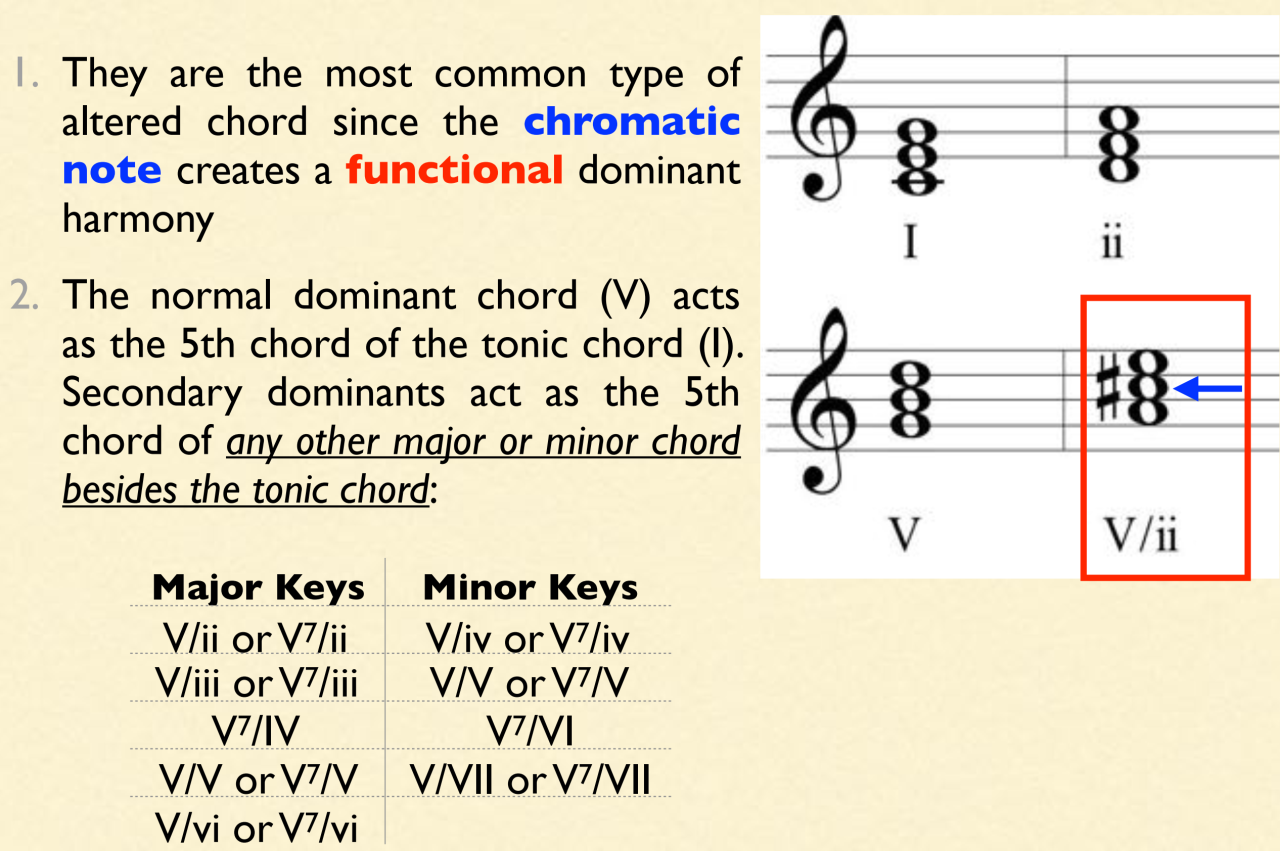
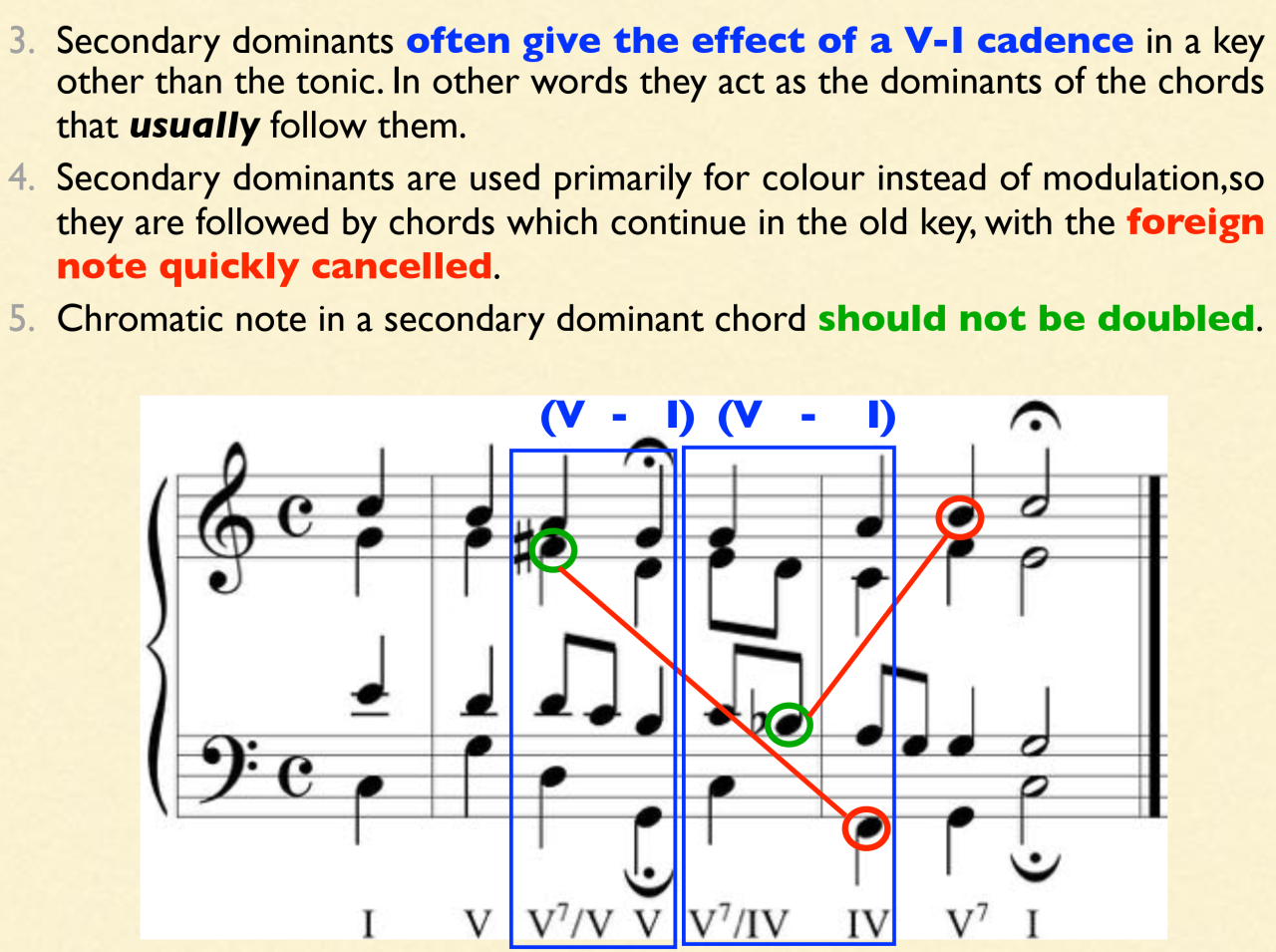
Secondary dominant chords are the most popular type of chromatic chords that briefly make another chord in the key sound like a temporary tonic (the term tonicization is sometimes used to describe this temporary tonic). They add colour, tension, and direction by introducing an accidental that does not belong to the key, then resolving strongly to a target chord, usually by semitone movement.
Among all chromatic chords, secondary dominants are the most useful place to begin. They appear in every style of music; from classical music, jazz and rock songs to barbershop harmony, Christmas carols, and even very simple lullaby tunes. Once you understand how they work, you start hearing them everywhere. They are not random decorative chords. They have a clear function: they intensify the arrival of another chord.
The easiest way to understand them is to begin with the ordinary dominant. In a major or minor key, chord V has a very strong pull towards chord I. A secondary dominant takes that same dominant-to-tonic relationship and just applies it temporarily to different chord in the same key. That is why the effect sounds familiar, satisfying, and so musically persuasive.
For those readers interested in the detail, here is the theory behind secondary dominants (you can ship this if you prefer):
- A secondary dominant is a chromatic chord with at least one accidental outside the key.
- It usually acts like chord V of another chord, such as V of ii or V of vi (written as V/ii and V/vi).
- Its job is to create tension and then usually resolve clearly to the target chord so V/ii resolves to ii.
Why Secondary Dominants Matter
Secondary dominants matter because they make harmony sound more directed. A basic progression built only from diatonic chords can be perfectly correct, but it may sound plain. The moment you introduce a secondary dominant, the music acquires extra tension and a more expressive sense of movement. Instead of simply arriving at the next chord, the harmony seems to lean towards it with purpose.
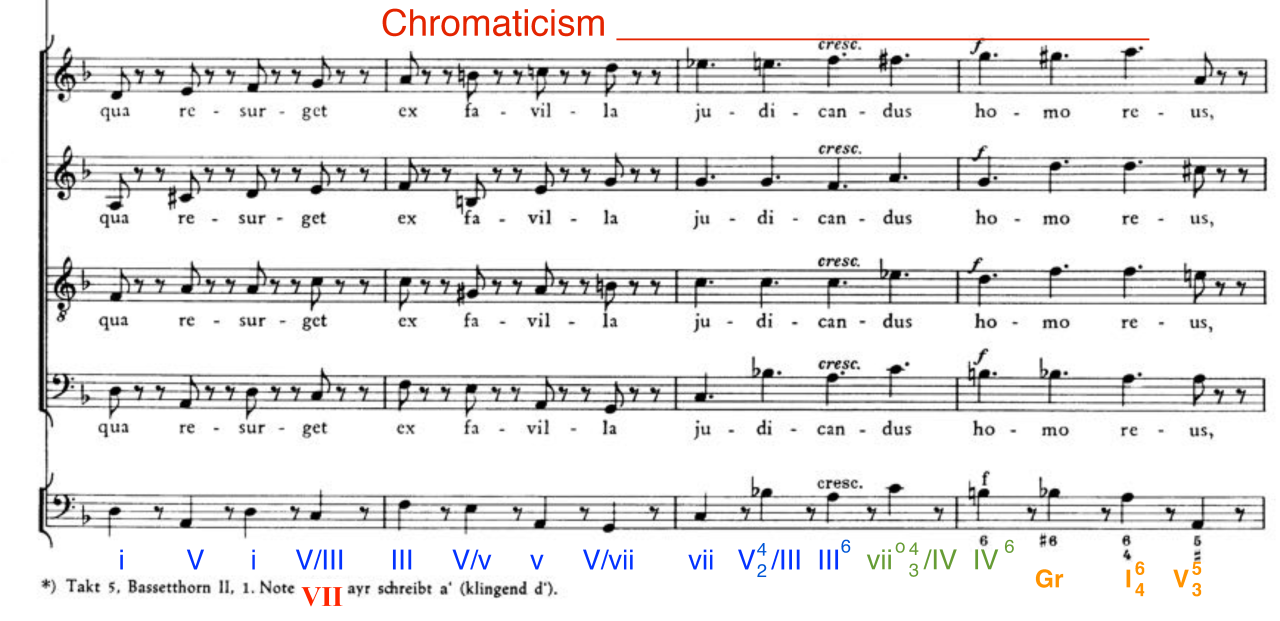
This is why they appear in so many styles. In a simple carol, they add warmth and richness. In pop and rock songs, they create memorable harmonic turns. In the Lacrimosa from Mozart's Requiem, they can generate a powerful chain of tension and release (look how many he uses in just two bars to get that rising chromatic scale in the top soprano part!):
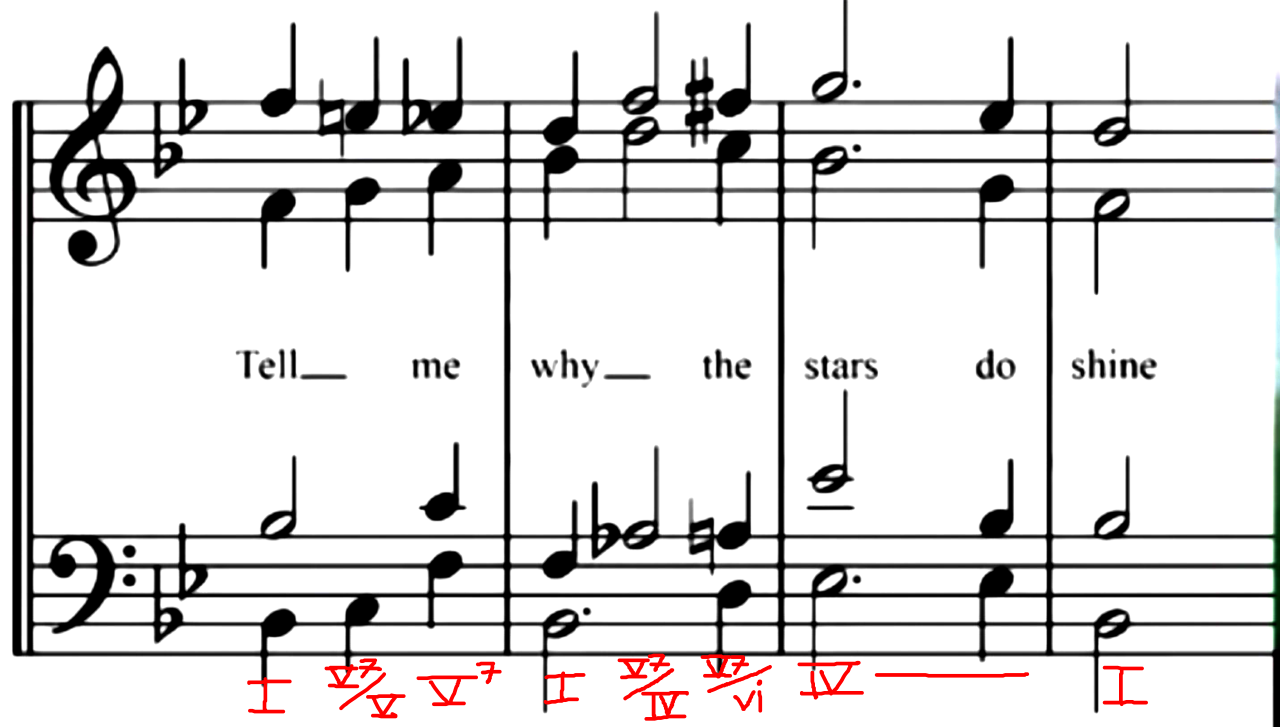
In barbershop harmony, they help produce that distinctive forward-driving pull between chords. Their popularity comes from the fact that they are both beautiful and functional.
Pro Tip
Do not try to memorise dozens of isolated examples. Learn the principle instead: what is you target chord (let's say IV), count up a fifth from it, make that chord major or dominant seventh (V7/IV), and then listen for the chromatic note resolving.
How To Identify A Secondary Dominant
Start by confirming the home key. Once you know the key, list the normal diatonic chords that belong to it. Then look for a chord containing an accidental that does not fit that key signature. That is your clue that some form of chromatic harmony may be at work.
Next, ask where the chord resolves. A secondary dominant usually moves to the chord of which it is the dominant. In C major, for example, A major or A7 does not belong naturally to the key, because of the C sharp in the A major chord. Yet A major has a strong pull to D minor, which is chord ii in C major. Therefore A major or A7 is V of ii.
This is the real listening skill: hear the pull. The accidental often behaves like a leading note, rising by semitone to a note in the next chord. That upward attraction is one of the clearest signs that you are hearing a secondary dominant.
Insight
The most important question is not simply “What is this chord called?” but “Where is it trying to go?” Secondary dominants are best understood by their direction and resolution, not by memorised labels alone.
Common Types In Major Keys
In major keys, you can form secondary dominants for most of the diatonic chords. In C major, that means you may encounter V of ii, V of iii, V of IV, V of V, and V of vi. Each one temporarily highlights its target chord by treating it as if it were a tonic.
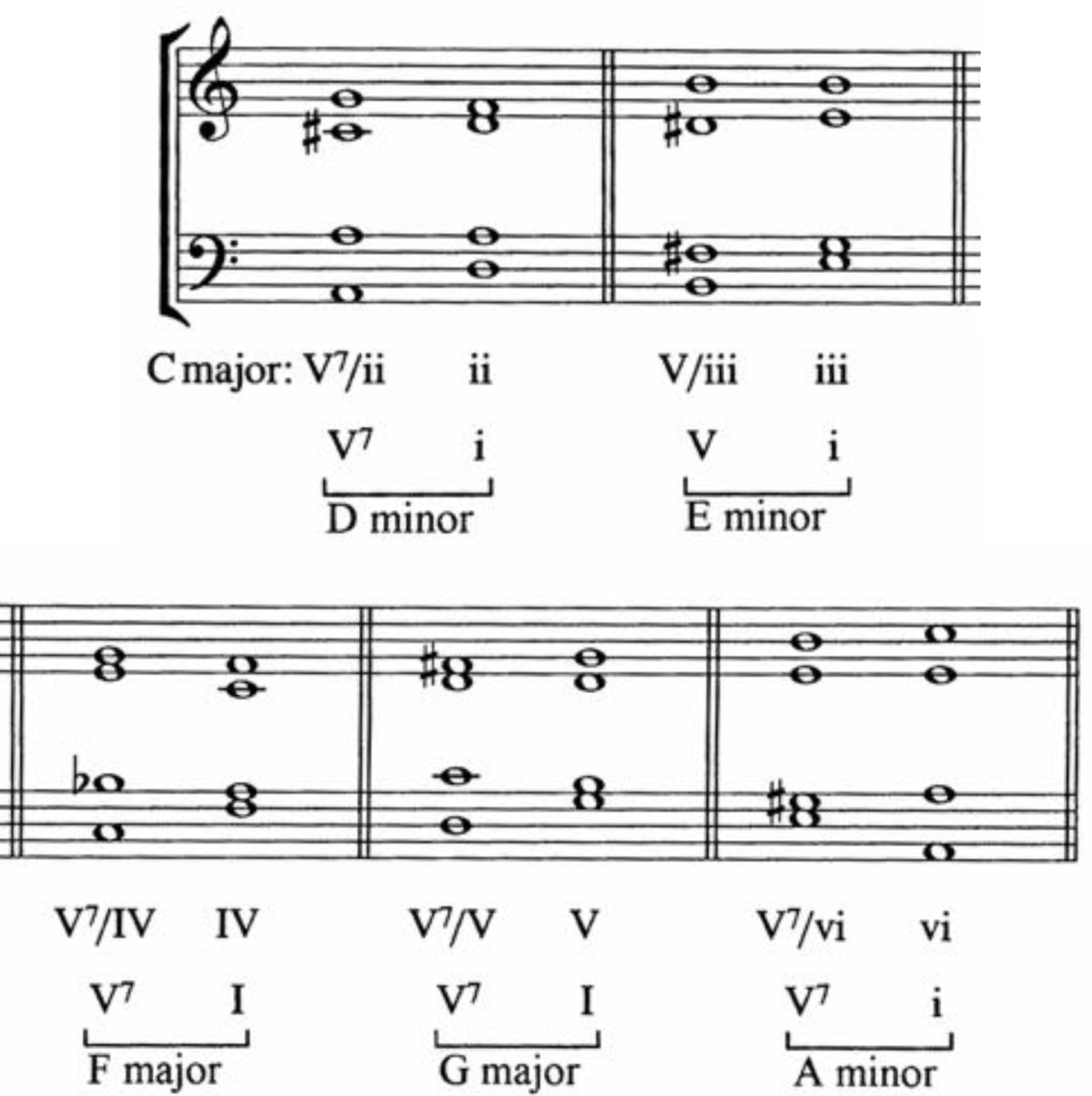
| Target Chord In C Major | Secondary Dominant | Chromatic Note | Typical Resolution |
|---|---|---|---|
| ii = D minor | A major or A7 | C sharp | Moves to D minor |
| iii = E minor | B major or B7 | D sharp | Moves to E minor |
| IV = F major | C7 | B flat | Moves to F major |
| V = G major | D major or D7 | F sharp | Moves to G major |
| vi = A minor | E major or E7 | G sharp | Moves to A minor |
Chord vii° is the usual exception. Because it is diminished, it is not normally treated as a temporary tonic in the same way (which makes sense when you think about it - you can't make the B a temporary tonic because the key of B diminished doesn't exist!).
Practice Box
Take the key of C major and play these pairs at the keyboard: A7 to D minor, B7 to E minor, C7 to F, D7 to G, and E7 to A minor. Listen carefully to how each first chord seems to demand the second.
Secondary Dominants Versus Modulation
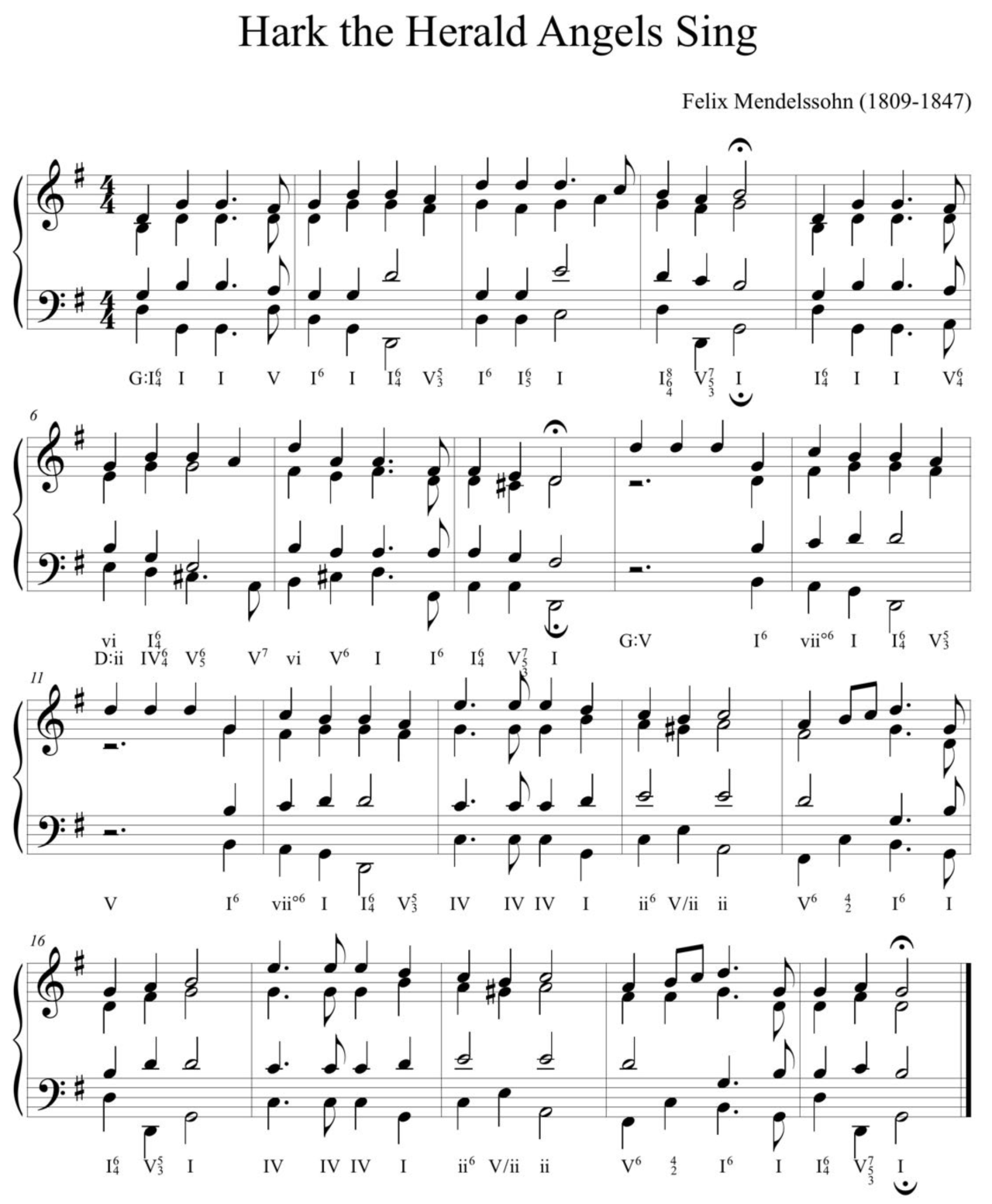
One of the most important distinctions is the difference between tonicization created by secondary dominants and modulation. A secondary dominant briefly points towards another chord, but it does not establish a new key. A true modulation is more convincing and more sustained. The new accidental tends to recur, and the ear begins to accept the new tonic as home (see bars 6-8 below, where the recurring C# signifies a modulation to D major, the dominant key).
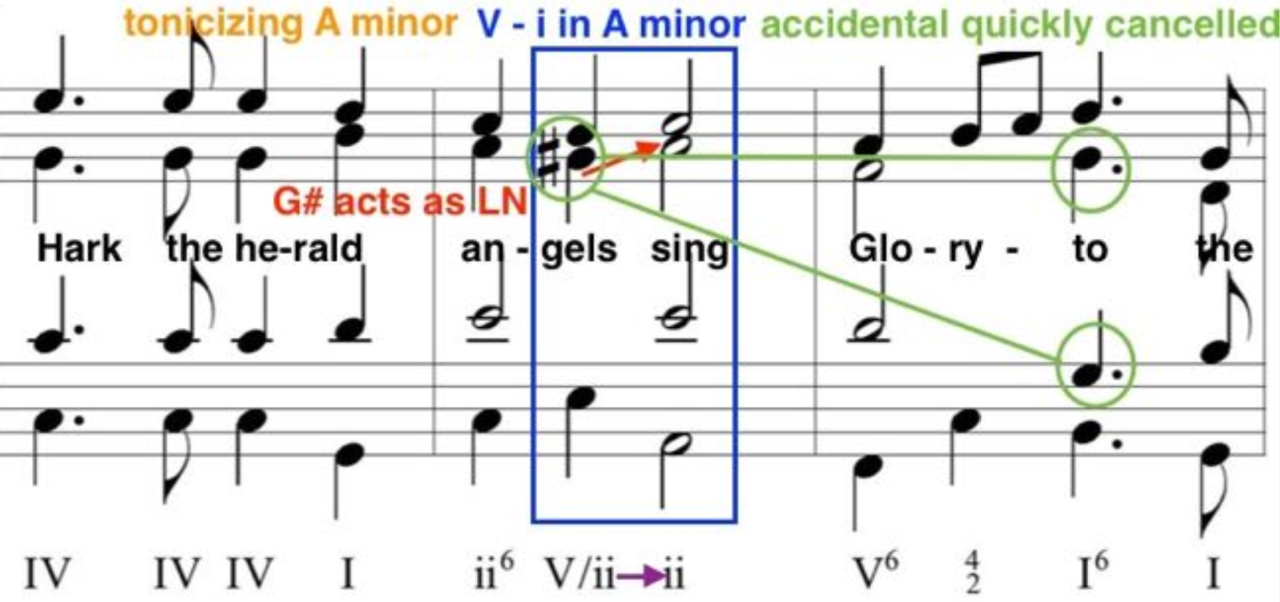
With a secondary dominant, the chromatic note often appears only briefly. The music quickly continues in the original key. You hear a short detour rather than a permanent move. That is why a single E7 in G major does not automatically mean the music has modulated to A minor. The E7 may simply be V7 of chord ii, followed by a return to the home key.
Common Mistake
Do not label every accidental as a modulation. If the altered note appears only briefly and the music quickly re-establishes the original key, you are probably dealing with tonicization through a secondary dominant rather than a full key change.
What The Ear Should Listen For
In listening, secondary dominants are often easiest to recognise by semitone attraction. The chromatic note usually pushes strongly into the following chord. In V of ii, the raised note tends to rise into chord ii. In V7 of IV, the altered note (the 7th of the chord) often falls into chord IV. In each case, there is a sense of tension being introduced and then resolved.
This is why secondary dominants are so expressive. They are not merely colourful sonorities. They create expectation. The next chord sounds more important because it has been prepared so strongly. Even a very short progression can become more memorable when one of these chords is inserted at the right moment.
How To Use Secondary Dominants In Real Music
A useful compositional approach is to begin with a simple diatonic progression and then look for destination chords that could be strengthened. Suppose your progression in C major is I – ii – V – I. You can intensify the move to V by preceding it with A7, giving I - V/V - V - I. The overall structure stays clear, but the line becomes more vivid.
The same idea works in many common progressions. If you are about to move to IV, you may introduce V7 of IV. If you are about to move to vi, you may use V of vi. This gives a melody or accompaniment more shape without forcing a complete modulation. It is an elegant way to enrich harmony while keeping the listener oriented.
Dominant sevenths are especially effective because the added seventh increases the sense of urgency. The essential ingredient is the chromatic note that creates the altered dominant quality and directs the resolution.
Quote Box
The simplest way to think about a secondary dominant is this: it briefly makes another chord feel like home, just long enough for the harmony to arrive with greater force.
Step-By-Step Practice Routine
Begin by choosing one key only, such as C major or G major. Play the ordinary tonic and dominant first so that the sound of a normal V–I relationship is fixed clearly in your ear. This gives you the model from which all the secondary dominants are understood.
Next, write out the diatonic triads in the key and label them with Roman numerals. Then pick one target chord at a time, such as ii or vi, and work out its dominant by counting up a fifth from the root of that chord and making the result major chord (you can add the 7th too if you like to make it a dominant seventh chord).
After that, play the secondary dominant and its resolution repeatedly. Sing or play the chromatic note by itself if needed, and notice how it resolves. This is especially helpful for training your ear to hear the tendency note rather than merely seeing it on the page.
Now place the secondary dominant into a short progression. For example, try I–V/ii–ii–V–I, then I–V/V–V–I, and then I–V/vi–vi–ii–V–I. Keep the rhythm simple so that your attention stays on the harmonic pull.
Finally, return to real repertoire. Look through hymns, carols, songs, or classical extracts and search for accidentals that resolve into diatonic chords. Once you begin spotting them in context, the theory becomes practical and much easier to remember.
Key Takeaways
✅ Secondary dominants are chromatic chords that temporarily tonicize another chord in the key.
✅ Their defining feature is an accidental outside the key that creates a strong pull towards a following chord.
✅ They are best identified by hearing where the harmony wants to resolve, not by memorising labels in isolation.
✅ They add colour and direction without necessarily causing a full modulation to a new key.
✅ The most effective way to learn them is to play, hear, and resolve them in simple progressions before finding them in real music.
FAQ
Are Secondary Dominants Always Major Chords?
They are usually major triads or dominant seventh chords because they must sound like dominants. The major third is crucial, since it creates the chromatic leading note that pushes towards the following chord.
How Do I Know Whether A Chord Is A Secondary Dominant Or A Modulation?
Look at duration and context. If the altered note appears briefly and the music quickly returns to the original key, it is likely a secondary dominant. If the new accidentals continue and the new tonic feels established over several bars, a modulation is more likely.
Why Is There No V/vii˚?
In standard tonal practice, chord vii° is diminished and is can't be treated as a temporary tonic in the same way as the other diatonic chords, because major and minor keys exist, but diminished keys do not. For that reason, students do not work with a normal secondary dominant of vii°.
Do I Need The Seventh To Make It A Secondary Dominant?
No. The seventh makes the pull stronger, but it is not essential. You do need it when using V7/IV because with the 7 it would just be a normal diatonic chord (chord I, in fact!). So, to make it a proper chromatic chord you need the chromatic that comes from the 7th. What really matters is the altered dominant quality, especially the chromatic note that resolves into the target chord.
Where Are Secondary Dominants Commonly Found?
They are found in an enormous range of repertoire, including classical music, jazz, rock, barbershop harmony, hymns, and Christmas carols. Keep a close on cadences (end of phrases), where it's common to introduce them. They are one of the most widespread and useful forms of chromatic harmony.
To take your learning to the next level,
check out some of these amazing Courses & Apps

Categories: : Music Theory
Did this article answer all your questions?
If you have any questions, or you want to learn more,
Click the Picture Below to Join the Community for FREE!