How to Read Irish Bouzouki TAB: Chords, Rhythm & Traditional Irish Accompaniment
 Declan Plummer
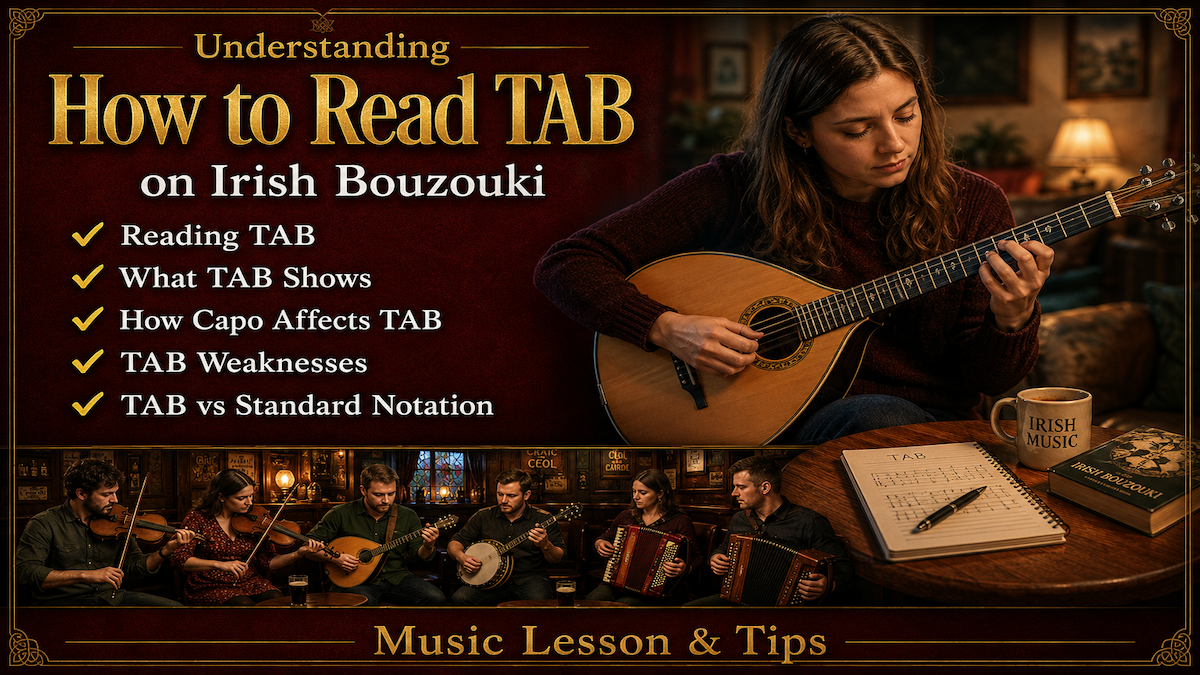
Learn how to read Irish bouzouki TAB, understand rhythm, chords, capo use, and authentic accompaniment techniques.
How To Read Irish Bouzouki TAB
Learning how to read Irish bouzouki TAB can help students understand fret positions, chord shapes, rhythms, hammer-ons, and accompaniment patterns more clearly. However, TAB works best when combined with ear training and standard notation, especially in Irish traditional music where rhythm, phrasing, and feel are essential.
In this lesson, we are going to explore how Irish bouzouki TAB works using accompaniment examples from “The Maids of Mount Cisco” and “Farewell to Whalley Range.” We will look at capo positions, rhythmic interpretation, chord movement, drones, hammer-ons, counter melodies, and why standard notation is still one of the most valuable skills a traditional musician can develop.
One of the biggest misunderstandings beginners have is believing TAB is a shortcut that removes the need for understanding music notation. In reality, TAB still requires rhythm awareness, technical control, listening skills, and knowledge of the instrument’s tuning system. The real goal is not simply to follow numbers on a page, but to understand why the accompaniment sounds musical.
- Irish bouzouki TAB shows fret positions rather than note names.
- Capo placement changes how TAB numbers relate to the instrument.
- Learning by ear and reading standard notation remain essential musical skills.
- Rhythm, strumming direction, and phrasing are not fully explained by TAB alone.
- Traditional Irish accompaniment relies heavily on drones, resonance, and counter melodies.
What Irish Bouzouki TAB Actually Shows
TAB is a visual representation of where your fingers go on the instrument. Instead of showing traditional notes on a stave, it uses numbers to indicate fret positions. Each horizontal line represents a string or course on the bouzouki, and the numbers tell you which fret to press.
For Irish bouzouki players, this can initially feel more approachable than standard notation because you can immediately see physical finger placement. However, TAB does not naturally communicate rhythm, phrasing, articulation, or musical structure as effectively as traditional notation.
PRO TIP
Use TAB as a physical guide for learning chord and melody shapes, but always listen carefully to recordings so you understand how the rhythm and phrasing should actually sound.
Understanding Irish Bouzouki Tuning
One important limitation of Irish bouzouki TAB is that it only applies correctly to a specific tuning system. Most Irish bouzoukis use GDAD tuning, which differs significantly from standard guitar tuning.
This means TAB written for Irish bouzouki cannot simply be transferred directly to guitar. Guitar has six strings, while Irish bouzouki normally has four courses. The intervals between strings are also completely different.
INSIGHT
Many students assume TAB is universal, but bouzouki TAB is highly instrument-specific. Understanding the tuning system is essential before the numbers make musical sense.
| Instrument | Typical Tuning | Number Of Strings/Courses |
|---|---|---|
| Irish Bouzouki | G D A D | 4 Courses |
| Guitar | E A D G B E | 6 Strings |
| Mandolin | G D A E | 4 Courses |
How Capos Affect TAB Reading
One of the most important concepts when reading bouzouki TAB is understanding capo position. Every number in the TAB becomes relative to the capo rather than the nut of the instrument.
For example, if the capo is placed on the seventh fret and the TAB says “3,” you do not count from the nut. You count three frets above the capo position.
This changes the sounding pitches dramatically and allows traditional musicians to create resonant drone textures in different tonal centres while still using familiar chord shapes.
PRACTICE EXERCISE
Take a simple chord progression and move the capo to different positions while keeping the same finger shapes. Listen carefully to how the tonal colour changes even though the shapes remain identical.
Capo Positions Used In The Lesson
| Tune | Capo Position | Musical Purpose |
|---|---|---|
| The Maids Of Mount Cisco | Capo 7 | Bright resonance and drone textures |
| Farewell To Whalley Range | Capo 4 | F# minor pentatonic atmosphere |
The Biggest Weakness Of TAB
The biggest weakness of TAB is rhythm. While it clearly shows where your fingers should go, it often fails to communicate exactly when notes should happen and how long they should last. It also makes pattern recognition in the melody much more difficult.
Traditional notation combines pitch and rhythm simultaneously. TAB separates them or ignores rhythm entirely. This creates confusion for many students, especially when learning syncopated accompaniment patterns or complex traditional dance rhythms.
In Irish traditional music, rhythm is absolutely essential. A reel, jig, slip jig, or hornpipe will immediately lose its character if the rhythmic feel is incorrect.
COMMON MISTAKE
Many students focus only on the fret numbers and completely ignore rhythmic flow. This often results in accompaniment that sounds mechanical and disconnected from the tune.
Why Standard Notation Is More Powerful
Standard notation communicates far more information than TAB alone. It shows rhythm, note relationships, phrasing, dynamics, melodic contour, and structural patterns all at once.
Once students become comfortable reading notation, they begin recognising repeated rhythmic shapes and melodic movements instantly. Music starts functioning and looking like a language, rather than looking like a mathematical equation of isolated numbers the way TAB can look.
This is particularly valuable in Irish traditional music because accompaniment patterns often mirror or answer the melody. Standard notation makes those relationships easier to identify.
INSIGHT
Reading notation is similar to reading words rather than spelling out every letter individually. Eventually, your brain begins recognising larger rhythmic and melodic patterns automatically.
Understanding Rhythm In Bouzouki Accompaniment
When accompanying Irish tunes, rhythm is just as important as chord choice. The bouzouki often acts like a rhythmic engine underneath the melody, supporting dancers and reinforcing the groove of the tune.
In the lesson, several accompaniment styles appear. Some sections are heavily chordal and rhythmic, while others rely more on counter melodies, drones, and open string resonance.
The strumming pattern must feel natural and flowing. Downstrokes generally align with strong beats, while upstrokes fill weaker subdivisions between beats.
| Beat Position | Typical Movement | Musical Effect |
|---|---|---|
| Strong Beat | Downstroke | Stable pulse and emphasis |
| Weak Beat | Upstroke | Flow and momentum |
| Held Chord | Sustain or Dampening | Creates phrasing contrast |
Using Drones And Open Strings
One of the defining characteristics of Irish bouzouki accompaniment is the use of drones and ringing open strings. These create resonance and texture rather than tightly controlled harmonic precision.
In many traditional accompaniment patterns, open strings create additional notes above the chord. In jazz terminology these might be labelled as 9ths, 11ths, or suspended tones, but in Irish traditional music they are usually approached more organically.
Instead of analysing every extension academically, many players simply think in terms of drone resonance, colour, and flow.
PRO TIP
Allow open strings to ring whenever possible. Irish bouzouki accompaniment often sounds richer and more atmospheric when resonance is preserved instead of muted too aggressively.
Hammer-Ons And Ornamented Movement
The lesson also demonstrates how hammer-ons appear in TAB notation. A hammer-on occurs when the left hand produces the second note without the right hand striking the string again.
This creates smoother melodic movement and allows accompaniment patterns to feel more fluid and expressive. Hammer-ons are especially useful in Irish accompaniment because they imitate some of the flowing ornamentation found in melody instruments like fiddle, flute, and whistle.
Students should practise hammer-ons slowly at first, ensuring the second note speaks clearly without excessive force.
PRACTICE EXERCISE
Play a simple open-string note and hammer onto the third fret repeatedly without using the pick for the second note. Focus on clarity, timing, and even tone.
Counter Melody Versus Chordal Accompaniment
A major theme throughout the lesson is the difference between purely chordal accompaniment and counter melodic accompaniment.
Some sections use rhythmic chord strumming, while others move independently underneath the tune. This creates interaction between accompaniment and melody rather than simple harmonic support.
Counter melodies often mirror fragments of the tune, answer melodic phrases, or move in parallel intervals such as thirds, fifths, or sixths.
This is where ear training becomes extremely important. The best counter melodies usually emerge from listening carefully to the tune rather than mechanically following written numbers.
COMMON MISTAKE
Students often try to fill every space with complex movement. Traditional accompaniment usually works best when the texture remains supportive rather than overcrowded.
Why Ear Training Still Matters Most
Although TAB can help students understand positions and movements, the lesson repeatedly emphasises that learning by ear remains one of the most musical approaches to Irish traditional music.
Traditional musicians historically learned through listening, repetition, imitation, and participation in sessions. This develops timing, phrasing, ornamentation, and instinctive musicality in a way that notation alone cannot provide.
Listening also teaches students how accompaniment interacts with real performers rather than existing only on paper.
INSIGHT
The goal is not to memorise numbers mechanically. The goal is to internalise the sound of the music so thoroughly that the accompaniment begins to feel natural.
The Importance Of Repetition
One of the most valuable lessons from the session is seeing how much repetition is required to create polished accompaniment recordings. Even experienced musicians repeat sections many times before achieving a take they are happy with.
This repetition should not be viewed negatively. Repetition builds consistency, timing, accuracy, confidence, and deeper familiarity with the instrument.
Eventually, repeated practice can create a focused state where movement begins feeling automatic and musical ideas become more fluid.
PRO TIP
Record yourself regularly during practice sessions. Listening back reveals timing issues, tuning problems, and weak transitions that are easy to miss while playing.
How To Practise Irish Bouzouki TAB Effectively
Students often become frustrated because they repeat mistakes without understanding why those mistakes occur. Effective practice requires reflection and analysis rather than blind repetition.
If a particular bar consistently breaks down, stop and investigate the cause. The issue may involve awkward fingering, poor rhythmic understanding, weak picking technique, or unfamiliar chord movement.
Keeping a practice journal can help identify recurring problems and track long-term improvement.
PRACTICE EXERCISE
After every practice session, write down one section that improved and one section that still feels unstable. Create a specific plan for solving the problem rather than repeating it mindlessly.
Step-By-Step Practice Routine
Step 1: Listen to the tune several times before touching the instrument. Focus on rhythm, phrasing, and structure.
Step 2: Identify the capo position and understand how the TAB numbers relate to the capo.
Step 3: Practise the chord shapes slowly without rhythm until finger placement feels comfortable.
Step 4: Add steady downstroke and upstroke patterns using a slow metronome tempo.
Step 5: Practise individual hammer-ons and melodic fragments separately before combining them into full phrases.
Step 6: Play along with recordings at reduced speed so you can match timing and phrasing accurately.
Step 7: Record short sections of your playing and compare them against the original accompaniment.
Step 8: Gradually reduce reliance on the TAB by memorising rhythmic patterns and listening more carefully to the tune.
Step 9: Experiment with your own small variations and counter melodies once the accompaniment feels secure.
Step 10: Revisit the tune regularly over several weeks rather than expecting perfection immediately.
Developing Long-Term Musicianship
A recurring idea throughout the lesson is that music learning never truly ends. Even advanced professional musicians continue learning new tunes, techniques, influences, and stylistic approaches throughout their entire careers.
Students sometimes imagine that one day they will finally “arrive” and stop making mistakes. In reality, musicianship is an ongoing process of refinement, experimentation, listening, and growth.
The important thing is not avoiding mistakes entirely, but learning how to respond constructively when they happen.
INSIGHT
The best musicians are usually not the people who never make mistakes. They are the people who keep learning, adapting, and improving over many years of consistent practice.
Key Takeaways
✅ Irish bouzouki TAB is useful for learning fret positions and accompaniment shapes, but it does not fully communicate rhythm or phrasing.
✅ Capo placement changes how TAB numbers function, so students must always think relative to the capo position.
✅ Standard notation provides far more musical information and helps students recognise rhythmic and melodic patterns more effectively.
✅ Open strings, drones, and resonance are essential parts of traditional Irish bouzouki accompaniment.
✅ Ear training remains one of the most important skills for developing authentic traditional accompaniment.
✅ Consistent repetition, reflection, and slow focused practice are the keys to long-term improvement.
FAQ
Should Beginners Learn TAB Or Standard Notation First?
If possible, beginners should prioritise learning standard notation first because it develops rhythm reading, musical understanding, and long-term musicianship. TAB can still be useful as a supplementary tool for learning shapes and positions.
Why Does Irish Bouzouki TAB Look Different From Guitar TAB?
Irish bouzouki uses a different tuning system and fewer strings than guitar. Because of this, the fret relationships and chord shapes are completely different.
How Important Is Learning By Ear In Irish Music?
Learning by ear is extremely important because it develops timing, phrasing, ornamentation, and instinctive musicality. Many traditional players rely heavily on listening and imitation rather than written notation alone.
What Is The Purpose Of Open Strings In Bouzouki Accompaniment?
Open strings create resonance, drones, and harmonic colour. They help produce the rich atmospheric texture that is characteristic of Irish bouzouki accompaniment.
How Long Does It Take To Become Comfortable Reading TAB?
That depends on practice consistency and previous musical experience. Most students can begin recognising basic TAB patterns fairly quickly, but developing fluent accompaniment skills takes ongoing repetition and listening experience.
To take your learning to the next level,
check out some of these amazing Courses & Apps

Categories: : Irish Traditional Music
Did this article answer all your questions?
If you have any questions, or you want to learn more,
Click the Picture Below to Join the Community for FREE!