Stop Playing Irish Music By the Book - How to Sound Authentic!
 Declan Plummer
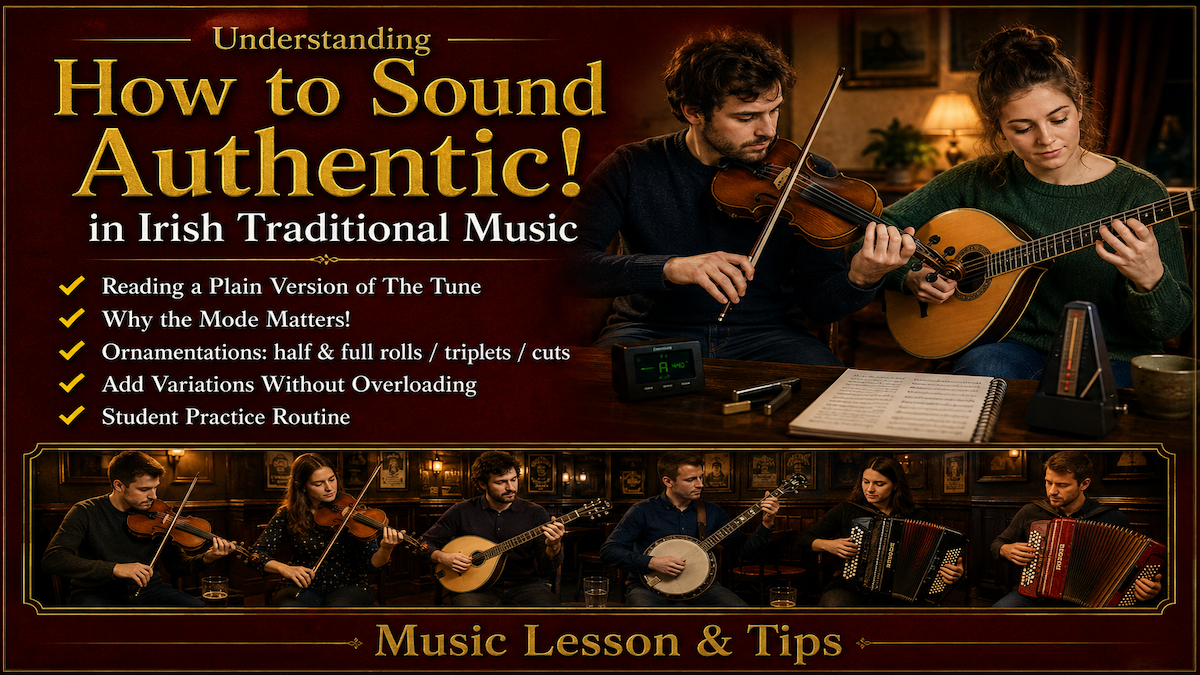
Learn how to turn Irish sheet music into authentic trad music using rolls, cuts, triplets, modes and variation.
How To Turn Sheet Music Into Authentic Irish Traditional Music
To make Irish traditional music sound authentic from sheet music, treat the notation as a basic skeleton rather than a complete performance. Identify the mode, understand the tune structure, then add suitable rolls, half rolls, cuts, triplets, rhythmic lift and tasteful variation in places where the melody naturally allows them.
Many students can now find Irish tunes very easily through online collections, printed books, ABC notation and standard staff notation. That access is incredibly useful, but the notation alone rarely tells the full story of how the music should actually sound. A reel written on the page can look quite plain, even when the living tradition behind it is full of energy, lift, ornamentation and subtle variation.
This lesson uses The Maids Of Mount Cisco as a practical example of how to take a written Irish reel and begin shaping it into a more convincing traditional performance. The tune is often associated with A Dorian, and that modal identity affects both the melody and the accompaniment. Before adding ornaments, it is important to know what mode you are in, because that changes the notes, chords and overall colour of the tune.
The goal is not to decorate every possible note until the tune becomes cluttered. The aim is to understand where ornaments can go, why they fit there, and how to choose between them musically. Once you can see the opportunities, you can decide which ones to use in performance.
- Use sheet music as a guide, not as the complete finished performance.
- Identify the mode before choosing chords or melodic emphasis.
- Add rolls, half rolls, cuts and triplets where the written rhythm naturally supports them.
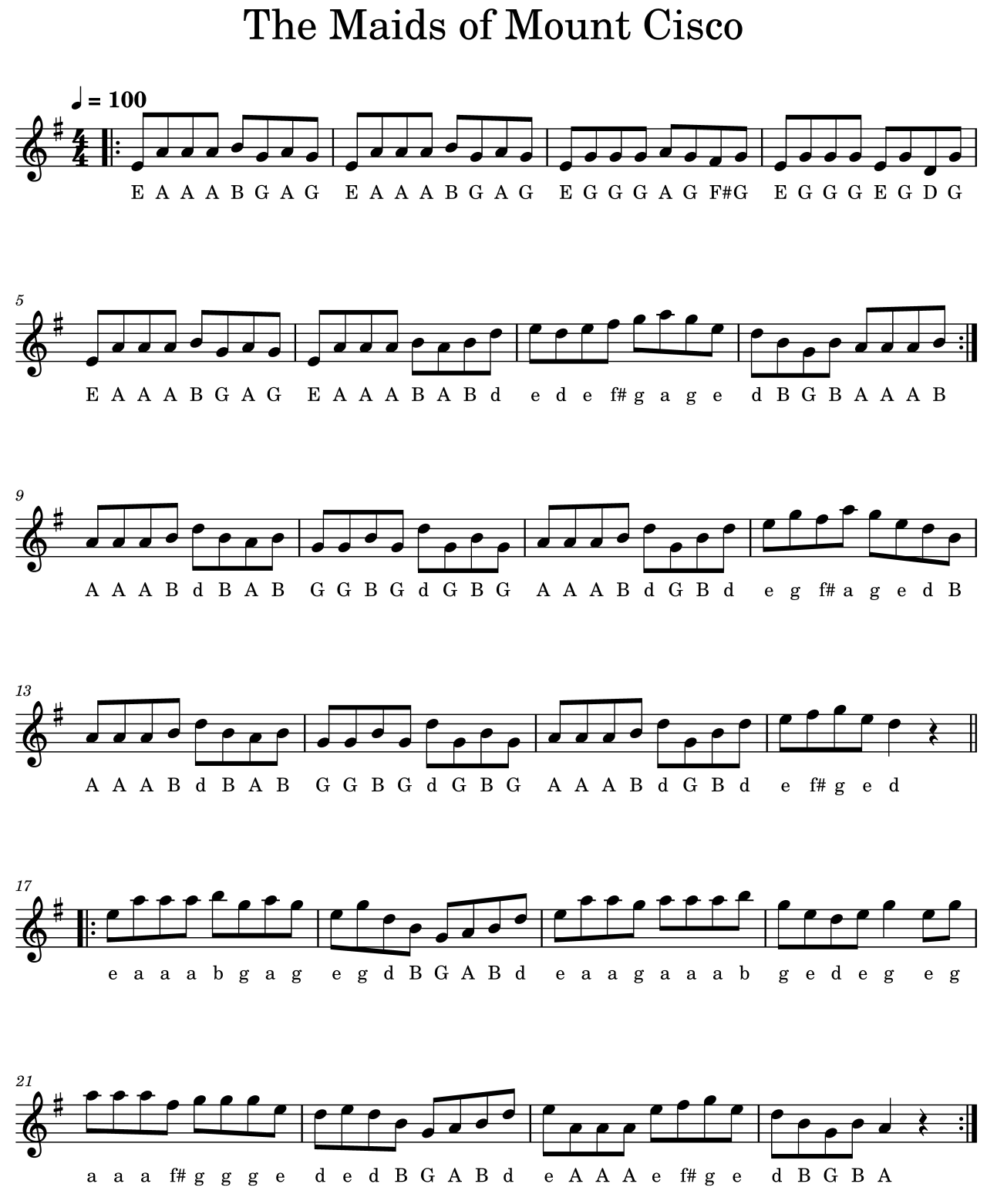
Starting With A Clean Version Of The Tune
When learning from a written source, it is usually best to begin with a clean version of the melody. Some online transcriptions already include suggested ornaments, but these are not always the best place to start. A plain version helps you see the basic shape of the tune without being distracted by extra markings.
If you download a MIDI file into notation software such as MuseScore, the tune may appear longer than it really is because repeated sections are written out in full. In a three-part reel, this can make the page look far more complicated than necessary. A useful first step is to reduce the notation so that each section is clearly shown once, with repeat marks added where needed.
PRO TIP: Before adding ornamentation, simplify the score visually. Remove unnecessary repeated-out sections, add clear repeat signs, and make the tune easy to read. A clean page makes musical decisions much easier.
Why The Mode Matters
One of the first musical questions is not simply “what key is this in?” but “what mode is this in?” In this tune, the sound is A Dorian. That means the tune centres on A, but it uses the Dorian pattern rather than ordinary A minor.
The Dorian mode follows the pattern tone, semitone, tone, tone, tone, semitone, tone. Starting on A gives: A, B, C, D, E, F#, G and A. The F# is especially important. It may not appear constantly, but it changes the whole colour of the tune and helps separate A Dorian from A Aeolian.
This matters for accompaniment. If the tune were A Aeolian, the harmony might naturally include D minor or F major. In A Dorian, the F# makes D major much more suitable. That single note changes the chord choices available to a bouzouki or guitar player.
INSIGHT: In Irish traditional music, calling every modal tune “minor” can cause confusion. A Dorian tune is not the same as A natural minor, and the accompaniment should reflect that difference.
Structure Breakdown Table
| Musical Feature | What To Look For | Performance Choice |
|---|---|---|
| Full Roll | Three quavers of the same pitch, a dotted crotchet, or a quaver plus crotchet | Play the note, cut above, then tap below |
| Half Roll | Two quavers of the same pitch or a crotchet-length note | Cut immediately, then tap below |
| Triplet | A skip of a third, such as B to D or E to G | Play as a quick ornamental figure, closer to two semiquavers and a quaver |
| Cut | A note approached from below, often on the beat | Strike briefly from the note above |
Adding Full Rolls
The FULL ROLL is one of the most important ornaments in Irish traditional music. It often appears where the written notation gives you three quavers of the same pitch, or the rhythmic value of three quavers. This could be three repeated quavers, a dotted crotchet, or a crotchet plus a quaver of the same note.
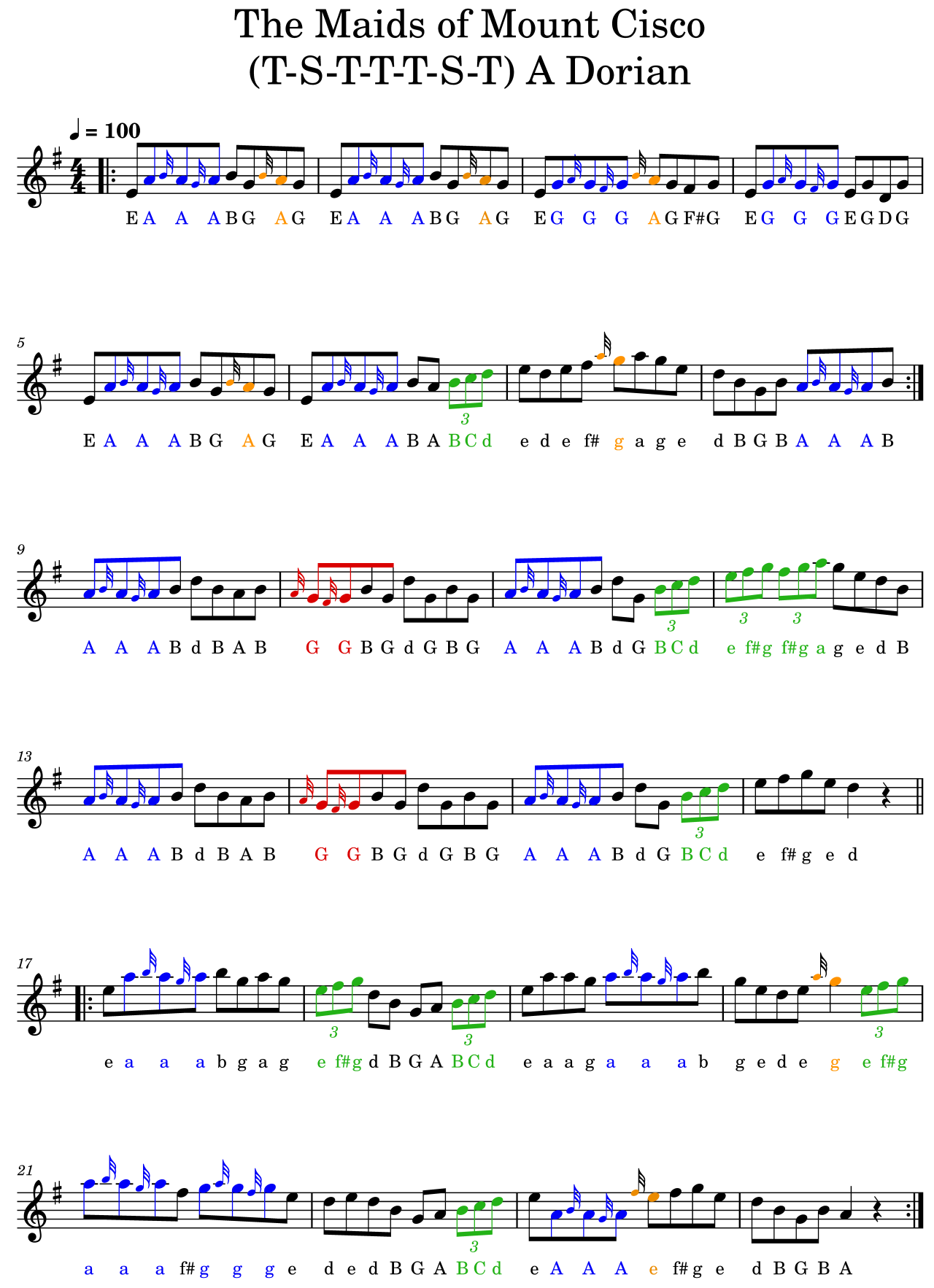
On the tin whistle, a full roll normally contains three parts: the main note, a cut from above, and a tap from below. For example, an A roll starts with A, uses a quick cut above, then taps from below before returning to the flow of the tune (see bar 1 below for the A full roll highlighted in blue). The notation may look simple, but the physical action gives the note life and movement.
In an A Dorian tune, you will often find many opportunities for A rolls because A is the tonal centre. You may also find G rolls or other rolls depending on the melodic shape. The octave does not change the basic idea: a high A roll and a low A roll are still serving the same ornamental function.
PRACTICE: Take one line of the tune and mark every note that lasts for the value of three quavers. Do not play them all as rolls immediately. First, identify the possibilities, then choose the ones that sound most musical.
Adding Half Rolls
A HALF ROLL is shorter than a full roll. It is useful when the written note only lasts for the value of two quavers. Instead of playing the note, cutting it and tapping it across three quaver spaces, the half roll begins more quickly. You cut almost immediately, then tap below. See the G half-roll in bar 10 below (highlighted in red).
This distinction matters because rolls must fit the rhythm. If a note only has the length of a crotchet, forcing a full roll into that space can sound rushed or clumsy. The half roll gives you a decorative effect without disturbing the pulse of the reel.
COMMON MISTAKE: Do not treat every long note as if it needs the same ornament. A dotted crotchet can take a full roll, but a plain crotchet usually needs a half roll or a simpler decoration.
Using Triplets In Reels
TRIPLETS are another common feature, but they are often not played like even classical triplets. In Irish traditional performance, a figure such as B-C-D is usually much sharper and tighter than three equal notes. It is often closer to two quick semiquavers followed by a quaver.
A very common place to add this is where the written melody moves from B to D. Because B and D are a third apart, the missing C can be inserted between them as a quick ornamental figure. The same logic can apply to E-F#-G (see bar 18 for an example) or F#-G-A (see bar 12 for an example), depending on the shape of the tune.
Descending figures can also work, especially in piping styles to closed/tight staccato playing. For example, a movement from G down to E may invite a quick G-F#-E figure. However, on tin whistle or flute, you may choose to use this more sparingly, depending on the flow of the tune and your own style.
Cuts, Variation And Accompaniment
Where To Add Cuts
CUTS are short, single-note decorations. They are especially useful when a note is approached from below and lands on the beat. If the melody moves from G up to A, you may cut the A from above with a very quick B (see bar 3 below for an example highlighted in orange). If the melody moves from F sharp to G, you may cut the G from above with A (see bar 7 below for an example highlighted in orange).
The cut should be quick and light. It is not a separate melodic note in the ordinary sense. It is a percussive interruption that gives the phrase lift and articulation. Used well, cuts help the tune dance. Used too heavily, they can make the line sound fussy.
Adding Variation Without Overloading The Tune
Once the main ornaments are in place, you can begin thinking about variation. Variation might mean repeating a roll, changing a short melodic turn, adding a syncopated figure, or replacing a plain movement with a more decorated one. The important point is that variation should grow from the tune rather than distract from it.
For example, if a phrase moves around E and G, you might choose between playing it plainly, adding repeated rolls, or using a quicker E-F#-G figure. All three can be valid, but they should not all be forced into the same pass of the tune. A good traditional performance often varies the tune slightly each time through.
Thinking About Bouzouki Chords
For accompaniment, the mode gives you the foundation. In A Dorian, the main harmonic world includes A minor, G major and D major. The D major chord is especially important because of the F# in the mode. Without understanding that modal note, an accompanist might choose chords that make the tune sound more like ordinary minor rather than Dorian.
A bouzouki part does not need to copy the melody. It can support the pulse, outline the mode, and occasionally add a short riff or response. The strongest accompaniment usually comes from understanding the tune’s structure first, then adding chord movement that reinforces the modal character.
The Maids of Mount Cisco: Tin Whistle:
The Maids of Mount Cisco: Tin Whistle & Bodhrán:
Download the Irish Bouzouki TAB here
Practice Routine
Step By Step Practice Routine
Start by playing the tune exactly as written at a slow tempo. This gives you a clear sense of the skeleton melody. Next, identify the mode and mark the notes that define it, especially any note that separates one mode from another, such as F sharp in A Dorian.
Then mark every possible full roll. Look for three repeated quaver values, dotted crotchets, or a quaver plus crotchet of the same pitch. Practise these slowly on one note at a time before adding them back into the phrase.
After that, find possible half rolls on shorter held notes. Add triplets where the melody skips a third, such as B to D or E to G. Finally, add cuts on suitable notes approached from below, especially when they fall on the beat.
Once you have all the options marked, reduce them. Do not perform every ornament every time. Play one version plainly, one version with rolls, one version with triplets, and one version with a mixture. This teaches you to make musical choices rather than simply decorate by habit.
Key Takeaways
✅ Sheet music gives you the framework of an Irish tune, but the traditional sound comes from rhythm, phrasing, ornamentation and variation.
✅ Always identify the mode before choosing chords, because A Dorian and A minor do not create the same musical colour.
✅ Full rolls work best where the note has the value of three quavers, while half rolls suit shorter two-quaver spaces.
✅ Triplets are often written as triplets but performed with a sharper traditional feel, closer to two quick notes followed by a longer one.
✅ Authentic playing is not about using every ornament possible; it is about choosing the right decoration at the right moment.
FAQ
Can I Learn Irish Traditional Music From Sheet Music?
Yes, but sheet music should be treated as a starting point. It gives you the notes and structure, but you still need to add phrasing, ornamentation, lift and variation by listening carefully and practising in a traditional style.
What Is The Difference Between A Full Roll And A Half Roll?
A full roll normally fills the value of three quavers and includes the note, a cut and a tap. A half roll is shorter, usually fitting into the value of two quavers, and begins more immediately with the cut and tap action.
Why Is A Dorian Different From A Minor?
A Dorian uses F sharp, while A natural minor uses F natural. That one note changes the sound of the tune and affects the harmony. In A Dorian, D major is available, while A natural minor would suggest different chord choices.
Should I Add Ornaments Everywhere They Fit?
No. It is useful to identify every possible ornament location, but performance requires taste. Use enough ornamentation to bring the tune to life, but leave space so the melody still sounds clear, rhythmic and natural.
How Should Bouzouki Players Approach A Dorian Tunes?
Bouzouki players should begin by recognising the modal centre and important scale notes. In A Dorian, chords such as A minor, G major and D major can help support the tune while keeping the distinctive Dorian sound clear.
Categories: : Irish Traditional Music
Did this article answer all your questions?
If you have any questions, or you want to learn more,
Click the Picture Below to Join the Community for FREE!