Irish Traditional Music Modes Explained for Bouzouki, Guitar and Trad Players
 Declan Plummer
Learn Ionian, Dorian, Mixolydian and Aeolian modes in Irish trad music, with capo tips, chord choices and practice guidance.
Understanding Modes In Irish Traditional Music
Modes in Irish traditional music are scale patterns that shape the sound, mood and chord choices of a tune. Instead of thinking only in major and minor keys, Irish trad players often work with Ionian, Dorian, Mixolydian and Aeolian modes, each creating a different musical colour.
When learning Irish bouzouki accompaniment, guitar backing, tin whistle, fiddle, flute or uilleann pipes, understanding modes makes the whole tradition feel clearer. It helps you recognise why some tunes sound major, why others sound minor, and why certain chords work beautifully while others clash immediately.
This lesson focuses on the practical side of modes. Rather than treating them as abstract theory, we will look at the main modal sounds used in Irish traditional music, the keys they most often appear in, and how they affect capo position, chord progressions and accompaniment choices.
- Irish traditional music mainly uses Ionian, Dorian, Mixolydian and Aeolian modes.
- D and G Ionian are the most common sounds, so they are the best starting point for accompaniment.
- Capo position changes resonance, brightness and chord shape choices on Irish bouzouki.
What Is A Musical Mode?
A mode is simply a scale pattern created by the distance between eight notes. In Western music, those distances are usually tones and semitones. A semitone is the smallest normal distance between two notes, such as B to C or C to C# on the piano. A tone is simply two semitones.
Major and minor scales are not separate from modes. They are types of mode. The major scale is also called the Ionian mode, while the natural minor scale is also called the Aeolian mode. Irish traditional music uses these sounds, but it also relies heavily on Dorian and Mixolydian.
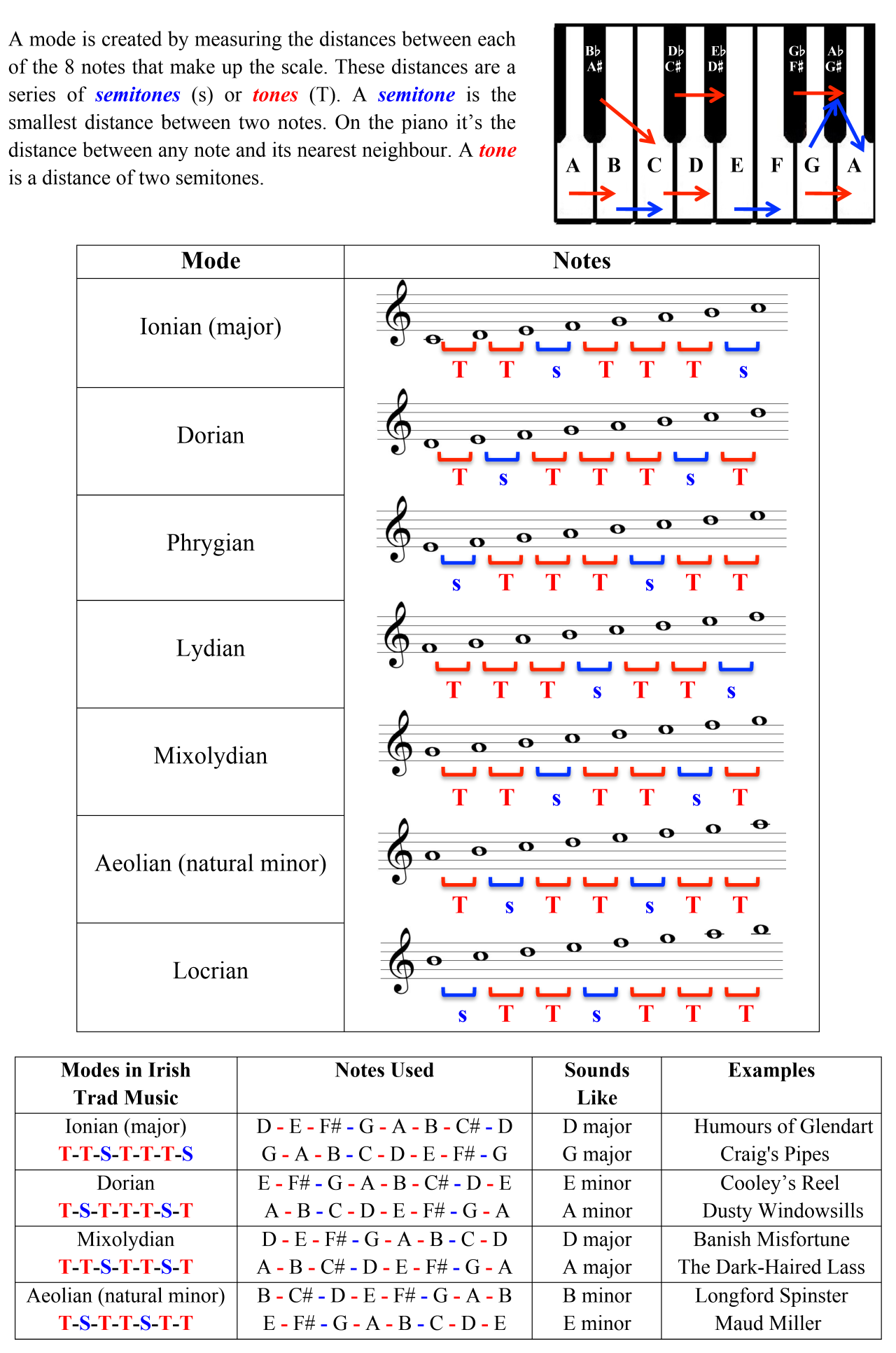
Pro Tip: Do not try to memorise every tone and semitone pattern first. Learn the sound of each mode through scales, tunes and chords. Your ear will recognise the mode more quickly than your memory will recall a formula.
The Four Main Modes In Irish Trad
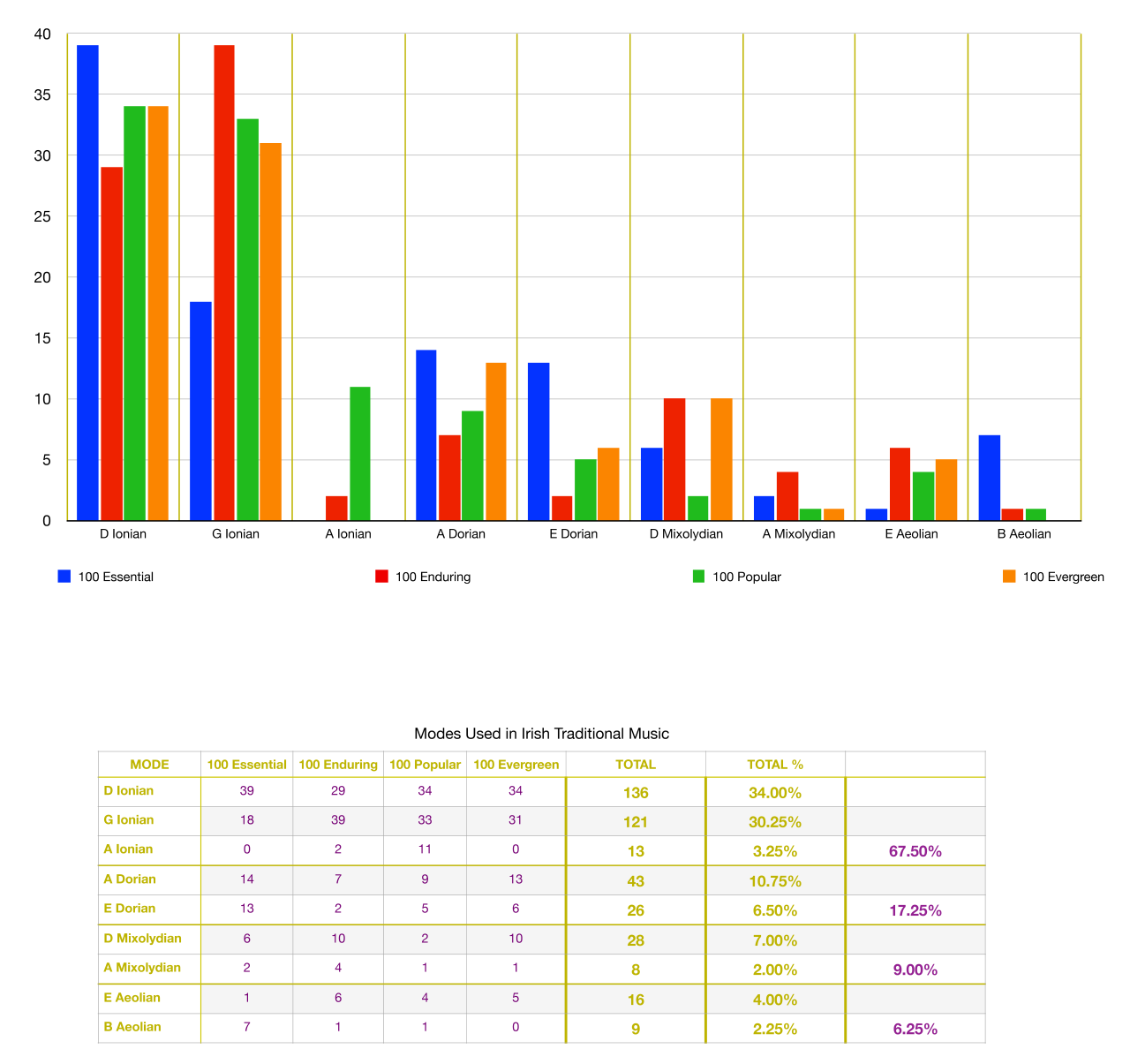
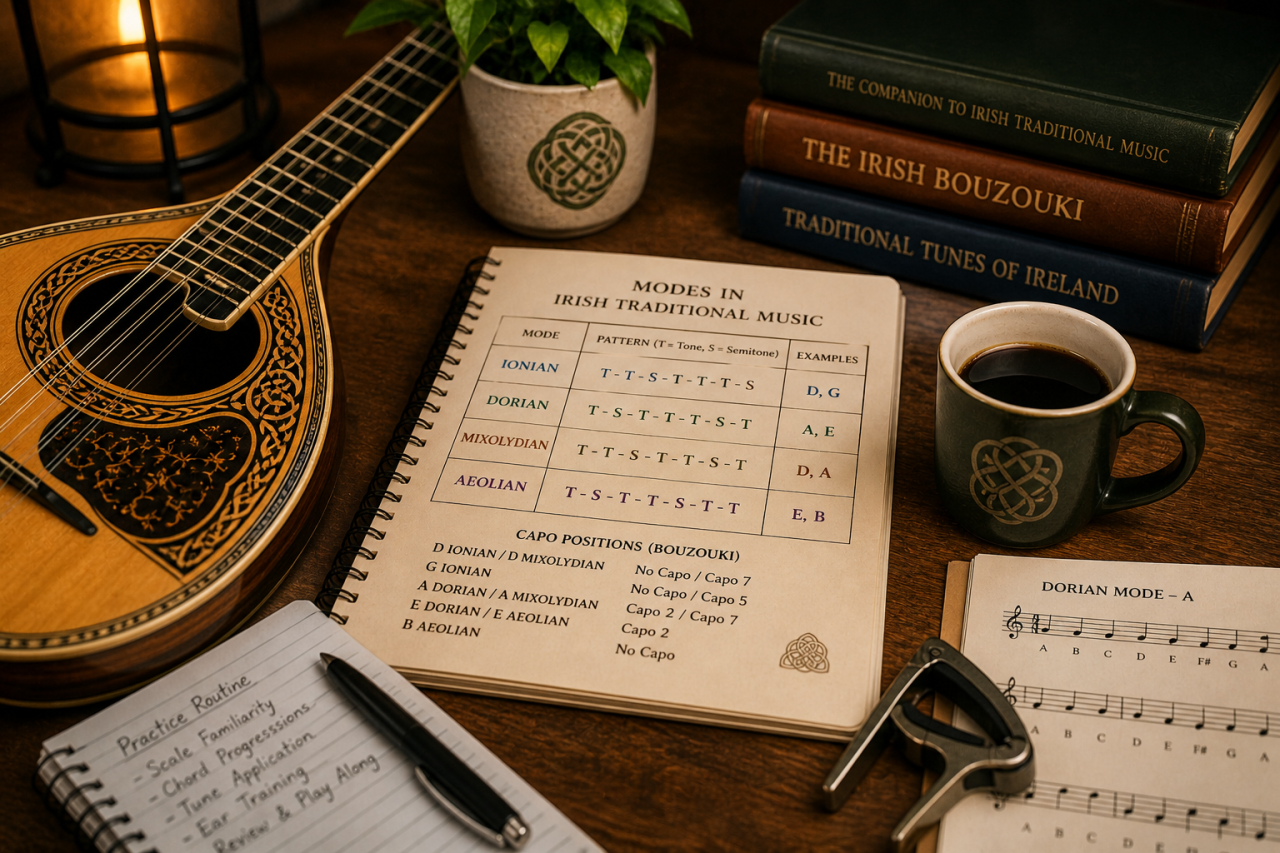
Although seven modes exist in theory, Irish traditional music commonly uses four: Ionian, Dorian, Mixolydian and Aeolian. Phrygian, Lydian and Locrian may appear in other styles or theoretical discussions, but they are not central to standard Irish, Scottish, Welsh or English traditional repertoire. Below is a table analysing all the tunes found in the Mally Presents books series, by Dave Mallinson. Each of the four books analysed (100 Essential, 100 Enduring, 100 Popular, 100 Evergreen), contains an incredible collection of the most famous and widely-performed session tunes in the Irish traditional repertoire. In all four books, Ionian is the most popular mode (over 66%), followed by Dorian as a distant second (less than 20%), then Mixolydian (less than 10%), and finally Aeolian (just over 6%):
| Mode | Common Trad Keys | General Sound |
|---|---|---|
| Ionian | D, G (other keys sometimes) | Major, bright, stable |
| Dorian | A, E | Minor-like, with a flattened seventh |
| Mixolydian | D, A | Major-like with a flattened seventh |
| Aeolian | E, B | Natural minor, far less common in trad |
Ionian Mode: The Major Sound
Ionian is the major scale sound. In Irish traditional music, the most important Ionian keys are D major and G major. These are extremely common because they suit the range and fingering of instruments such as tin whistle, flute and pipes.
This is no accident: whistles, for example, have a range of tunings (starting with the lowest: A, Bb, C, D, Eb, F and G) - and D tuning rests in the middle, giving this whistle tuning an even balance between tone (so it's not as shrill has the higher tuned whistles) and volume (so it's not as quiet as the lower whistles). D whistles can also easily perform the scale of G major (with C natural); so it's not surprising that the Ionian modes for D and G are the most popular keys in Irish traditional music. The D whistle, with its comfortable note spacing, is the ideal standard tuning for the whistle, and therefore the flute and uilleann pipes. Similarly, the fiddle is just the folk name given to the modern day violin, with its long-established tuning of GDAE, also making D and G major (the opening strings) the ideal keys for beginners to learn with the least amount of accidentals.
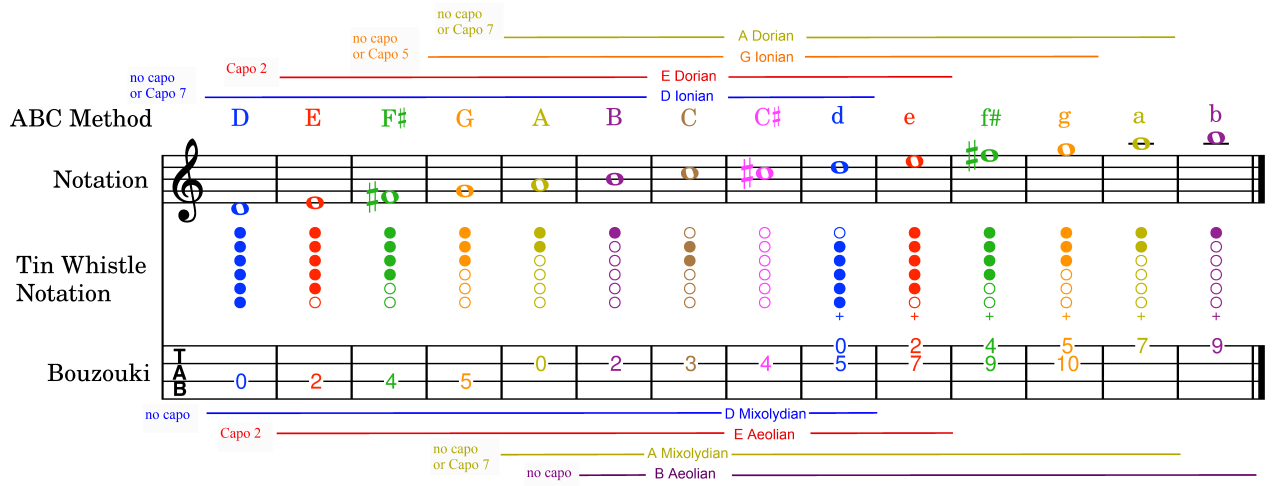
In D Ionian, the scale uses D, E, F#, G, A, B, C# and D. In G Ionian, the scale uses G, A, B, C, D, E, F# and G. These notes shape the chords you are likely to use when accompanying the tune.
Insight: If a tune feels bright, settled and major, it is very likely to be Ionian. For Irish accompaniment, D and G Ionian should be among the first modal areas you practise seriously.
Ionian Chord Progression Box
| Mode | Useful Chords | Typical Movement |
|---|---|---|
| D Ionian | D, G, A, Bm | D → G → A → D OR Bm → G → A → D |
| G Ionian | G, C, D, Em | G → C → D → G OR Em → C → D → G |
Dorian Mode: Minor Sound With A Flattened Seventh
Dorian often sounds minor, but it is not the same as the classical minor scale. The crucial difference is the flattened seventh. In E Dorian, for example, you use D natural rather than D#. This changes the harmony completely.
In classical E minor, chord V (the dominant chord) often becomes B major because of the D# leading note. In E Dorian, that D# is not part of the mode, so a D major chord leading back to E minor or E power chord is much more natural in a trad setting. So in classical music V - i (B major to E minor) is a common progression in minor keys, especially to end phrases. But in Irish traditional music bVII - i (D major to E minor) is far more common!
The same idea applies to A Dorian. It may sound close to A minor, but the presence of G natural instead of G# gives it a modal quality. Instead of hearing E major strongly pulling back to A, you will often hear G major moving into A.
Common Mistake: Do not automatically treat Dorian tunes as ordinary minor-key tunes. Adding a raised seventh can clash badly with melody instruments that are playing the flattened seventh.
How To Hear Dorian
Listen for a minor-like centre with a freer, more open sound than classical minor. In E Dorian, the D natural is a strong clue. In A Dorian, the G natural is the giveaway. That flattened seventh often creates a powerful walking movement back to the tonic.
Mixolydian Mode: Major Sound With A Flattened Seventh
Mixolydian is easiest to recognise as a major-like sound with a flattened seventh. D Mixolydian is very important in Irish music. It is almost the same as D major, but it uses C natural instead of C#.
That one note changes the harmony. In D Ionian, an A major chord leading to D feels natural because the scale includes C# (V - I ). In D Mixolydian, the C natural makes a C major chord much more characteristic (bVII - I). This gives the tune a strong modal flavour.
Practice Box: Play D Ionian and D Mixolydian back to back. First use C#, then replace it with C natural. Listen carefully to how one note changes the entire chord world around the tune.
D Ionian Versus D Mixolydian
| Sound | Seventh Note | Likely Chord Colour |
|---|---|---|
| D Ionian | C# | A major to D |
| D Mixolydian | C natural | C major to D |
Aeolian Mode: The Natural Minor Sound
Aeolian is the natural minor mode. In Irish traditional music, it appears far less often than Ionian, Dorian or Mixolydian, but it is still worth learning. The main Aeolian centres discussed here are E Aeolian and B Aeolian.
One important feature of Aeolian tunes is that they often do not stay in Aeolian for long. A tune beginning in B Aeolian usually changes into D Ionian in the second section. Likewise, E Aeolian usually changes to G Ionian in the second section. This modal shift is part of the character of many tunes.
Insight: Aeolian is rare enough that you should make a point of remembering the first few Aeolian tunes you learn. They give you practical reference points for a sound you may not meet every day.
Capo Positions For Irish Bouzouki Accompaniment
Once you understand the mode, capo position becomes much easier to choose. The capo is not just about finding the right key. It also changes the resonance, brightness and available chord shapes on the Irish bouzouki.
For D Ionian, no capo gives maximum resonance. Capo seven can also work if you want a brighter sound and are willing to play as though you are in G. This can be useful when two accompanists are playing together, as one can stay low while the other plays higher.
For E Dorian and E Aeolian, capo two is often a strong choice. It brightens the instrument without sacrificing too much resonance. For G Ionian, both no capo and capo five can work well, depending on the texture of the group.
| Tune Centre | Common Capo Choice | Effect |
|---|---|---|
| D Ionian & Mixolydian | No Capo / Capo 7 |
Resonant low sound or brighter high sound (use G chord progressions!) |
| E Dorian & Aeolian | Capo 2 | Clear modal shapes with good resonance. Works of E Dorian and E Aeolian! |
| G Ionian & Mixolydian | No Capo / Capo 5 |
Open ringing sound or higher accompaniment texture (use D chord progressions!) |
| A Dorian & Aeolian | No Capo / Capo 2 / Capo 7 |
Different chord colours and modal character use G Dorian chord progressions use D Dorian chord progressions |
How To Practise Modes In Irish Traditional Music
The best way to practise modes is not simply to read about them. You need to play them, hear them and connect them to real tunes. Before accompanying a tune, identify its tonic note, listen for the seventh, and decide whether the sound is major-like, minor-like, Mixolydian or Aeolian.
If you are learning a tune in D Mixolydian, warm up with the D Mixolydian scale. If you are accompanying something in E Dorian, play the E Dorian scale and then try simple chord movements using E minor or E power chord, D major and related modal colours.
Practice Box: Take one tune you already know and test whether it feels Ionian, Dorian, Mixolydian or Aeolian. Then build two simple chord progressions for it: one low and resonant, and one brighter with a capo.
Step By Step Practice Routine
Step one: choose one mode only. Start with D Ionian, G Ionian, A Dorian or E Dorian before moving into rarer sounds.
Step two: play the scale slowly and name each note aloud. This helps connect the sound of the mode to the notes used in the tune.
Step three: identify the seventh note. Ask whether it is raised or flattened, because this will usually tell you whether the tune is Ionian, Dorian or Mixolydian.
Step four: test two or three simple chords. Avoid overcomplicating the accompaniment before the modal centre is secure.
Step five: experiment with capo position. Compare resonance, brightness and comfort, then choose the position that best supports the melody and the other musicians.
Step six: practise with real tunes. Modes only become useful when they help you accompany actual jigs, reels, slip jigs and hornpipes with confidence.
Key Takeaways
Key Takeaways
✅ Irish traditional music mainly uses Ionian, Dorian, Mixolydian and Aeolian modes.
✅ Ionian is the most common sound, especially in D and G, so it should be a priority for beginners.
✅ Dorian sounds minor-like but uses a flattened seventh, which changes the chord choices dramatically.
✅ Mixolydian sounds major-like but also uses a flattened seventh, creating a distinctive modal colour.
✅ Capo position should be chosen for tone, resonance, brightness and practical chord shapes, not just key.
FAQ
What Modes Are Most Common In Irish Traditional Music?
The most common modes are Ionian, Dorian, Mixolydian and Aeolian. Ionian is especially common in D and G, while Dorian is often found around A and E.
Is Dorian The Same As Minor?
No. Dorian can sound minor-like, but it has a flattened seventh compared with many classical minor-key habits. This makes the harmony more open and modal.
Why Does Mixolydian Sound Different From Major?
Mixolydian sounds close to major, but the seventh note is flattened. In D Mixolydian, C natural replaces C#, which changes the chords and gives the tune a traditional modal character.
What Capo Position Should I Use For Irish Bouzouki?
It depends on the mode, key and sound you want. No capo gives more resonance, while higher capo positions create brightness. E-based tunes often work well with capo two.
Should I Memorise Tone And Semitone Patterns?
It is useful to understand them, but it is more practical to learn the scales, hear the modal sound and apply the notes directly to real Irish tunes and chord progressions.
Categories: : Irish Traditional Music
Did this article answer all your questions?
If you have any questions, or you want to learn more,
Click the Picture Below to Join the Community for FREE!