Music Theory for Beginners: How to Understand and Calculate Intervals (Complete Guide)
 Declan Plummer

Learn how to calculate musical intervals, understand chords, and master essential music theory with this beginner-friendly guide.
Understanding Musical Intervals In Music Theory
Musical intervals describe the distance between two notes and form the foundation of harmony, chords, and melody in music. By learning how intervals are measured and named, musicians can understand how chords are built, recognise harmonic movement, and analyse music more effectively.
In music theory, intervals are one of the most important concepts to understand early in your learning journey. They explain why certain combinations of notes sound stable, tense, bright, or dark. Every chord, melody, and harmonic progression ultimately relies on relationships between notes.
When musicians learn to identify intervals, they gain a powerful analytical tool. It becomes easier to understand how chords are constructed, how melodies move, and how composers create emotional impact through harmony.
- Musical intervals measure the distance between two notes.
- Intervals form the building blocks of chords and harmony.
- Understanding intervals helps musicians analyse music more clearly.
- Learning interval naming makes chord construction much easier.
What Is A Musical Interval?
A musical interval is simply the distance between two notes. This distance can occur either when two notes are played together or when they are played one after the other.
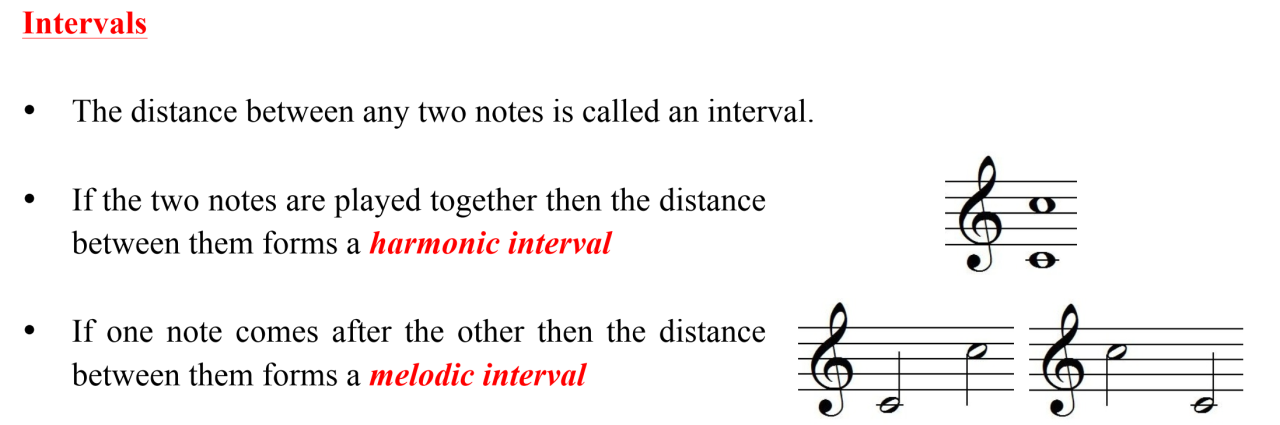
If two notes sound at the same time, we call the interval a harmonic interval. If one note follows another, we call it a melodic interval. Both types use exactly the same system of measurement.
Pro Tip
When learning intervals, always visualise them on a musical staff or instrument.
Seeing the notes helps you understand the distance more clearly than thinking only in abstract terms.
Harmonic Intervals
A harmonic interval occurs when two notes are played simultaneously. This type of interval forms the basis of chords and harmonic texture in music. For example, when a pianist plays two notes at the same time, the distance between those notes creates a harmonic interval.
Melodic Intervals
A melodic interval occurs when one note follows another in sequence. Most melodies are built from melodic intervals that move upward or downward. Understanding these movements helps musicians recognise patterns and phrases within melodies.
How To Calculate Musical Intervals
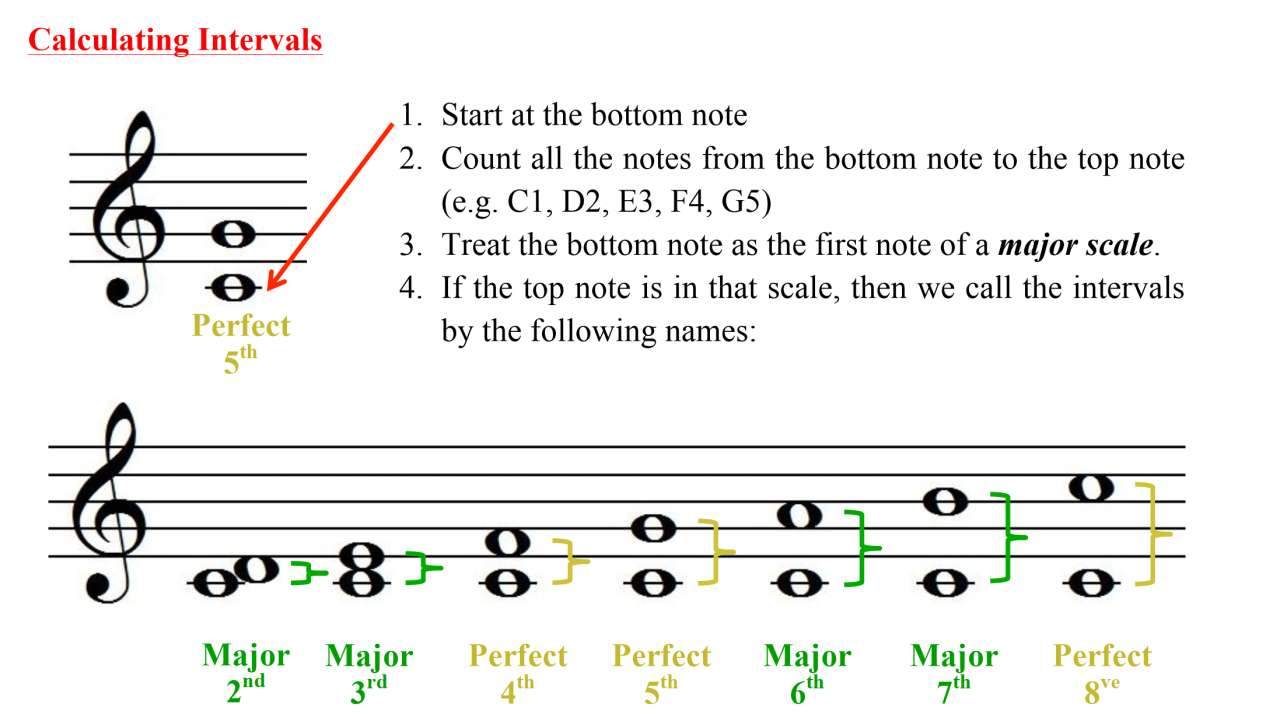
Calculating intervals involves counting the distance between two note names. The most important rule is that you always include both the starting note and the ending note in your count.
For example, if you start on C and move to G, you count C as one, D as two, E as three, F as four, and G as five. This means the interval is a fifth.
Practice Exercise
Choose a starting note and count upward through the musical alphabet until you reach another note.
Write down the interval number each time. Practising this daily using different clefs will make interval recognition much faster.
Counting Interval Numbers
Intervals are named using numbers that correspond to the number of letter names between two notes. These numbers include second, third, fourth, fifth, sixth, seventh, and octave.
Insight
Intervals are essentially the alphabet of harmony.
Just as letters combine to form words, intervals combine to form chords and harmonic structures.
Common Interval Names In Music Theory
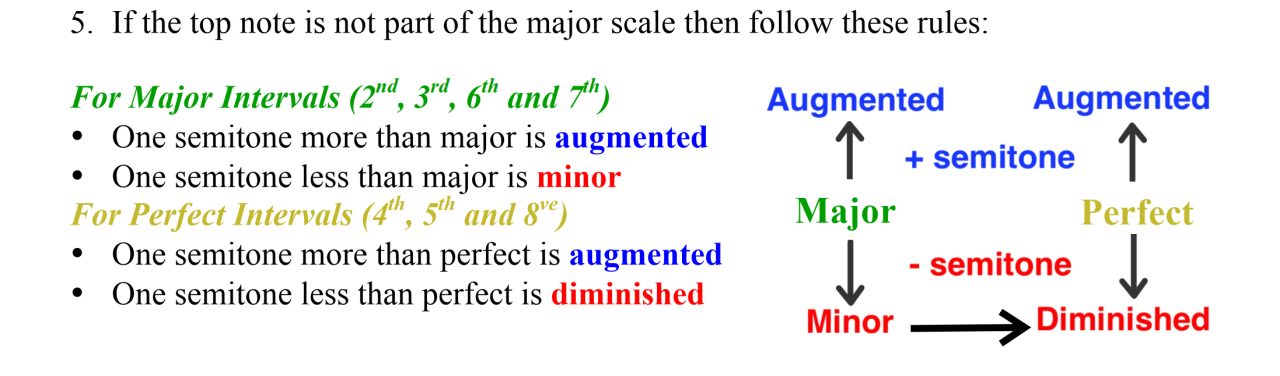
Once the interval number is determined, musicians classify intervals according to their quality. The most common interval qualities include major, minor, perfect, augmented, and diminished.
| Interval | Example | Quality |
|---|---|---|
| Second | C–D | Major Second |
| Third | C–E | Major Third |
| Fourth | C–F | Perfect Fourth |
| Fifth | C–G | Perfect Fifth |
| Octave | C–C | Perfect Octave |
Common Mistake
Many beginners forget to count the starting note when calculating intervals.
Always include the bottom note in your count or the interval number will be incorrect.

How Intervals Form Chords
Chords are built by stacking intervals on top of one another. For example, a major chord consists of a major third stacked on top of the root note, followed by a perfect fifth.
By analysing the intervals inside a chord, musicians can quickly identify the chord type and understand how it functions within a progression.
| Chord Type | Intervals Used |
|---|---|
| Major Chord | Major Third + Perfect Fifth |
| Minor Chord | Minor Third + Perfect Fifth |
| Diminished Chord | Minor Third + Diminished Fifth |
Practice Routine For Learning Intervals
A structured practice routine can help musicians learn intervals much faster. Instead of memorising them randomly, it is better to follow a consistent method that builds recognition and understanding step by step.
- Choose a starting note and identify intervals above it.
- Write the interval names beside each pair of notes.
- Practice both ascending and descending intervals.
- Play the intervals on your instrument to reinforce the sound.
- Test yourself regularly without looking at notes.

Key Takeaways
✅ Musical intervals measure the distance between two notes and form the basis of harmony.
✅ Understanding interval numbers and qualities makes chord construction easier.
✅ Practising interval recognition strengthens both theoretical knowledge and musical ear training.
✅ Intervals provide the foundation for analysing melodies, chords, and harmonic progressions.
FAQ
What Is The Easiest Way To Learn Musical Intervals?
The easiest way to learn intervals is by combining visual practice with playing them on an instrument. Writing them on a staff and hearing them played helps reinforce recognition.
Why Are Intervals Important In Music Theory?
Intervals are important because they determine how chords and melodies are constructed. Understanding intervals allows musicians to analyse music and understand harmonic relationships.
Do Intervals Apply To All Instruments?
Yes. Musical intervals are universal across all instruments. Whether you play piano, guitar, violin, or bouzouki, intervals describe the same relationships between notes.
How Long Does It Take To Learn Intervals?
Most musicians can learn the basics of intervals within a few weeks of focused practice. Consistent daily exercises make interval recognition much faster.
Categories: : Music Theory
Did this article answer all your questions?
If you have any questions, or you want to learn more,
Click the Picture Below to Join the Community for FREE!