Time Signatures Explained: Simple, Compound & Rhythm Mastery Guide
 Declan Plummer
Learn time signatures clearly—simple vs compound, rhythm grouping, and practical exercises for confident music reading and performance.
Understanding Time Signatures In Music
Time signatures show how beats are organised in music, how notes are grouped into bars, and how rhythm should feel when you clap, count, or play. Once you understand simple, compound, and irregular time signatures, reading rhythm becomes clearer and performance becomes much more confident.
Time signatures are one of the foundations of music theory. They tell you how many beats belong in each bar and what kind of note value carries the beat. That affects not only reading and writing notation, but also how you physically feel pulse, phrase rhythm, and accompany other musicians.
This matters across many styles. In Irish traditional music, recognising the difference between jigs, reels, hornpipes, slips jigs, slides, polkas, and marches depends heavily on rhythmic feel. In classical and theory study, time signatures also help with note grouping, bar lines, rests, sight-reading, and exam questions.
A useful way to think about time signatures is that they organise music the same way punctuation and spacing organise language. Without that structure, reading becomes much harder. With it, everything on the page makes more sense.
- The top number shows how many note values fill a bar, while the bottom number shows the note value being counted.
- Simple time divides each beat into two equal parts, while compound time divides each beat into three equal parts.
- Correct grouping and beaming make rhythm easier to read, count, and perform accurately.
What A Time Signature Actually Means
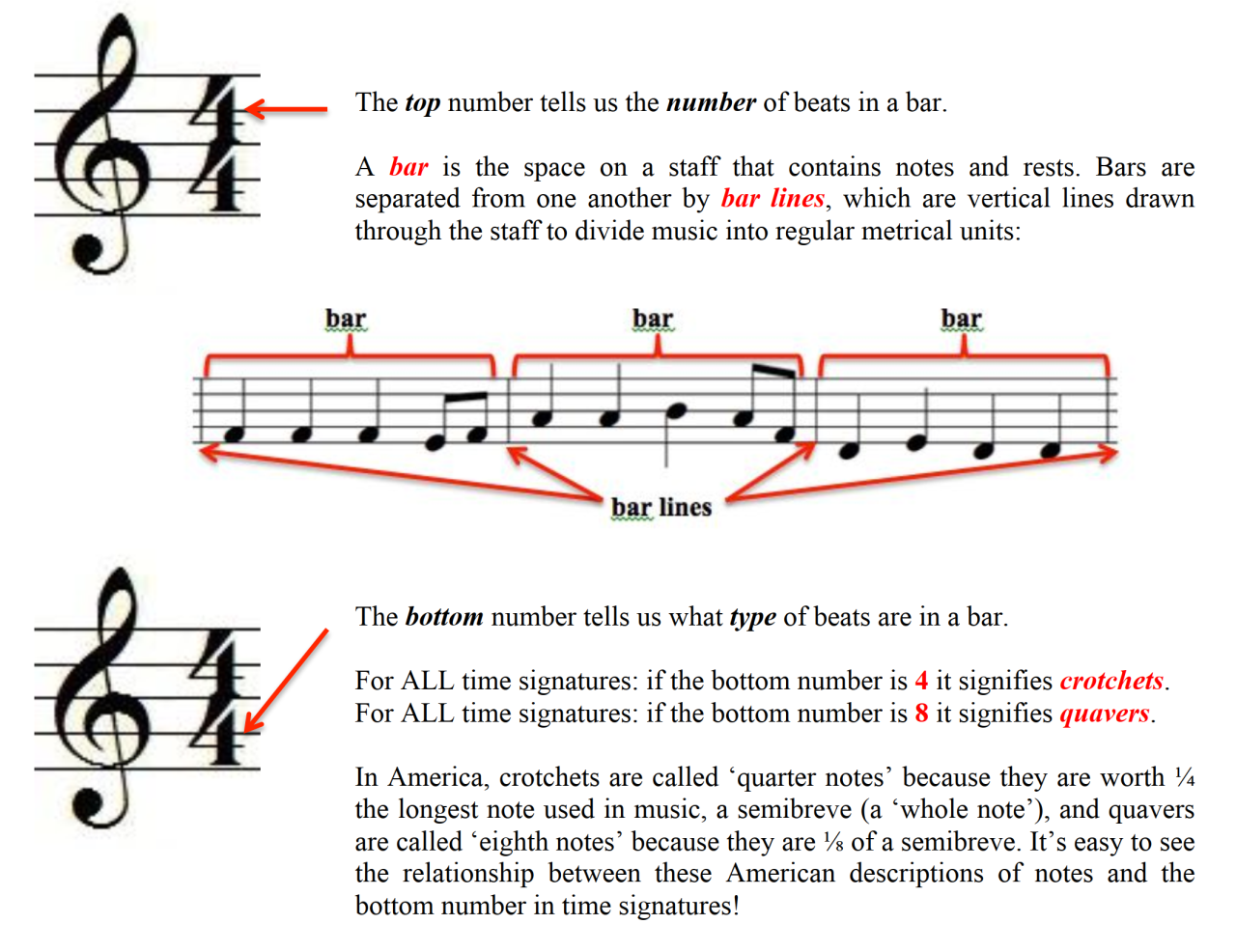
A time signature consists of two numbers written one above the other and placed after the clef. The top number tells you how many note values fit into a bar. The bottom number tells you which note value is being counted.
For example, in 4/4 time, the top number tells you there are four counted note values in the bar, and the bottom number tells you that the counted value is the quarter note. So a 4/4 bar contains four quarter-note beats.
Bars are the spaces on the staff that contain notes and rests. Bar lines divide the music into those regular units. That division is essential because it helps you see where beats begin and end, and it makes rhythm readable at a glance.
Pro Tip
When you are unsure about a time signature, do not start by staring at the numbers. Clap the pulse first. Ask yourself how many strong beats you actually feel in each bar. The body often understands the rhythm before the mind labels it.
Simple Time Signatures
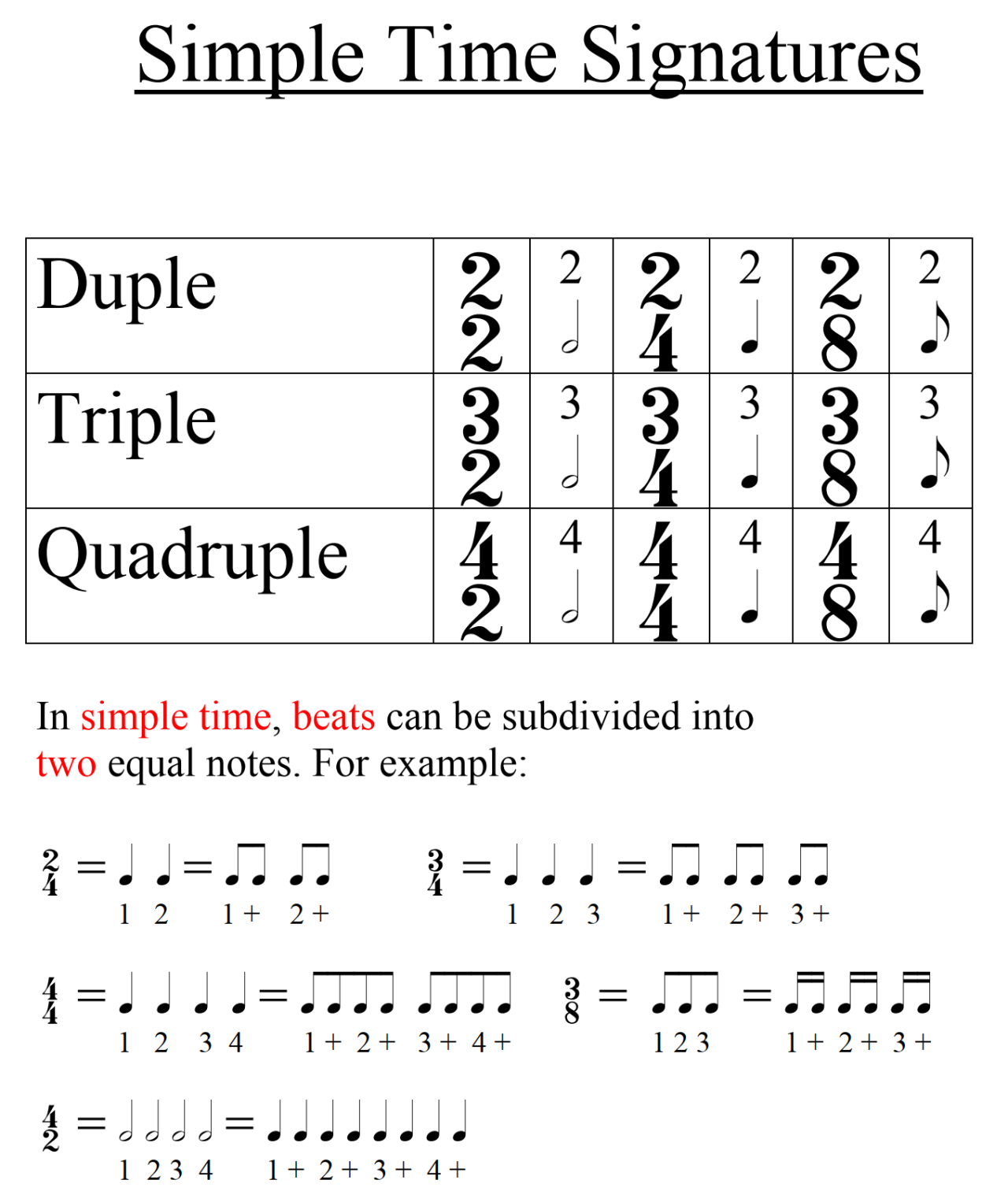
Simple time signatures are the easiest to recognise. If the top number is 2, 3, or 4, you are usually dealing with simple time. The defining feature is that each beat can be divided into two equal parts.
That means 2/4 has two beats in the bar, 3/4 has three beats, and 4/4 has four beats. In each case, the beat divides naturally into pairs. A quarter note can split into two eighth notes, and an eighth note can split into two sixteenth notes.
This is why simple time is called simple. What you see is mostly what you count. In 2/4, you feel two beats. In 3/4, you feel three. In 4/4, you feel four. There is no extra mental step required.
You can also describe these as simple duple, simple triple, and simple quadruple time. Duple means two beats in the bar, triple means three, and quadruple means four. These labels are especially helpful in theory exams and more advanced study.
Compound Time Signatures Explained
Compound time is where many students begin to hesitate, but the core idea is straightforward. If the top number is 6, 9, or 12, you are usually in compound time. Here, each beat divides into three equal parts instead of two.
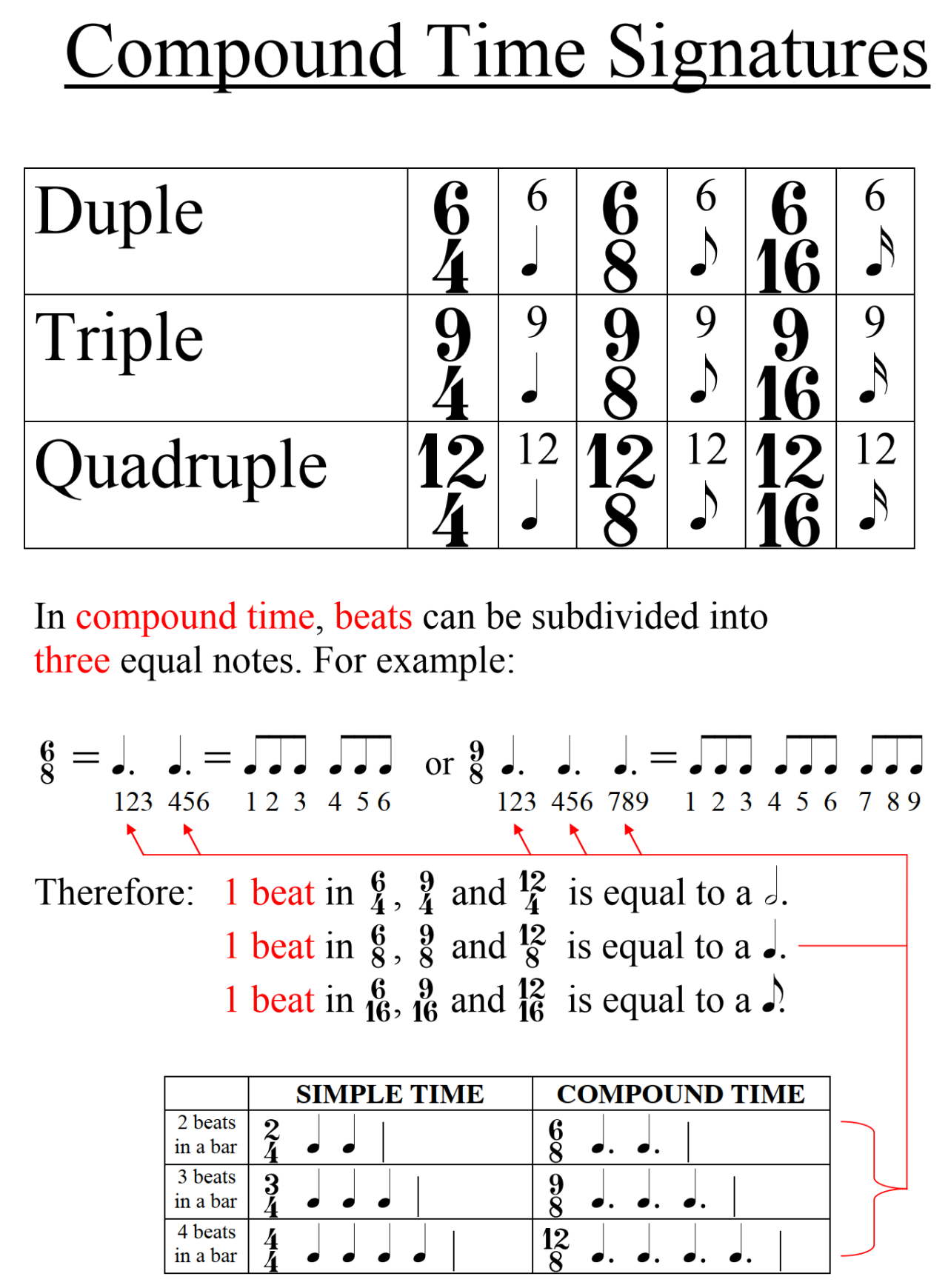
This is the crucial point: 6/8 does not mean six separate beats in the bar. It means six eighth notes grouped into two larger beats. You count it as two beats, each divided into three parts: 1-2-3, 4-5-6.
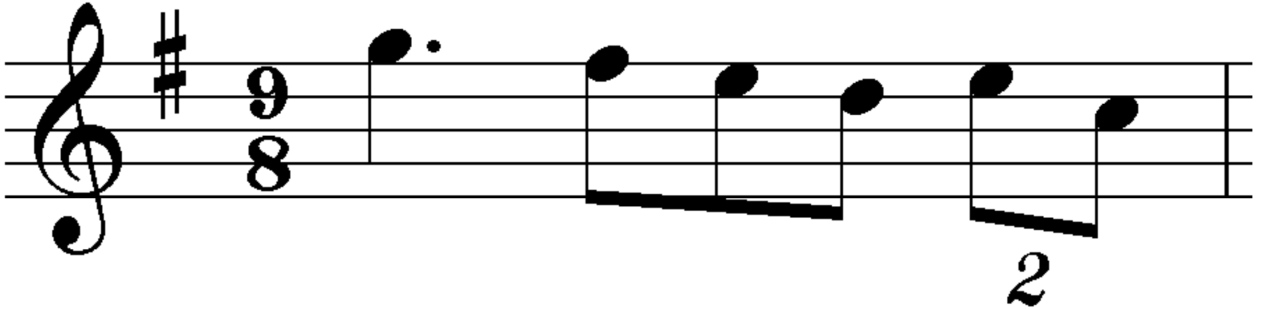
The same logic continues in 9/8 and 12/8. In 9/8, there are three main beats, each split into three eighth notes. In 12/8, there are four main beats, each split into three eighth notes. That is why compound time feels rolling and flowing rather than square and even.
Insight
The easiest way to identify compound time is to tap your foot instead of counting every small note. If your foot falls twice in a bar of 6/8, three times in 9/8, or four times in 12/8, you are feeling the real beat correctly.
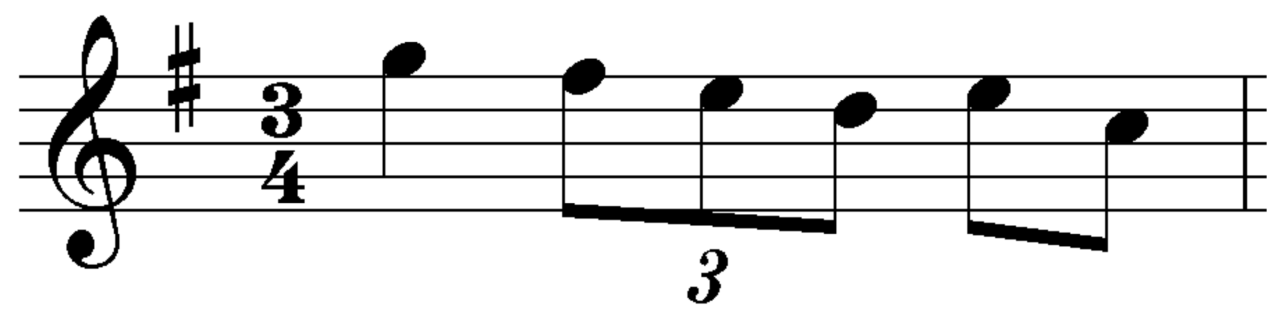
becomes
Simple Vs Compound Time
A practical comparison helps. In 2/4, each beat divides into two eighth notes. In 6/8, each beat divides into three eighth notes. So although both can feel like two main beats per bar, the internal subdivision is different.
That difference changes the character of the music. A polka in 2/4 has a more direct and even pulse, while a jig in 6/8 has a lilting, circular motion. The top numbers may suggest more notes on the page, but the actual pulse you feel is what matters most.
Practice Box
Try clapping 2/4 as “1 and 2 and” and then clap 6/8 as “1 2 3 4 5 6,” placing stronger emphasis on 1 and 4. This simple drill trains your ear to distinguish simple duple from compound duple time.
Common Time Signatures In Real Music
Many common styles can be linked to typical time signatures. In popular music, 4/4 is dominant. In classical dance forms and folk repertoire, 3/4 often appears in waltzes. In Irish traditional music, the connection between time signature and tune type is especially useful.
| Time Signature | Main Beat Feel | Common Use |
|---|---|---|
| 2/4 | 2 beats, split into 2 | Polkas, marches |
| 3/4 | 3 beats, split into 2 | Waltzes, mazurkas |
| 4/4 | 4 beats, split into 2 | Reels, pop, rock, hornpipes |
| 6/8 | 2 beats, split into 3 | Jigs, compound duple music |
| 9/8 | 3 beats, split into 3 | Slip jigs |
| 12/8 | 4 beats, split into 3 | Slides, compound quadruple music |
Common Mistake
Do not count 6/8 as six equal foot taps. That usually leads to stiff playing and confusion. Count the subdivision if needed, but feel the larger beat as two pulses per bar.
How Note Grouping And Beaming Work
One of the most important rules in rhythmic notation is this: group notes according to the beat. This rule explains how notes should be beamed together and why some ways of writing rhythm are easier to read than others.
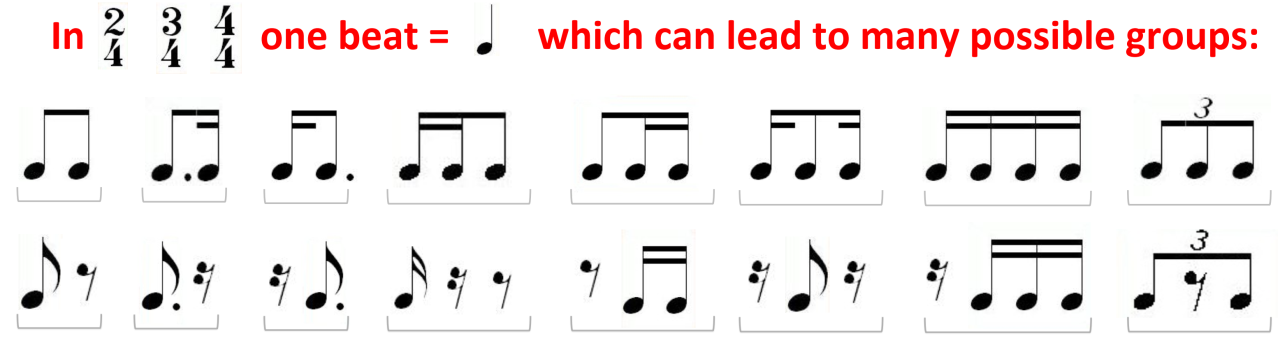
In simple time, any combination of smaller notes that adds up to one beat can usually be grouped together. In 2/4, 3/4, or 4/4, that means grouping values that add up to one quarter-note beat.
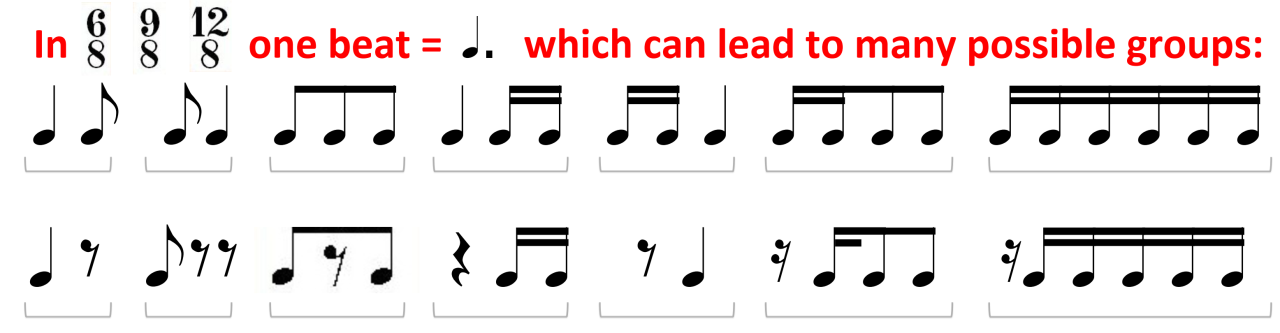
In compound time, the same principle applies, but the beat is larger. In 6/8, 9/8, and 12/8, one beat is usually a dotted quarter note. So note groupings should show that larger three-part beat clearly.
This matters because notation is visual language. Correct grouping lets a performer see the beat immediately. Incorrect grouping hides the pulse and makes even simple music harder to play.
Quote Box
Think of note grouping as the musical equivalent of spacing words correctly in a sentence. The notes may still be technically correct, but if they are grouped badly, the reader has to work much harder to understand them.
Rests And Subdivisions
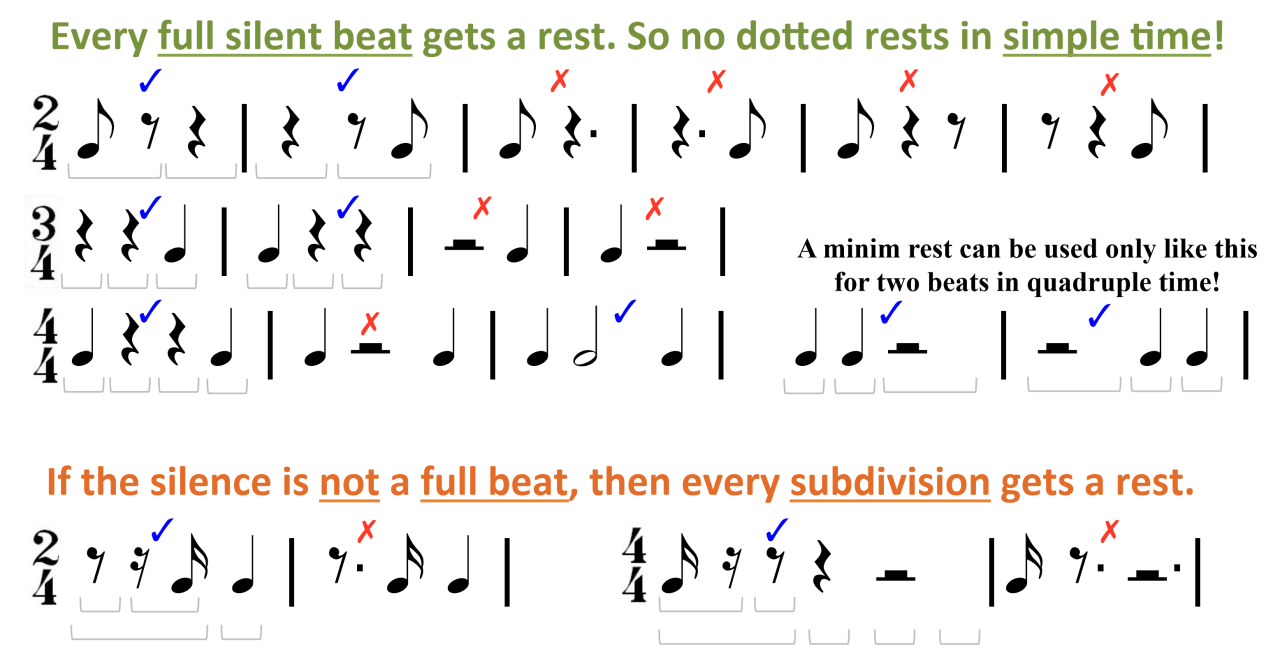
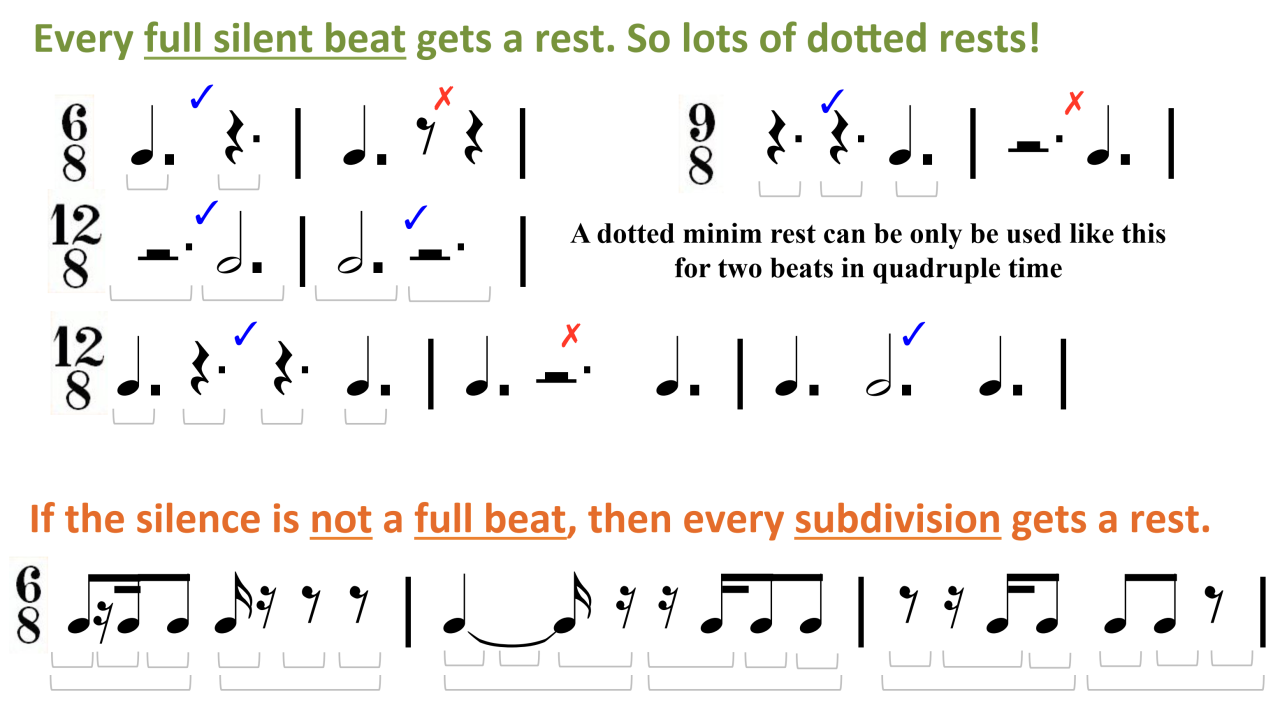
Rests follow the same logic as notes. If a silence lasts for a full beat, use a rest that clearly represents that beat. If the silence is smaller than a full beat, the subdivisions must still be shown accurately so the performer can see where the pulse sits.
In simple time, you generally avoid using dotted rests to represent ordinary beat structure. In compound time, dotted rests appear much more naturally because the beat itself is compound and often equals a dotted value.
Students often get confused here, but the solution is consistent: build the rhythm upward through the subdivisions until the total matches the full beat, and then match the rest of the bar accordingly.
Irregular Time Signatures
Irregular time signatures sit outside the usual simple and compound categories. Common examples include 5/4 and 7/4. These are often understood as combinations of smaller beat groups, such as 2+3, 3+2, or even 2+2+3.
That internal grouping is what gives irregular metre coherence. Without it, the music can feel unstable. With it, the rhythm becomes memorable, even when the number of beats in the bar is unusual.
For most beginners and many traditional players, irregular time signatures are less urgent than mastering 2/4, 3/4, 4/4, 6/8, and 9/8. Still, recognising that irregular metres are often built from familiar smaller units makes them far less intimidating.
Practice Box
Count 5/4 as either “1-2, 1-2-3” or “1-2-3, 1-2.” Repeat the same grouping every bar. This will help you hear irregular metre as a consistent pattern rather than as five disconnected beats.
How To Practise Time Signatures Effectively
The best way to learn time signatures is not by memorising numbers in isolation, but by combining theory with physical rhythm. Clap, count aloud, tap your foot, and say subdivisions while looking at written bars.
Move between pairs such as 2/4 and 6/8, or 3/4 and 9/8, so you can hear how the number of main beats may stay similar while the subdivision changes completely. This is where genuine understanding develops.
It also helps to study short rhythmic cells repeatedly. Quarter notes, paired eighth notes, dotted rhythms, Scotch snaps, triplets, and rest patterns appear constantly in real music. Becoming fluent with these small units makes sight-reading much easier.
Pro Tip
Do not rush through theory grades by memorising just enough to pass. Time signatures become far more useful when you practise them slowly, repeatedly, and in actual music. Strong rhythm reading supports everything from sight-reading to ensemble playing.
Practice Routine
Start by choosing one simple time signature and one compound time signature, such as 2/4 and 6/8. Clap both slowly and count out loud. Focus on where the strong beats fall rather than on speed.
Next, write one bar of each time signature using only basic note values. Then rewrite the bars using different subdivisions, making sure each bar still adds up correctly. This trains both counting and visual recognition.
After that, practise grouping. Take a short rhythm and ask whether the beams clearly show the beat. If not, rewrite it so that every group reflects the pulse accurately.
Then add rests. Use one beat of sound followed by part-beat silence, and check that the rest values show the subdivision properly. This is one of the fastest ways to improve exam accuracy and reading confidence.
Finally, apply everything to real music. Choose a reel, jig, waltz, or march and identify the time signature, number of main beats, beat subdivision, and note grouping. This final step connects theory to performance, which is where the lesson truly becomes useful.
Lesson Summary
Key Takeaways
✅ Time signatures organise beats, bars, and rhythmic feel, making music readable and playable.
✅ Simple time divides each beat into two parts, while compound time divides each beat into three.
✅ In 6/8, 9/8, and 12/8, do not confuse the number of written subdivisions with the number of felt beats.
✅ Correct beaming and rest placement must always reveal the beat structure clearly.
✅ The most effective way to learn time signatures is to combine counting, clapping, notation, and real repertoire.
FAQ
What Is The Difference Between 3/4 And 6/8?
3/4 has three main beats in the bar, and each beat divides into two. 6/8 usually has two main beats in the bar, and each beat divides into three. They can contain the same total amount of note value on paper, but the pulse feels very different.
Why Is 6/8 Not Counted As Six Beats?
Because the eight-note subdivisions are grouped into two larger beats. In most 6/8 music, you feel two pulses per bar, with each pulse divided into three smaller notes.
How Do I Know If A Rhythm Is Grouped Correctly?
Check whether the beaming matches the beat. In simple time, groups usually add up to one simple beat. In compound time, groups usually add up to one compound beat. If the grouping hides the pulse, it probably needs to be rewritten.
Which Time Signatures Should Beginners Learn First?
Start with 2/4, 3/4, and 4/4. Once those feel comfortable, move on to 6/8 and 9/8. These cover the majority of beginner and intermediate rhythmic situations in many styles.
Are Time Signatures Important For Traditional Music Players?
Yes. Even if you learn mostly by ear, time signatures help you recognise tune types, accompany more accurately, phrase rhythms properly, and join sessions with a much stronger sense of pulse and structure.
Categories: : Music Theory
Did this article answer all your questions?
If you have any questions, or you want to learn more,
Click the Picture Below to Join the Community for FREE!