Diatonic Chords in a Major Key Explained for Music Students
 Declan Plummer
Learn how diatonic chords work in a major key, how to build them, and how they shape chord progressions.
Understanding Diatonic Chords In Major Keys
Diatonic chords are the seven chords that naturally belong to a key. In a major key, they follow a clear pattern of major, minor, and diminished qualities, and once you understand how they function, it becomes much easier to analyse chord progressions, hear movement in music, and build stronger accompaniments.
This lesson looks at how chords are built from the notes of a major scale, how Roman numerals help describe their role, and why some chords feel stable while others sound as though they need to move. It also explains why chord seven has such strong tension, why chord three is often weak, and how inversions make progressions sound smoother.
For music students, accompanists, and anyone learning harmony on piano, guitar, or Irish bouzouki, this is one of the most useful foundations in music theory. Once you can recognise the pattern of diatonic harmony, you begin to hear the same harmonic logic in classical music, pop, trad, jazz, and many other styles.
Rather than memorising isolated facts, the aim is to understand the behaviour of the chords. That means hearing how they sound, seeing how they are built, and learning where they usually want to go next.
- The seven diatonic chords in a major key follow the pattern I, ii, iii, IV, V, vi, and vii°.
- Major chords usually sound more stable, minor chords are more colouristic, and the diminished seventh chord carries strong tension.
- Common progressions such as ii–V–I and IV–V–I appear across many styles because of how naturally these chords move.

How Diatonic Chords Are Built
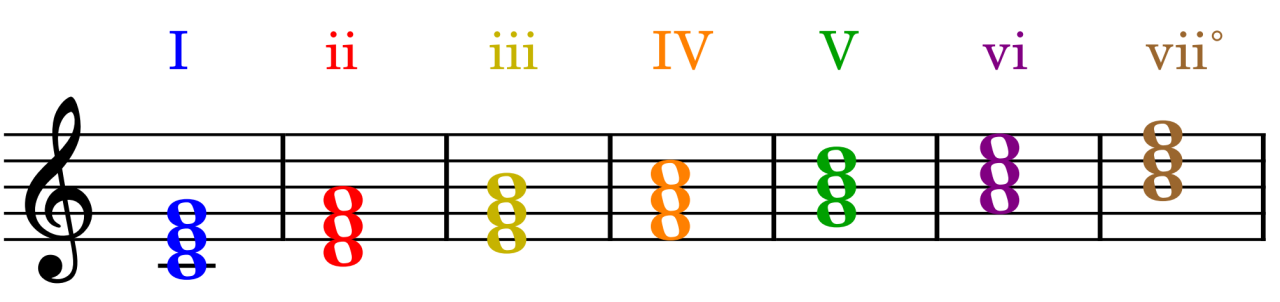
To build diatonic chords in a major key, start with the scale itself. In C major, the notes are C, D, E, F, G, A, and B. If you build a three-note chord on each degree of the scale using stacked thirds, you get the seven basic triads of the key.
That produces C major on the first note, D minor on the second, E minor on the third, F major on the fourth, G major on the fifth, A minor on the sixth, and B diminished on the seventh. These are called diatonic chords because they all come directly from the notes of the key, with no added sharps or flats outside the scale.
This is one of the most important patterns in tonal music. It means that harmony is not random. Once you know the key, you already know the pool of chords that will most often appear in the music.
Pro Tip
Do not just memorise the chord names. Learn the pattern of qualities as well: major, minor, minor, major, major, minor, diminished. That pattern transfers to every major key.
Roman Numerals And What They Mean
Roman numerals give you more than chord names. They tell you where the chord belongs inside the key. In C major, C major is not only C major; it is also chord I. D minor is ii, E minor is iii, F major is IV, G major is V, A minor is vi, and B diminished is vii°.
The use of capital and lowercase letters matters. Capital numerals show major chords, while lowercase numerals show minor chords. The small circle beside vii shows that the chord is diminished. This system is especially useful because it works in every key. Once you understand the function of I, IV, or V, you can recognise that same function whether the key is C major, G major, or A major.
This is why Roman numeral analysis is so helpful for both theory and practical accompaniment. It describes what the chord does, not just what it is called.
Insight
A chord label such as “C major” tells you its pitch content. A label such as “I” tells you its role in the key. That extra layer of information is what makes Roman numerals so powerful for analysis.
The Major, Minor, And Diminished Pattern
In a major key, the primary chords are I, IV, and V. These are the major chords that most strongly establish the key. They often sound open, stable, and structurally important. In many tunes and songs, these are the first chords students learn because they form the harmonic backbone of so much repertoire.
The secondary triads are ii, iii, and vi, which are minor. These often provide colour, motion, and contrast. They can connect stronger chords, prepare cadences, or soften the harmonic sound. Although they are fully part of the key, they usually feel less final than the tonic chord.
The last chord, vii°, is different again. It is diminished, and that gives it a very unsettled sound. The interval inside it creates tension, which is why it so often leads directly to I. If you stop on vii° without resolution, the music can feel unfinished.
Practice Tip
Play all seven diatonic triads slowly in one key and say their quality out loud: major, minor, minor, major, major, minor, diminished. This is an excellent ear-and-theory drill.
Common Mistake
Do not assume that every chord in a major key must also be major. That is one of the most common early misunderstandings in harmony.
Structure Breakdown Table
| Scale Degree | Roman Numeral | Chord In C Major | Quality | Typical Function |
|---|---|---|---|---|
| 1 | I | C major | Major | Tonic, point of rest |
| 2 | ii | D minor | Minor | Pre-dominant motion |
| 3 | iii | E minor | Minor | Weak, less common |
| 4 | IV | F major | Major | Prepares dominant or returns to tonic |
| 5 | V | G major | Major | Dominant, strong pull to I |
| 6 | vi | A minor | Minor | Colour, extension, softening effect |
| 7 | vii° | B diminished | Diminished | Leading-note tension |
How Chords Function In Progressions
Once the chords are built, the next step is to hear how they behave in relation to one another. Some chords feel like home, some move away from home, and some create a strong need to return. This is where harmonic function becomes useful.
Why Chord Seven Wants To Resolve
The diminished chord on scale degree seven is often called the leading-note chord. In C major, that chord is B diminished: B, D, and F. The note B wants to rise to C, and the unstable interval inside the chord creates a strong sense that the harmony has not finished yet.
This is why vii° so often resolves to I. If you use it in a progression, the ear expects the tonic to appear very soon afterwards. That resolution is one of the clearest examples of harmonic tension and release.
Quote Insight
A good way to hear chord seven is this: it sounds as though the music is leaning forward and asking to be completed.
Why Chord Three Is Often Weak
Chord iii is much less common than many beginners expect. One reason is that it shares two notes with the tonic triad, which makes it feel less independent. In C major, E minor overlaps strongly with C major, and its remaining note still points back towards the tonic world.
Because of that, iii often sounds less decisive than ii, IV, or V. It can certainly be used, but in straightforward major-key harmony it is usually not the strongest structural choice.
Inversions And Smoother Movement
Root-position chords are important and can be indicated with the letter a in Classical analysis: (Ia, iia, iiia, IVa, Va, via, vii˚a). However, they are so common that we normally don't even bother writing 'a' next to the Roman Numeral analysis. For example, C in Jazz/Pop analysis means a C major chord in root position, with C as the lowest note of the chord (C-E-G); and Classical musicians would simply analyse this as a I in the key of C major. So every chord here is a root position chord, but we don't need to write Ia, iia, iiia, IVa, Va, via, vii˚a - the following analysis is standard for root position chords:
But if every chord stays in root position the music can become heavy and predictable. Inversions solve that problem by changing which note of the chord is in the bass. The chord is still the same harmony, but its shape and movement feel different.
First inversion is especially useful. As you can see below, this can be indicated in the analysis by the letter b - so in the key of C major, the standard root position chord of C major (C-E-G) can often change its bass note to E. This means Jazz/Pop musicians would analyse how its played: C/E to indicated a C major chord in first inversion; whereas Classical musicians normally analyse the chord's function in the key of C major, and they would call it a Ib chord. Similar logic applies to G major chord (G-B-D), which is chord V in the key of C major. It also often changes its bass note to B: so Jazz/Pop musicians normally called a G/B chord, and Classical musicians would call it a Vb chord.
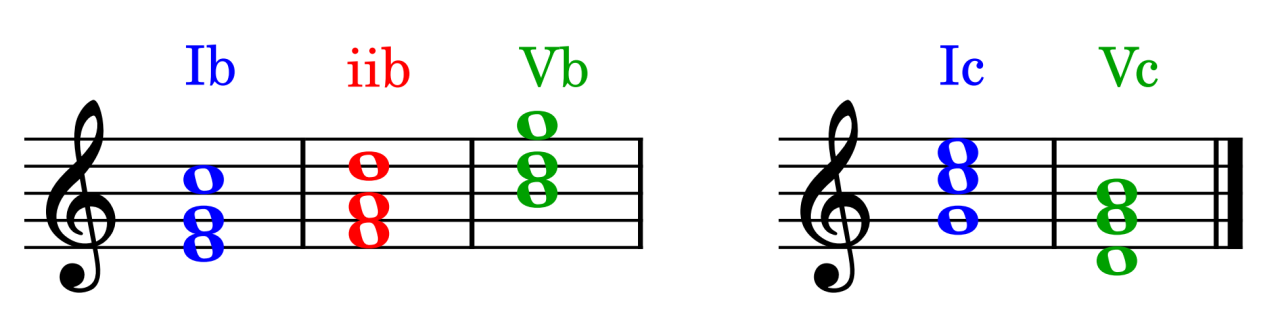
It allows smoother bass lines and gentler transitions between chords. Chords such as I, ii, and V often sound more flowing when inversions are used carefully. Instead of jumping from root to root, the bass can move by step or small intervals.
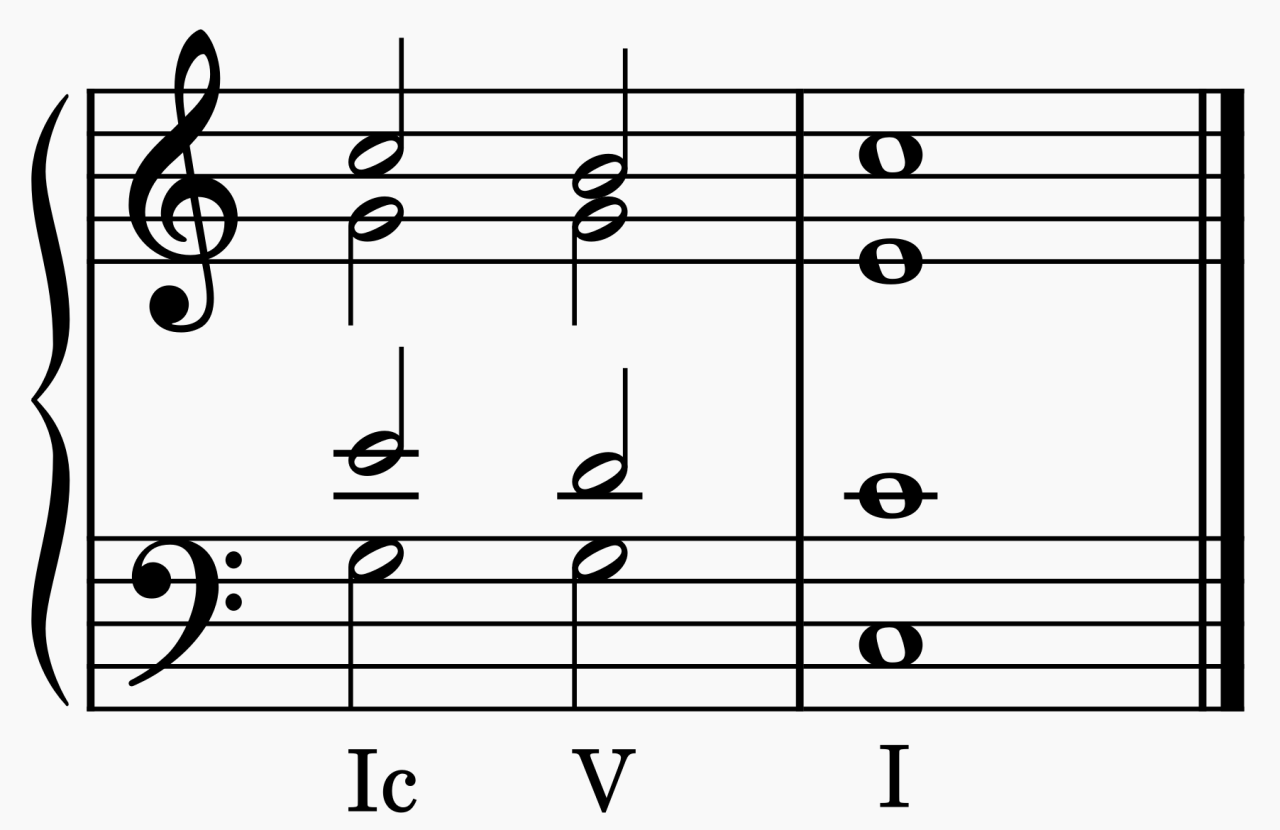
Second inversion chords can be indicated by the letter c, but they are much rarer in music than first inversion chords. They primarily happen at cadences (the end of phrases, sections or the final bars of the piece). The progression Ic-V-I is particularly effective and very popular in all styles of music.
Practice Tip
Take a simple progression such as I–IV–V–I and then replay it using one or two inversions. Listen to how the bass line becomes smoother and the harmony feels more musical.
Common Mistake
Do not think of inversions as different chords. They are the same chord with a different bass note, used to improve voice leading and shape.
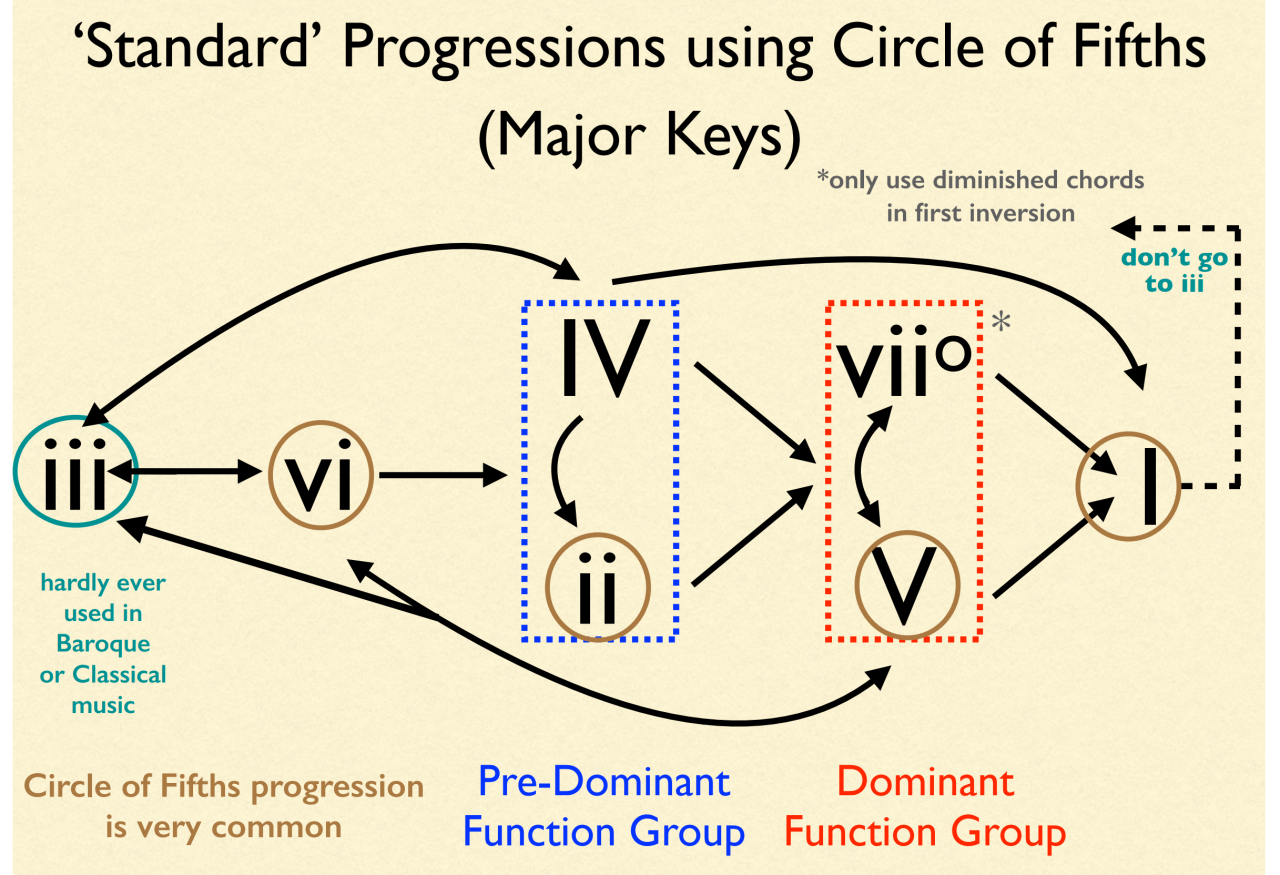
Chord Progression Box
Common Progressions To Hear And Practise
IV–V–I creates a strong traditional cadence.
ii–V–I is one of the most important progressions in tonal and jazz-based harmony.
vi–ii–V–I expands the movement and leads naturally towards the tonic.
vii°–I demonstrates leading-note tension resolving into rest.
Practice Guidance For Students
When learning harmony, it helps to combine theory, playing, and listening. Do not keep these as separate skills. The more they reinforce one another, the faster the ideas start to make musical sense.
How To Practise Diatonic Harmony
Start in one comfortable key, such as C major or G major. Build all seven triads and name each one by Roman numeral and quality. Then play them again and listen carefully to the contrast between the stable tonic, the stronger pull of the dominant, and the more unsettled colour of the diminished chord.
After that, move into short progressions. Practise I–IV–V–I first, then ii–V–I, and then add vi at the front. Once those are secure, experiment with first inversion on selected chords so that you begin hearing the difference between chord identity and chord spacing.
If you accompany traditional music, this work is especially helpful because it trains your ear to recognise functional movement. Even when a tune is simple, a stronger grasp of harmony lets you choose chords more confidently and shape your accompaniment with better direction.
Pro Tip
Say the function while you play: tonic, pre-dominant, dominant, tonic. This strengthens your understanding far more than naming notes alone.
Practice Routine
Begin by playing a major scale slowly and identifying each scale degree. Then build the diatonic triad on each note and name its Roman numeral aloud.
Next, play through the full sequence of chord qualities in the key: major, minor, minor, major, major, minor, diminished. Repeat this until the pattern becomes automatic.
After that, choose three short progressions to drill. A very good set is I–IV–V–I, ii–V–I, and vi–ii–V–I. Play them in root position first, then revisit them using simple inversions.
Spend a few minutes listening critically to the role of chord seven. Play vii° and then resolve it to I several times so that your ear becomes familiar with the pull of the leading note.
Finish by applying the same ideas in a second key. This step is crucial because it prevents you from understanding harmony only in C major. The goal is to recognise functions, not just shapes.
Key Takeaways
✅ Diatonic chords come directly from the notes of the key, so learning the scale is the first step to understanding the harmony.
✅ In a major key, the chord-quality pattern is always major, minor, minor, major, major, minor, diminished.
✅ Roman numerals are valuable because they show harmonic function, not just chord names.
✅ Chord vii° is unstable and usually resolves to I, which makes it one of the clearest examples of tension and release.
✅ Inversions help progressions sound smoother by improving bass movement and voice leading.
✅ Progressions such as ii–V–I appear so often because the chords move naturally towards one another.
FAQ
Why Are Some Chords Minor In A Major Key?
Because the chords are built directly from the notes of the scale. When thirds are stacked on different scale degrees, the interval structure changes, so some triads come out major, some minor, and one diminished.
Why Does Chord Seven Sound Unfinished?
Chord seven contains the leading note and a diminished interval, both of which create tension. That tension strongly suggests resolution, usually to chord one, which is why it rarely sounds complete on its own.
What Is The Difference Between A Chord Name And A Roman Numeral?
A chord name tells you the notes of the chord, such as G major or A minor. A Roman numeral tells you the chord’s place and function in the key, such as V or vi.
Should I Learn This In C Major First?
Yes, C major is often the easiest place to begin because it uses only the natural notes. Once the system makes sense there, move the same pattern into other major keys so that you understand the concept fully.
How Does This Help With Accompaniment?
It helps you predict likely chord movement, hear cadences more clearly, and choose stronger harmonic support for melodies. Instead of guessing, you begin to accompany with a better sense of structure and direction.
To take your learning to the next level,
check out some of these amazing Courses & Apps



Categories: : Music Theory
Did this article answer all your questions?
If you have any questions, or you want to learn more,
Click the Picture Below to Join the Community for FREE!