Understanding Irish Traditional Tune Types for Better Accompaniment
 Declan Plummer
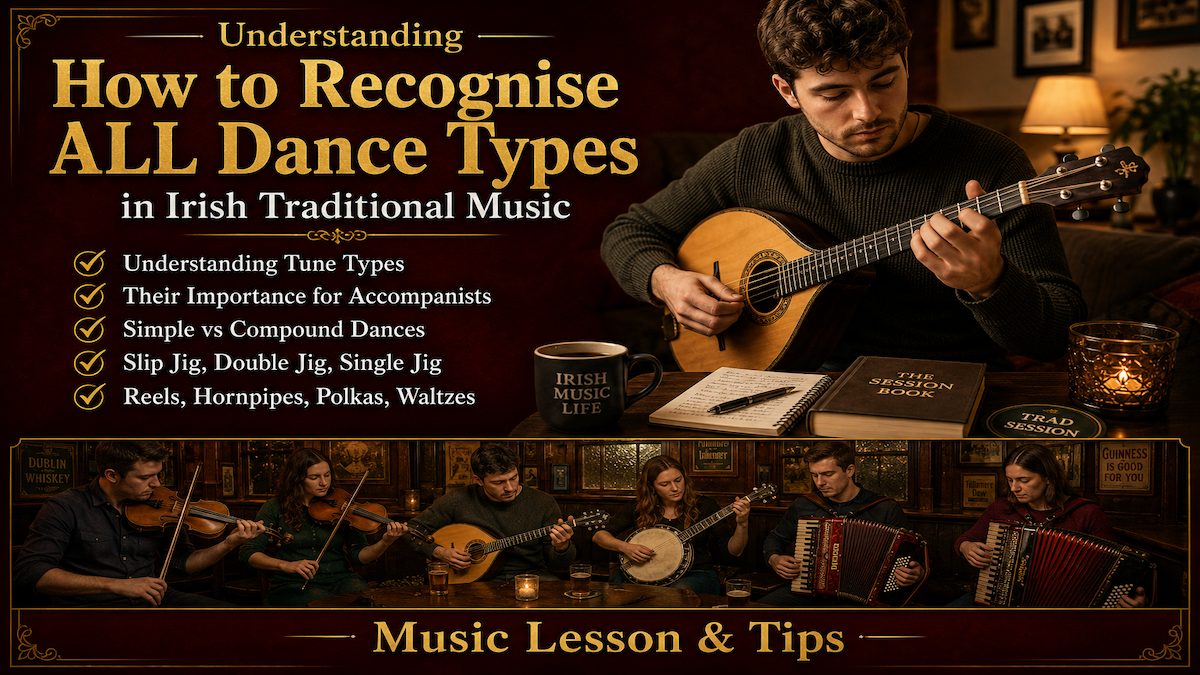
Learn how to hear jigs, reels, slip jigs, hornpipes and polkas for stronger Irish music accompaniment.
Understanding Irish Traditional Tune Types
Irish traditional tune types are identified by their pulse, rhythm, subdivision, tempo, and musical feel. For accompanists on Irish bouzouki, guitar, bodhrán, or piano, learning to hear the difference between jigs, reels, slip jigs, hornpipes, polkas, marches, and waltzes is essential for playing musically and confidently.
When you accompany Irish traditional music, you are not only choosing chords. You are listening for the structure of the tune, the rhythmic shape of the dance type, the key or mode, and the energy of the players around you. This is why accompaniment requires a strong ear as well as a reliable rhythmic foundation.
A melody player may learn the notes of a tune first, but an accompanist must quickly recognise what type of tune is being played. Is it a reel, a double jig, a single jig, a slip jig, a hornpipe, or a polka? Each one asks for a different style of accompaniment and a different rhythmic approach.
This lesson explains the main Irish traditional tune types from the point of view of a practical accompanist. The focus is not on memorising labels, but on training your ear to recognise pulse, subdivision, rhythmic density, and musical feel.
- Irish tune types are best recognised by listening to pulse, subdivision, rhythm, tempo, and phrasing.
- Slip jigs are in 9/8, ordinary jigs are usually in 6/8, reels and hornpipes are commonly in 4/4, polkas and marches are usually in 2/4, waltzes and mazurkas are in 3/4
- Accompanists need to hear the tune type quickly so they can choose suitable rhythms, chords, and playing textures.
Why Tune Types Matter For Accompanists
In Irish traditional music, the tune type shapes nearly everything about the accompaniment. A reel does not move like a slip jig. A hornpipe does not feel like a polka. A single jig has a different bounce from a double jig, even though both are connected to the same compound-time family.
For an Irish bouzouki or guitar player, this means that the first job is not to play louder, busier, or more impressively. The first job is to listen. You need to know where the main pulse is, how the beat divides, whether the tune is moving in simple time or compound time, and how much rhythmic activity is happening inside each bar.
If you are unsure, the safest musical choice is to play lightly or stop. It is far better to pause and listen than to force a rhythm that works against the melody. In a session, poor accompaniment can distract melody players and make the tune harder to play.
PRO TIP: When you hear a tune for the first time, do not start by guessing chords. First, find the pulse. Then listen one level deeper to hear whether the beat divides into two or three.
Simple Time And Compound Time
A major part of recognising Irish dance tunes is understanding the difference between simple time and compound time. Simple time means that each main beat divides naturally into two equal parts. Compound time means that each main beat divides naturally into three equal parts.
A waltz, for example, may have three main beats in a bar: one, two, three. But each of those beats normally divides into two: one-and, two-and, three-and. That gives the waltz a simple-time feeling: 3 beats with 2 subdivisions per beat.
A slip jig also has three main beats in the bar, but each beat in a slip jig divides into three smaller parts. Instead of one-and, two-and, three-and, you feel one-two-three, four-five-six, seven-eight-nine. That is the defining sound of 9/8 slip jig rhythm.
INSIGHT: Two tune types can both feel like they have three large beats, but the subdivision underneath the beat tells you what they really are. A waltz divides into two; a slip jig divides into three.
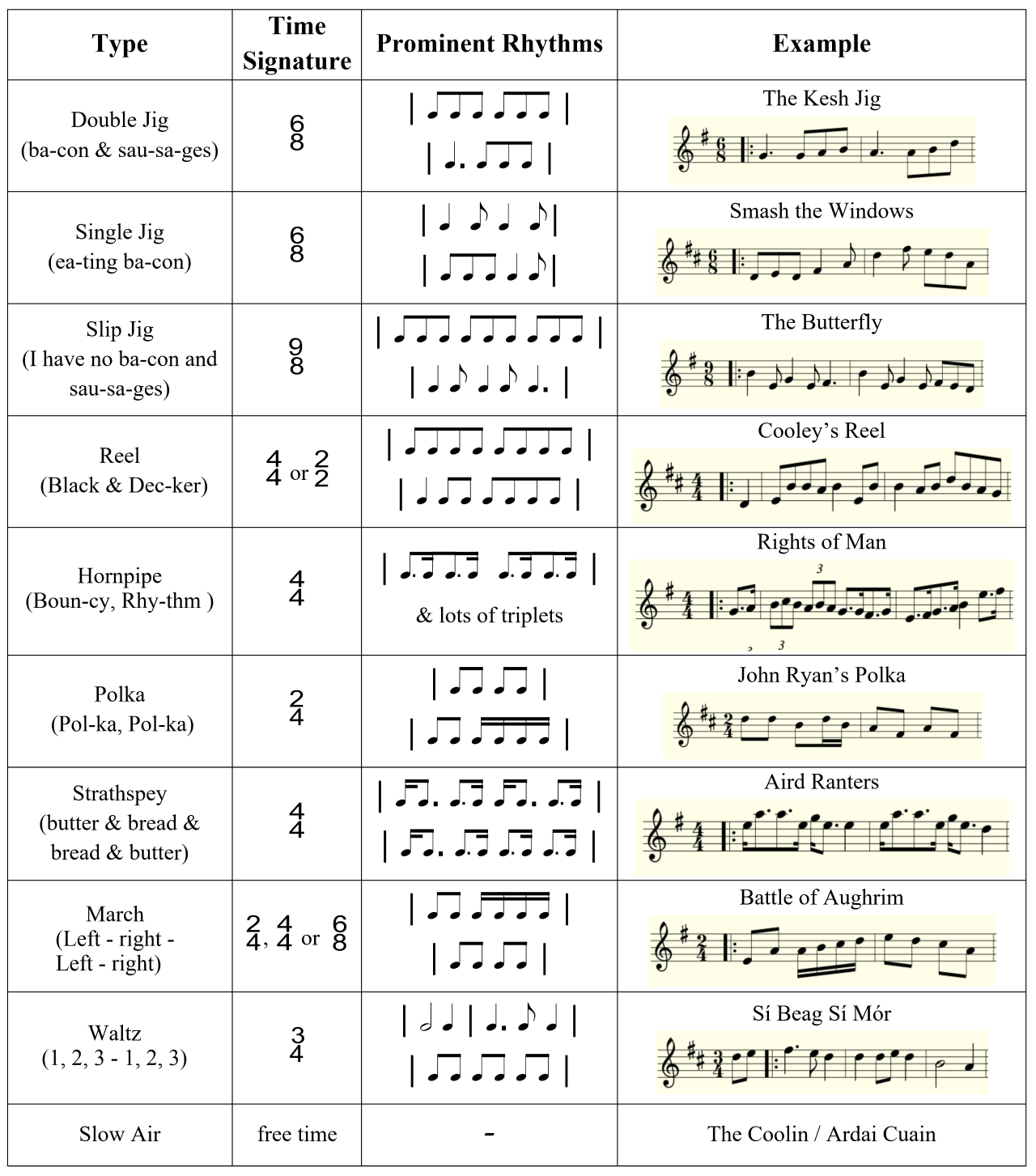
Structure Breakdown Table
| Tune Type | Common Time Feel | What To Listen For |
|---|---|---|
| Slip Jig | 9/8 | Three main beats, each divided into three smaller notes. |
| Double Jig | 6/8 | Two main beats with steady flowing quaver movement. |
| Single Jig | 6/8 | More crotchet-quaver movement and a lighter bounce. |
| Reel | 4/4 or 2/2 | Rapid, continuous quaver movement with strong forward drive. |
| Hornpipe | 4/4 | Dotted rhythm, bounce, and true triplet figures. |
| Polka | 2/4 | Fast, lively pulse with fewer notes per bar than a reel. |
Slip Jigs And The 9/8 Feel
A slip jig is one of the easiest tune types to identify once you know what to hear. It is built around nine quavers in each bar, usually felt as three groups of three. That gives the rhythm its graceful, rolling character.
A helpful way to count a slip jig is emphasise the one, four and seven: one-two-three, four-five-six, seven-eight-nine. The final group of three is especially important because it is what separates the slip jig from ordinary jigs in 6/8. A double jig has two groups of three; a slip jig has three groups of three.
Students sometimes confuse slip jigs with waltzes because both can seem to have three large beats. The difference is the subdivision. A waltz divides each beat into two. A slip jig divides each beat into three. That means the surface rhythm of a slip jig has a more flowing compound feel.
PRACTICE BOX: Count along with a slip jig using “1-2-3, 4-5-6, 7-8-9.” Then listen for the same three-part grouping without counting. The goal is to hear the 9/8 shape instinctively.
Slip Jig Accompaniment Feel
When accompanying a slip jig, avoid treating it like a slow waltz. The rhythm should not become heavy or square. The accompaniment needs to respect the long compound flow across the bar, allowing the melody to move through all three groups of three.
On Irish bouzouki, this may mean using lighter strumming, carefully placed bass movement, and chord changes that support the phrase rather than interrupt it. The feel should dance, but it should not rush. A slip jig needs lift, space, and clarity.
Single Jigs And Double Jigs
Single jigs and double jigs are both usually written in 6/8, which means they have two main beats in each bar, and each beat divides into three smaller parts. The broad structure is similar, but the rhythmic character is not the same.
A double jig often has a more continuous stream of quaver movement. The rhythm may feel like it is constantly running forward, with repeated phrases and repeated rhythmic patterns. Many well-known beginner jigs fall into this category because the rhythm is clear and memorable.
A single jig often has more crotchet-quaver movement. This creates a bouncier, more stop-start effect. There can be fewer repeated quaver patterns and more rhythmic space inside the phrase. For melody players, this can make single jigs very interesting for ornamentation because longer notes provide useful places for cuts, rolls, and half-rolls.
COMMON MISTAKE: Do not assume that every 6/8 tune should be accompanied in exactly the same way. Single jigs and double jigs may share a time signature, but their internal rhythm and musical bounce can be quite different.
Listening For Jig Differences
To hear the difference, listen to how busy the bar feels. A double jig often gives you a steady run of smaller notes. A single jig tends to break that up with longer-shorter patterns. The pulse may remain the same, but the surface rhythm changes the character of the tune.
For accompaniment, this means your right-hand rhythm should follow the tune type rather than simply apply the same generic jig strum everywhere. A double jig can often tolerate more continuous rhythmic motion, while a single jig may benefit from a lighter, more spacious bounce.
Reels And Rapid Quaver Movement
Reels are among the most common tune types in Irish traditional music. They are usually felt in four or two, and they often contain a steady stream of quavers. This creates the strong forward drive that makes reels feel so energetic.
In a reel, the rhythm can feel almost like rapid fire. The tune moves continuously, and there is usually less space between the notes than in a polka or hornpipe. Even when written in 4/4, many players feel the larger pulse in two, especially at session tempo.
For students, reels can become difficult when played too fast. Speed alone is not the goal. If the tempo becomes so fast that phrasing, ornamentation, lift, and variation disappear, the tune loses much of its musical value.
PRO TIP: Practise reels slowly enough that you can still hear the phrase shape. If all you can do is chase the notes, the tempo is too fast for useful musical practice.
Reels Versus Polkas
Beginners sometimes confuse reels and polkas because both can feel lively, and both can have a strong simple-time pulse. The difference is in the rhythmic density. A reel usually has far more continuous movement per bar, while a polka often has fewer notes per bar and a more direct, melodic, punchy feel.
If you listen one level below the pulse, the difference becomes clearer. A reel is busier and more relentless. A polka is fast, but the tune itself is often simpler in rhythmic content. That simplicity is part of what gives polkas their strong dance energy and memorable tune.
Hornpipes, Dotted Rhythm, And Triplets
Hornpipes are usually in 4/4, but they do not feel like reels. A hornpipe normally has a bouncy, dotted quality. The rhythm has a swing-like character, with long-short movement giving the tune its distinctive lift.
One important feature of hornpipes is the use of triplets. In Irish traditional music, the word “triplet” can sometimes be used loosely for ornaments in reels, where the notes are not always evenly spaced (and in fact often resemble 2x semiquaver to quaver movement). In hornpipes, however, triplets are more likely to be true triplets, with three evenly spaced notes.
Hornpipes are also generally slower than reels. Even when played briskly, they rarely reach the same speed as a fast reel. If a tune is in 4/4 but feels more dotted, bouncy, and triplet-rich, it is likely to be a hornpipe rather than a reel.
INSIGHT: Hornpipe rhythm is not just a slower reel. The dotted feel, controlled bounce, and true triplet figures give hornpipes their own musical identity.
Polkas, Marches, Waltzes, And Other Tune Types
Polkas are usually in 2/4 and often feel fast, lively, and direct. For melody players, the note patterns can sometimes feel easier than reels because there are fewer notes per bar. For bodhrán players or accompanists, however, the speed and drive can make polkas demanding in a different way.
A polka has a strong two-beat feel. It often moves with a clear up-down energy, but it should not be confused with a reel. The reel normally contains more continuous quaver motion, while the polka often has a more compact rhythmic profile.
Marches and waltzes are less common in many Irish sessions than reels and jigs, but they still matter. A march has a strong walking pulse, while a waltz has three beats in a bar with each beat usually divided into two. The accompanist must recognise these differences so the rhythm does not become generic.
Strathspeys are more strongly associated with Scottish traditional music, though they can appear depending on the musical setting. They have a distinctive snap and rhythmic profile, and they require careful listening before accompaniment.
Using Backing Tracks For Better Practice
Backing tracks can be extremely useful for Irish traditional music practice. They give students something more musical than a metronome while still providing a steady tempo, clear pulse, and harmonic support. This is especially helpful for learners working on whistle, Irish bouzouki, fiddle, flute, or accompaniment skills.
A steady accompaniment track in a key such as G allows students to practise playing in time, hearing chord movement, and staying connected to the rhythm of the tune. A tempo around 120 can be a useful teaching speed because it is steady without being too fast for focused practice.
However, a backing track should support your listening rather than replace it. You still need to recognise the tune type, feel the subdivision, and understand how your part fits around the melody. Practising with a track is most valuable when it improves your musical awareness.
PRACTICE BOX: Use a backing track first to stabilise your timing, then practise without it to check whether you can still feel the pulse internally. The goal is not dependence on the track, but stronger independent rhythm.
Practice Routine For Recognising Irish Tune Types
Start by listening to one tune type at a time. Spend a few days with reels only, then jigs only, then slip jigs, hornpipes, and polkas. Do not try to learn every category at once. The ear improves faster when it has a clear comparison point.
- Choose one tune type, such as reels, and listen to several examples without playing.
- Tap the main pulse while listening. Do not worry about chords yet.
- Listen one level deeper and identify whether the beat divides into two or three.
- Count the rhythmic grouping aloud, such as 1-and-2-and or 1-2-3, 4-5-6.
- Add light accompaniment only after the pulse and subdivision feel secure.
- Compare two similar tune types, such as reels and polkas, or waltzes and slip jigs.
- Record yourself playing along and check whether your rhythm supports the tune.
This routine trains the exact listening skills an accompanist needs in a session. Over time, you should be able to recognise not only the tune type, but also the likely accompaniment approach before you have even chosen the first chord.
Key Takeaways
✅ Irish traditional tune types are recognised by pulse, subdivision, rhythmic density, tempo, and musical feel.
✅ Slip jigs are in 9/8 and have three groups of three, while ordinary jigs are usually in 6/8 with two groups of three.
✅ Reels and polkas can both feel lively, but reels usually have much more continuous quaver movement.
✅ Hornpipes are not simply slow reels; their dotted rhythm, bounce, and triplets create a distinct style.
✅ Accompanists should train their listening carefully because good accompaniment depends on recognising the tune type before choosing chords.
FAQ
What Is The Easiest Irish Tune Type To Recognise?
Slip jigs are often easy to recognise once you know the 9/8 sound, because they have three groups of three quavers in each bar. Reels are also recognisable because of their fast, continuous quaver movement.
What Is The Difference Between A Jig And A Slip Jig?
An ordinary jig is usually in 6/8, with two main beats divided into three smaller notes. A slip jig is in 9/8, with three main beats divided into three smaller notes. The extra group of three gives the slip jig its longer rolling feel.
Why Do Accompanists Need To Know Tune Types?
Accompanists need to know tune types because each style requires a different rhythmic approach. If you accompany a slip jig like a waltz, or a hornpipe like a reel, the accompaniment can work against the melody and disturb the session feel.
Are Backing Tracks Better Than A Metronome?
Backing tracks are often more musical than a metronome because they provide pulse, harmony, and style. A metronome is useful for strict timing, but a good accompaniment track helps students practise rhythm in a more realistic musical setting.
How Should I Practise Hearing The Difference Between Tune Types?
Listen to one tune type at a time, tap the pulse, then listen for the subdivision underneath. Compare similar styles, such as reels and polkas or waltzes and slip jigs. With repeated listening, the differences become much easier to recognise.
To take your learning to the next level,
check out some of these amazing Courses & Apps



Categories: : Irish Traditional Music
Did this article answer all your questions?
If you have any questions, or you want to learn more,
Click the Picture Below to Join the Community for FREE!